Vacuum Chamber
View system integration details
This page explains how Feedthrough is classified within Machinery and Equipment Manufacturing. Technical values and manufacturer relationships are research references; confirm the current specification and supplier evidence for each order.
A vacuum-tight electrical, fluid, or mechanical connection that passes through the wall of a vacuum chamber.
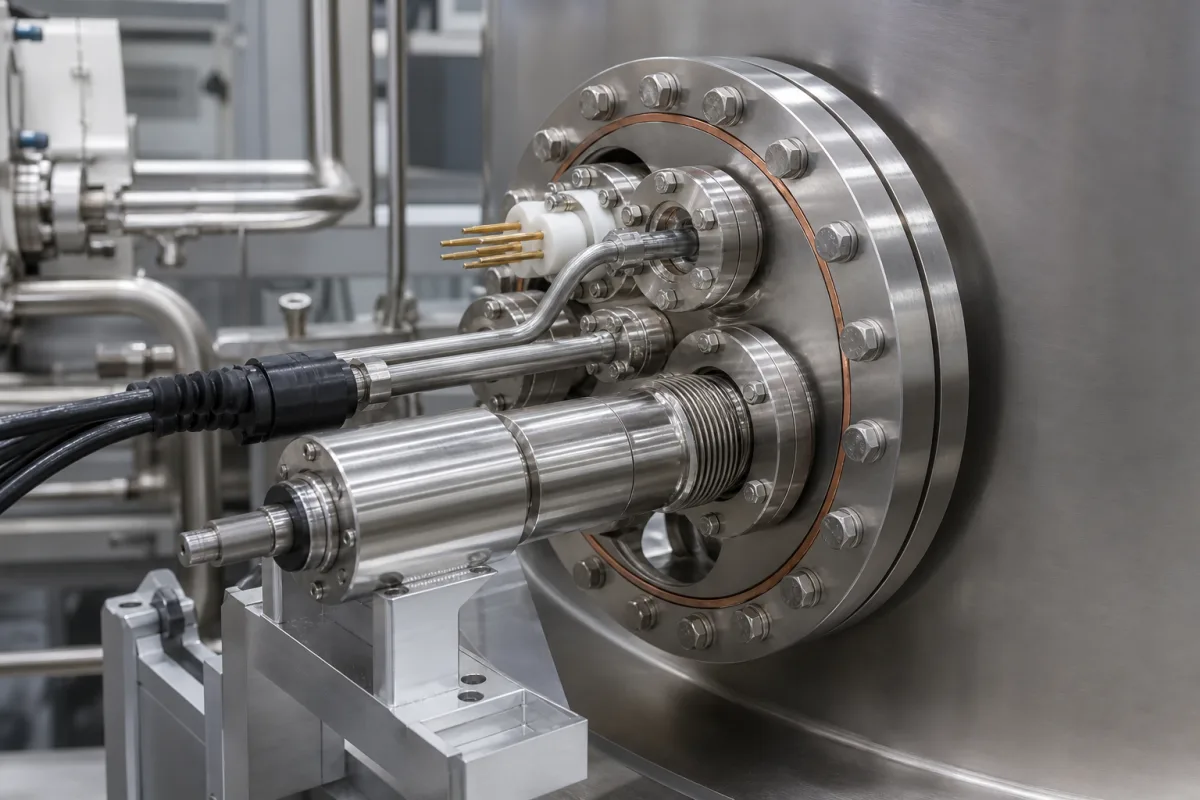
Technical details and manufacturing context for Feedthrough
| Parameter | Typical range | Notes & selection driver |
|---|---|---|
| Number of conductors | 1–50 pins | 1–50 — Depends on signal or power requirements. |
| Current rating per pin | 1–200 A | 1–200 — Higher current requires larger conductor cross-section.IEC 60512-2 |
| Voltage rating | 50–1000 V | 50–1000 — Limited by insulation and creepage distance.IEC 60512-2 |
| Leak rate | 1e-10–1e-6 mbar·L/s | 1e-10 to 1e-6 — Helium leak test; lower for UHV applications.ISO 3530 |
| Temperature range | -196–450 °C | -196 to 450 — Depends on sealing material: Viton up to 200°C, ceramic up to 450°C. |
| Pressure range | 1e-10–10 bar | 1e-10 to 10 — Internal vacuum to external pressure; higher for high-pressure feedthroughs. |
| Body material | 304/316L stainless steel | 304/316L stainless steel — 316L for corrosion resistance.ASTM A276 |
| Conductor material | Copper, Kovar, or molybdenum | Copper, Kovar, or molybdenum — Copper for high conductivity; Kovar for matched seals.ASTM B152 |
| Insulation material | Alumina (Al2O3) or glass | Alumina (Al2O3) or glass — Ceramic for high temperature and UHV; glass for cost.ASTM F19 |
| Seal type | Ceramic-to-metal, glass-to-metal, or O-ring | Ceramic-to-metal, glass-to-metal, or O-ring — O-ring for low vacuum; ceramic for UHV and high temp. |
| Mounting flange | CF, KF, or ISO | CF, KF, or ISO — CF for UHV; KF for high vacuum; ISO for larger sizes.ISO 2861, ISO 1609 |
| Flange size | DN16–DN250 mm | DN16 to DN250 — Depends on number of pins and current.ISO 1609 |
| Service life | 10000–50000 cycles | 10000–50000 — For mechanical feedthroughs; electrical feedthroughs have no moving parts. |
| Temperature | -196–450 °C | -196 to 450 °C — Outside this window: Seal failure, outgassing, or conductor oxidation. |
| Pressure (internal) | 1e-10–10 bar | 1e-10 to 10 bar — Outside this window: Leakage or implosion/explosion. |
| Voltage | 50–1000 V | 50–1000 V — Outside this window: Dielectric breakdown, arcing. |
| Current | 1–200 A | 1–200 A — Outside this window: Overheating, conductor melting. |
| Humidity (external) | 0–95 % RH non-condensing | 0–95 % RH non-condensing — Outside this window: Corrosion, electrical leakage. |
Ranges are indicative industry figures for RFQ preparation, not a supplier commitment. Confirm every value and standard with the legal manufacturer before ordering.
This component is essential for the following industrial systems and equipment:
Indicative industry ranges for design and RFQ preparation. Confirm the exact figures and applicable standard with the manufacturer before specifying.
Quoted from the published standard.
Manufacturer profiles associated with Feedthrough.
Manufacturer listings support early research and capability understanding. They are not certification, ranking, or transaction guarantees.
A practical evidence checklist for RFQ preparation and supplier evaluation.
CNFX does not score or rank suppliers. Buyers must verify all claims and documents with the legal manufacturer before ordering.
A feedthrough is used to transmit electrical power, signals, fluids, or mechanical motion through the wall of a vacuum chamber while maintaining the vacuum integrity. It provides a sealed interface that prevents leakage.
Common sealing types include glass-to-metal, ceramic-to-metal, and elastomer O-rings. The choice depends on the required vacuum level, temperature, and media. Ceramic-to-metal seals are used for UHV and high temperatures, while O-rings are suitable for low vacuum.
Bodies are typically made of 304 or 316L stainless steel. Conductors are made of copper, Kovar, or molybdenum. Insulation materials include alumina ceramic or glass. Material selection depends on conductivity, corrosion resistance, and thermal requirements.
Consider the type of transmission (electrical, fluid, mechanical), required current and voltage ratings, temperature range, pressure range, and vacuum level. Also consider the mounting flange type and size. Always verify specifications with the manufacturer.
Editorial classification, named public sources where available, and source-reviewed manufacturer records.
Ask for use case, specification boundaries, supplier type, and RFQ preparation information for this product.
Compare manufacturer profiles with relevant product and process capability.