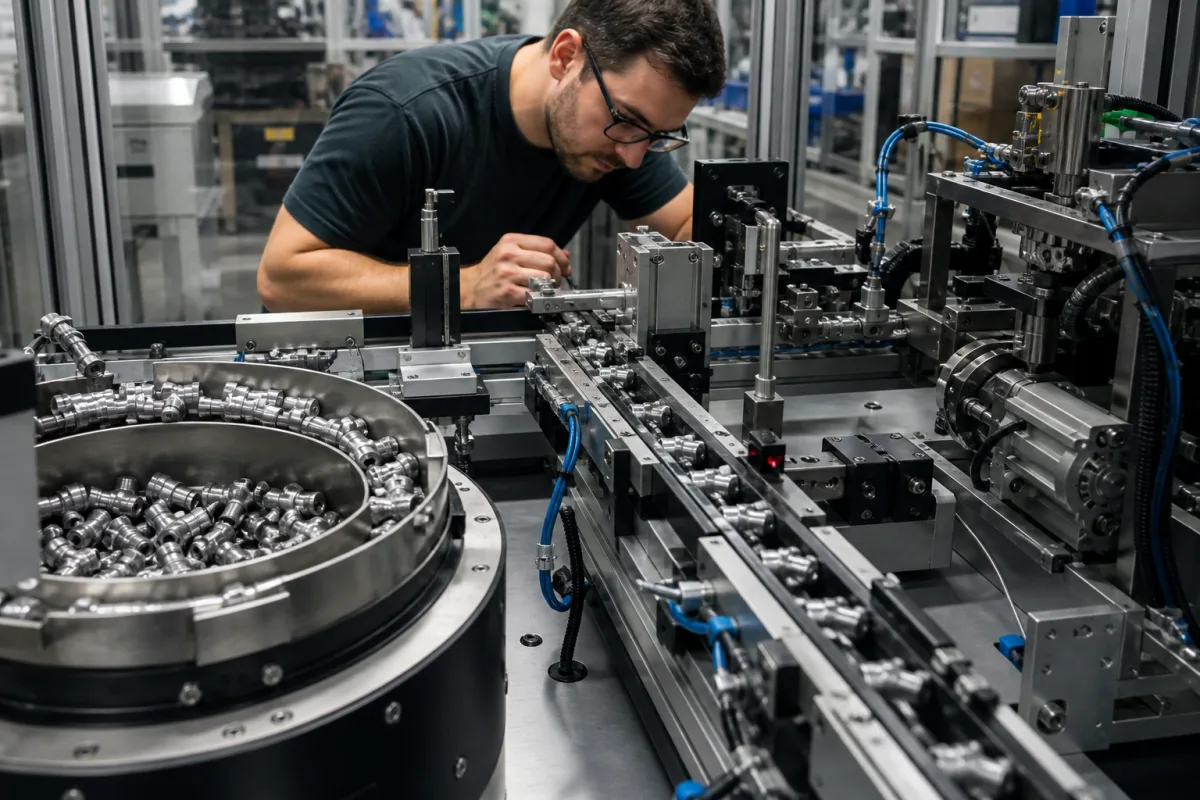
Feeding systems (choosing between dedicated bowl or centrifugal feeders and vision-guided flexible feeders to supply parts to an assembly station)
Choosing the part feeding system for an assembly station · dedicated vibratory bowl and centrifugal feeders against vision-guided flexible feeders with a robot, changeover in hours or minutes, parts per minute, part sizes and fragile materials
Feeding systems here means the choice of how loose parts are separated, oriented and handed to an assembly station: a dedicated vibratory bowl or centrifugal feeder tooled for one part, or a flexible feeder in which a vibrating platform spreads the parts, a camera finds the ones lying right and a robot picks them. Ask three things first: how many different parts and how often the station changes over, how many parts per minute it needs, and whether the parts are fragile, tangling or awkward for a bowl.
Selection between dedicated part feeders (vibratory bowl, centrifugal) and vision-guided flexible feeding systems with robots for assembly, kitting and machine tending. The vibratory bowl feeder itself, its drive base, tooling, linear track and controller are covered on the Vibratory bowl feeder page; terminal-insertion supply stations on their own page; press coil feeders, screw feeders for screwdriving and bulk material feeders are outside this page.
CNFX editorial research · Sources checked October 12, 2026 · 3 sources
Part mix and changeover decide it before rate does
RNA Automation compares the two approaches factor by factor: a flexible feeder changes over "in minutes — software-based selection" while a bowl feeder needs "hours — mechanical retooling"; the flexible feeder handles multiple part types with no part-specific tooling, while the bowl is dedicated to a single part geometry with bespoke tooling; flexible feeding suits high-mix, multi-SKU, frequent-changeover production and the bowl suits high-volume, single-part lines with rare changeover; and a bowl reaches "higher" throughput on single-part dedicated lines. RNA also lists rubber and silicone parts as "a common limitation for bowl feeders" and names glass, ceramic and fragile parts among those flexible feeders handle. [1]
RNA gives a single-robot flexible feeding system as reaching "up to approximately 45 parts per minute", describing it as a "1.5-second pick-and-place cycle time", and suggests dual feeders and robots at one pick station for higher rates. Editorial check: a 1.5-second cycle gives 60 ÷ 1.5 = 40 picks a minute, while 45 a minute needs about 1.33 s; ask the supplier which figure applies to your part and robot. [1]
Give the feeding supplier the part drawings and samples, the number of part types and how often they change, the required parts per minute per station, how parts arrive (bulk, tangled, oiled), any fragile or cosmetic surfaces, the pick orientation needed, the robot or transfer that takes the part, and the space available.
02
Inside a flexible feeder: hopper, vibrating platform, vision and robot
Asyril describes its flexible feeding as an Asyfill smart hopper that regulates the number of parts on the platform, an Asycube feeder whose patented 3-axis vibration pre-orients and gently separates parts, and an EYE+ control system with AI-based vision that chooses vibration sequences and gives part locations to a robot or linear axis, for parts from 0.1 to 150 mm. It says a new component or series changeover can be set up in its software "without any tools or hardware modifications". [2]
RNA describes the same three building blocks (vibratory platform, vision system and robot) and notes that only a quick change of end-of-arm tooling is needed at changeover. [1] Swoer, a Chinese feeder maker, lists dedicated vibratory bowl feeders, centrifugal feeders and flexible parts feeders, so both routes are offered by the same suppliers. [3]
1 company lists this product among what they make. Company figures are quoted from each
company's own website; every card states where the relationship came from.
Swoer
Manufacturing site to be confirmed for the order
Lists vibratory bowl feeders, centrifugal feeders and flexible parts feeders.
Explore company information and manufacturing capabilities, then discuss the scope of your project with a relevant supplier.
Share this page
Compiled and source-reviewed by the CNFX editorial team.
Each manufacturer above links to the page on that company's own website where the product is listed, with the date we checked it. How we source and review
· Page last updated 13 October 2026
Buyer questions
How is this different from the vibratory bowl feeder page?
This page covers choosing between dedicated and flexible feeding; the bowl feeder itself, its drive, tooling and track are on the Vibratory bowl feeder page. [1]
How fast is a flexible feeder?
RNA gives up to about 45 parts a minute with one robot, describing a 1.5-second cycle; 1.5 s works out at 40 a minute, so confirm with the supplier. [1]
How long does changeover take?
RNA says minutes for a flexible feeder against hours of retooling for a bowl feeder. [1]
What part sizes can a flexible feeder take?
Asyril gives 0.1 to 150 mm across its Asycube range. [2]
Sources and what still needs a direct check
Sources checked 2026-10-12. RNA Automation and Asyril, both feeder makers, publish their flexible feeding guidance and brochure; Swoer lists its feeder range.