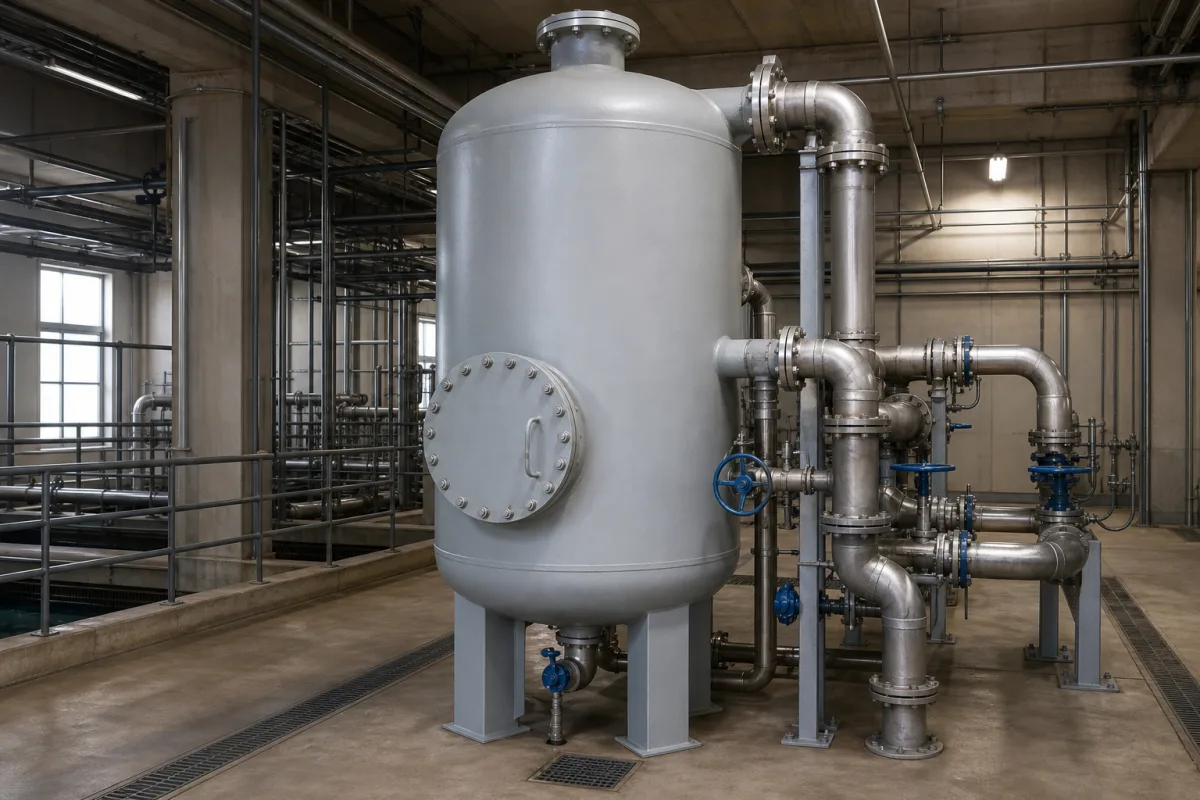
Media filter vessels · Filtration rate and backwash rate, media specification, carbon contact time, vessel fittings and pressure rating
A filter vessel is a closed pressure vessel that holds a bed of granular media — sand, anthracite, multimedia or activated carbon — with an underdrain to collect filtered water and distribute backwash water; vessels like the one pictured are piped with valves so each can be filtered and backwashed in turn. Ask three things first: what filtration rate the vessel area gives at your flow, what backwash rate the underdrain and pump can deliver, and which media and pressure rating the vessel is built for.
Pressure vessels for granular media filtration and activated carbon adsorption in water treatment, with their underdrains, fittings and media. Bag and cartridge filter housings, self-cleaning screen filters, gravity filters and complete reverse osmosis systems are outside this page.
CNFX editorial research · Sources checked October 12, 2026 · 4 sources
The 2022 Recommended Standards for Water Works (Ten States Standards) name iron and manganese removal as the use of rapid-rate pressure filters and state that they shall not be used for surface or other polluted waters or after lime-soda softening. The filtration rate shall not exceed 4 gallons per minute per square foot of filter area unless pilot or full-scale testing approved by the reviewing authority supports higher rates. At least two units are required, each able to treat the plant design capacity if only two are provided. [1]
Editorial calculation: 4 gpm/ft² is about 9.8 m/h, so a 2.0 m diameter vessel (3.14 m²) can treat about 30.7 m³/h under that limit; a plant needing 30 m³/h from two such vessels would need each to carry the full flow if one is out of service.
Napier-Reid, a filter maker, lists its pressure filters for turbidity, iron, manganese, sulfide and arsenic removal at filtration rates up to 10 gpm/ft² (24 m/hr), in vertical or horizontal configuration, with vessels of carbon steel, stainless steel or fiberglass reinforced polyester designed for 150 psig. Its carbon steel vessels are built to the ASME code, can be ASME "U" stamped, and are lined with NSF-approved epoxy for potable water; the maker states backwash water use as little as 2% of plant flow. [3]
Editorial calculation: 10 gpm/ft² is 2.5 times the 4 gpm/ft² Ten States limit, so where those standards apply a vessel sized at the maker's top rate needs pilot or full-scale testing approved by the reviewing authority; at 4 gpm/ft² the same vessel area carries 40% of the flow. 150 psig is about 1.03 MPa (× 0.006895). [1][3]
The same standards require loss-of-head gauges on each filter's inlet and outlet, a flow meter or indicator on each battery of filters, individual filtration and backwash of each filter, a minimum side-wall shell height of five feet, wash-water collectors at least 18 inches above the media, an air release valve at the highest point, means to observe the backwash water, and a manhole for inspection on filters 36 inches or more in diameter, preferably at least 24 inches across. [1]
Ireland's Environmental Protection Agency gives a European operator's view in its Water Treatment Manual: Filtration (2020). It contrasts loading rates of 7–10 m/h for rapid gravity and pressure filters with 0.3 m/h for slow sand filters, says the size of pressure vessels is limited by transport, and notes that horizontal vessels suit plants above 4 million litres per day because vertical vessels are limited to a media depth of 1–1.5 m. It describes modern dual-media beds of about 500 mm anthracite (effective size 1.4 mm, uniformity coefficient 1.5) over 500–800 mm of sand (effective size 0.4–0.6 mm, uniformity coefficient 1.4–1.5), and advises that pressure filters divert the drain-down "dump volume" to waste because the sudden pressure drop can dislodge particles. [4]
Editorial calculation: a 3 m diameter vertical vessel has 7.07 m² of bed (π × 1.5²), so EPA Ireland's 7–10 m/h corresponds to about 49–71 m³/h per vessel; check the supplier's flow per vessel against that band and against the rate your own regulator sets. [4]
Give the supplier the flow (normal and peak), raw water analysis and target contaminants, media type and depth, number of vessels and whether one must be able to run alone, design pressure and temperature, backwash water source and air scour, available space and height, and the code and inspection required for the vessel.
02
Plan the backwash rate and bed expansion
The Ten States Standards require the underdrain of a pressure filter to collect filtered water efficiently and distribute backwash water uniformly at not less than 15 gallons per minute per square foot of filter area (37 m/h), with readable backwash flow indicators and controls. [1]
Calgon Carbon's MODEL 12-40 carbon adsorber, a 12 ft (3,660 mm) ASME code carbon steel vessel holding 40,000 lb of GAC, is sized for about 25% backwash expansion within the straight side, with a backwash rate of 1,700 gpm (typ.), polypropylene slotted nozzles for collection and backwash distribution, and pressure gauges across each adsorber. [2]
Editorial calculation: the vessel's 3.66 m diameter gives about 10.5 m² of area, and 1,700 gpm is about 386 m³/h, or about 36.7 m/h — in line with the 37 m/h minimum above. For the 2.0 m vessel in the earlier example, 37 m/h means a backwash flow of about 115 m³/h, nearly four times its filtering flow, which the backwash pump and waste-water handling must cover. [1][2]
03
Specify the media and carbon contact time
In its section on rapid-rate gravity filters, which the pressure filter section does not repeat, the Ten States Standards require media meeting AWWA standards with a total depth of not less than 24 inches, with 30 inches named as the upper figure, a uniformity coefficient of the smallest material not greater than 1.65, and at least 12 inches of media with an effective size of 0.45 to 0.55 mm. Anthracite used as a cap should have an effective size of 0.8 to 1.2 mm, and torpedo sand supporting the filter sand 0.8 to 2.0 mm. [1]
For PFAS removal by granular activated carbon contactors, its interim guidance calls for at least two vessels in series in a lead/lag arrangement, an empty bed contact time of at least 10 minutes, and 12 × 40 mesh carbon (about 0.5 to 0.7 mm) with an iodine number of at least 850 mg/g, noting coal-based carbon has removed PFAS more efficiently. [1] Calgon Carbon's standard MODEL 12-40 system likewise pairs two vessels with a manifold for series operation, so either can be isolated for carbon exchange or backwash. [2]
Editorial calculation: a 10-minute empty bed contact time at 30 m³/h needs at least 30 × 10 ÷ 60 = 5 m³ of carbon in each contactor's bed.
04
Steel, stainless and self-cleaning media filters on offer
Listings include carbon steel and stainless steel sand and carbon filter tanks for water treatment, automatic self-cleaning sand and carbon filters, and ASME-coded filter vessels from pressure vessel fabricators. Ask each supplier for the design code and pressure, the underdrain type, the lining or coating, and the media supplied.
05
Shell, underdrain, collector, manway and lining
The shell, collector and manway rows carry Ten States minimums: a five-foot side wall, a wash-water collector 18 inches above the media and a manhole on filters of 36 inches or more. [1]
Part
Role
Fix in the order
Shell and heads
Pressure boundary; side wall ≥5 ft; ASME code, U stamp optional. [1][3]
Pressure, flow area, shell and lining data a fabricator should confirm
Filtration area fixes both the service flow and the backwash flow: at 37 m/h, backwash for the 2.0 m example vessel above is nearly four times its filtering flow. [1]
One fabricator lists carbon steel filter vessels and another ASME filter vessels; the other listings are sand and activated carbon filter tanks for water treatment, including automatic self-cleaning designs.
Explore company information and manufacturing capabilities, then discuss the scope of your project with a relevant supplier.
Share this page
Compiled and source-reviewed by the CNFX editorial team.
Each manufacturer above links to the page on that company's own website where the product is listed, with the date we checked it. How we source and review
· Page last updated 13 October 2026
Buyer questions
How fast can water flow through a pressure sand filter?
The Ten States Standards cap rapid-rate pressure filters at 4 gpm/ft² (about 9.8 m/h, editorial conversion) unless testing approved by the authority supports more. [1]
What backwash rate does a pressure filter need?
The underdrain must distribute backwash at not less than 15 gpm/ft² (37 m/h) under the Ten States Standards. [1]
How much contact time does a GAC vessel need for PFAS?
Ten States interim guidance asks for at least 10 minutes empty bed contact time, with two vessels in series. [1]
Can a pressure filter run faster than 4 gpm/ft²?
Napier-Reid lists its pressure filters at up to 10 gpm/ft² (24 m/hr), but the Ten States Standards allow more than 4 gpm/ft² only where testing approved by the reviewing authority supports it. [3][1]
What loading rate does a pressure filter run at compared with slow sand filtration?
EPA Ireland's filtration manual gives 7–10 m/h for rapid gravity and pressure filters against 0.3 m/h for slow sand filters. [4]
Sources and what still needs a direct check
Sources checked 2026-10-12. The Recommended Standards for Water Works are design standards of the Great Lakes–Upper Mississippi River Board, adopted by member US states and provinces. Calgon Carbon and Napier-Reid are makers; their data sheet and product page describe their own vessels.