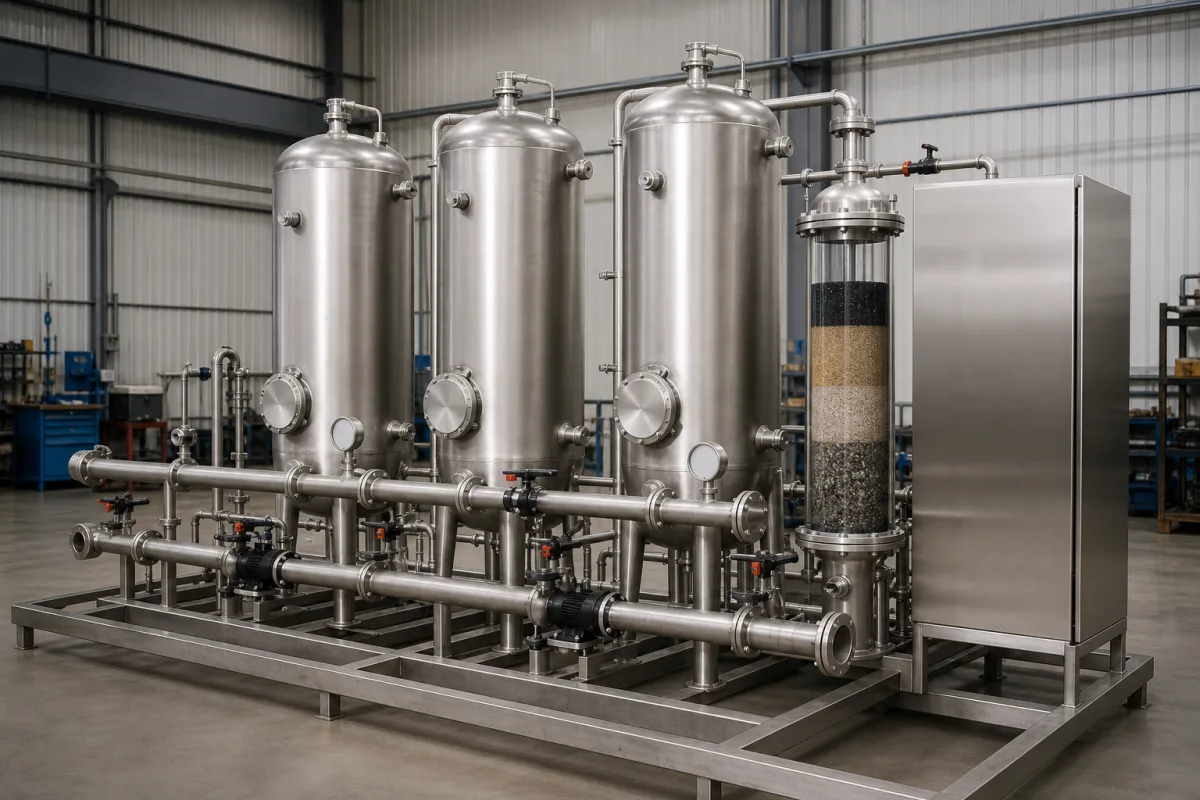
Pressure media filters · filtration rate in m/h, anthracite and sand sizes, bed depth and L/D ratio, backwash rate and redundancy
A multi-media filter is a pressure vessel holding layers of granular media, such as anthracite over sand on graded gravel (sometimes with garnet below), through which water flows downward so that coarse, light media trap larger particles and fine, dense media polish the water, before the bed is backwashed upward to clean it. Ask three things first: what filtration rate the vessel area gives at your maximum flow with one filter backwashing, what media sizes and depths are installed, and what backwash flow and air scour the system provides.
Vertical and horizontal pressure filters with dual or mixed media (anthracite, sand, garnet) for turbidity and suspended-solids removal in water and process-water treatment, as pretreatment to membranes or ion exchange. Open rapid gravity filters, slow sand filters, cartridge and bag filters, and activated-carbon-only vessels are outside this page.
CNFX editorial research · Sources checked October 12, 2026 · 4 sources
Ireland's Environmental Protection Agency, in its Water Treatment Manual: Filtration (2020), defines filtration rate as filtered flow (m³/h) per filter surface area (m²). It says rates above 7.5 m/h for mono-media and 10 m/h for dual-media filters are considered inappropriate in the manual when protozoa removal is targeted, while up to 15–20 m/h is acceptable in the manual when only metal removal is targeted. [2]
The manual requires enough filter area that the maximum rate is not exceeded with filters offline: larger plants design on an n − 2 basis (one backwashing, one in maintenance), and facilities with fewer than four filters may use n − 1. The manual gives pressure filter vessels as under 4 m in diameter and 10 m long because of transport, with a maximum media depth of 1–1.5 m; the manual says pressure filtration is more cost-effective at sites under 2 million litres per day, but backwashing cannot be watched. [2]
Editorial calculation: to treat 50 m³/h at 10 m/h with three vertical vessels on an n − 1 basis, the two remaining vessels need 5 m² together, 2.5 m² each, or about 1.78 m diameter. One 2.0 m vessel (3.14 m²) carries about 31 m³/h at 10 m/h. Flow, rate and vessel count are assumed examples; use the rate your water and treatment goal call for.
Give the supplier the raw water analysis (turbidity, suspended solids, iron, manganese, organics), flow range and operating hours, treatment goal (pretreatment to RO, ion exchange, drinking water, process water), required filtrate quality, design pressure, available backwash water and air, number of vessels and redundancy, materials and space.
02
Specify media sizes, depth and backwash
The EPA manual describes modern dual-media installations as using around 500 mm of anthracite (effective size 1.4 mm, uniformity coefficient 1.5) over 500–800 mm of sand (UC 1.4–1.5, effective size 0.4–0.6 mm), on graded support gravel. Its media table gives sand 0.5–0.7 mm ES at 2.6 g/ml, anthracite 1.2–1.4 mm at 1.5 g/ml and garnet 0.2–0.4 mm at 4.2 g/ml; a garnet layer of at least 150 mm was used in tri-media filters, but current consensus finds no benefit worth its cost. [2]
It cites the American Water Works Association's recommended minimum L/D ratio of 1,200 (bed depth over effective size) for Cryptosporidium removal; its example of 600 mm of 0.6 mm sand plus 400 mm of 1.3 mm anthracite gives 600/0.6 + 400/1.3 ≈ 1,308. Graded 16/30 sand (ES 0.54–0.7 mm) needs about 35–40 m/h of upflow for 15–20% bed expansion, the manual says modern plants target at least 20% expansion, colder water expands the bed more at the same rate, and media losses of up to 2–3% a year are expected, so a depth marker plate is advised. [2]
Carbotecnia, a filter maker, specifies its industrial multimedia (tri-media) filter with anthracite of 0.85–0.95 mm effective size, 16 × 35 mesh silica sand of 0.44–0.52 mm and 30–40 garnet of 0.33–0.37 mm, media to AWWA B-100, and a layer of 8–12 garnet over the gravel so the dense garnet and gravel do not mix in backwash. It lists a hydraulic service load of 7–10 gpm/ft², a backwash load of 20–22 gpm/ft², 30–100 psi operation and backwash at a differential above 10 psi or at most every 72 hours. [1] Editorial calculation: 7–10 gpm/ft² is about 17–24 m/h, well above the 10 m/h the EPA manual treats as the limit for dual-media drinking-water filters targeting protozoa, so agree the rate with the purpose of the filter. [2]
Editorial calculation: backwashing a 2.0 m diameter vessel (3.14 m²) at 35–40 m/h needs about 110–126 m³/h of wash water, far above its 31 m³/h service flow at 10 m/h, so size the backwash pump and water store for it. Diameter and rates are assumed examples.
03
Check the regulatory rate limit for pressure filters
California's drinking water regulation, 22 CCR §64660 (operating criteria for surface water treatment), limits pressure filters to filtration rates of 2.0 gpm/sq ft for single-media filters and 3.0 gpm/sq ft for dual, mixed-media or deep-bed filters, against 3.0 and 6.0 gpm/sq ft for gravity filters in conventional and direct filtration plants. Rates up to twice these need a demonstration that the filters meet the performance requirements of §64653; higher rates need 99% Giardia, 90% virus and 99% Cryptosporidium removal. [3]
These limits apply to surface water treatment plants under California rules; process-water filters ahead of membranes or ion exchange are set by the downstream equipment's needs instead. Compare them with the Irish EPA rates above, which are given in m/h. [3][2]
Editorial calculation: 1 gpm/sq ft ≈ 2.44 m/h, so 2.0 and 3.0 gpm/sq ft are about 4.9 and 7.3 m/h; a 2.4 m diameter dual-media pressure vessel (4.52 m²) at 7.3 m/h treats about 33 m³/h.
22 CCR §64660 requirement
Value
Pressure filter, single media
≤ 2.0 gpm/sq ft
Pressure filter, dual, mixed or deep-bed
≤ 3.0 gpm/sq ft
Gravity filter, single media / dual or mixed
≤ 3.0 / ≤ 6.0 gpm/sq ft
Individual filter turbidity, first 4 h after backwash
2.0 NTU at any time triggers removal from service and inspection
Individual filter turbidity after 4 h in service
0.5 NTU trigger
Pressure filter inspection
Annually, for media condition, mudballs and short circuiting, with written record
After backwash
Increase filtration rate gradually
State whether the water is regulated drinking water, the jurisdiction's rate limit and turbidity triggers, and ask the supplier for filtration rate, filter area and inspection access for media checks.
04
Compare Texas design rules for pressure and multi-media filters
The Texas Commission on Environmental Quality's public water system rule, 30 TAC §290.42, limits pressure filters to plants with a treatment capacity below 0.50 MGD and caps their design capacity at 2.0 gpm/sq ft with the largest filter off-line. High-rate gravity filters may be designed for 5.0 gpm/sq ft. Filter media must conform to AWWA standards, be at least 24 inches deep and give an L/d ratio of at least 1,000. [4]
Editorial calculation: taking mid-range effective sizes, the minimum Texas multi-media bed gives an L/d of about 76/0.25 + 229/0.55 + 610/1.0 ≈ 1,330, above the rule's 1,000 and the AWWA figure of 1,200 cited by Ireland's EPA. [4][2] At 2.0 gpm/sq ft (about 4.9 m/h), the 50 m³/h example above would need about 10.2 m² of filter area with the largest filter off-line, against 5 m² at the 10 m/h dual-media rate. Editorial calculation; these rules apply to Texas public water systems, so a process-water filter is set by its downstream equipment instead. [4]
30 TAC §290.42 item
Value in the rule
Editorial conversion
Pressure filter design rate, largest filter off-line
At least 3 in garnet (ES 0.2–0.3 mm), 9 in sand (ES 0.5–0.6 mm), 24 in anthracite (ES 0.9–1.1 mm); UC not above 1.6 [4]
About 76, 229 and 610 mm
High-rate dual-media bed
At least 12 in sand (ES 0.45–0.55 mm) and 24 in anthracite (ES 0.9–1.1 mm) [4]
About 305 and 610 mm
Support gravel
At least 12 in, 1/16 in to 2.5 in, in three to five layers [4]
About 305 mm
Backwash rate
At least 12.5 gpm/sq ft (20 in rise per minute); 21.8 gpm/sq ft (35 in/min) as the upper figure [4]
About 30.6 and 53.3 m/h
Bed expansion in backwash
At least 15% with air scour; 25% for mixed media without air scour; 40% for mono-media sand without air scour [4]
—
05
Who lists multi-media filter vessels
Listings include multi-media filters alongside sand, deep-bed and carbon media filters, FRP and steel filter tanks within water treatment plants, and multi-media filters within ranges of self-cleaning, bag and cartridge filters. Ask each for vessel area, media specification and backwash design.
06
From underdrain to air-release valve
Part
Role
Fix in the order
Pressure vessel
Holds media under pressure; vertical or horizontal. [2]
Diameter, design pressure, material, lining.
Underdrain
Collects filtrate; distributes backwash and air. [2]
Flow, vessel diameter, media and backwash rows lean on Ireland's EPA manual, with Carbotecnia and California's rule for pressure loss and rate limits; shell material and weight come from the supplier.
Field
What it means and published values
Ask the supplier for
Rated Flow (m³/h)
Flow divided by area gives the filtration rate. [2]
Flow at maximum rate, n − 1.
Operating Pressure (MPa)
Pressure vessel duty.
Design and test pressure.
Operating Temperature (°C)
Colder water expands the bed more in backwash. [2]
Range.
Filtration Precision (μm)
Depends on media and rate; can be given as turbidity.
Dawning and Lifeierte list multi-media filters next to sand, manganese and carbon media filters; Chunke lists multi-media filter tanks with FRP vessels, Ayater with bag and self-cleaning filters, and Moer within complete water treatment systems.
Explore company information and manufacturing capabilities, then discuss the scope of your project with a relevant supplier.
Share this page
Compiled and source-reviewed by the CNFX editorial team.
Each manufacturer above links to the page on that company's own website where the product is listed, with the date we checked it. How we source and review
· Page last updated 13 October 2026
Buyer questions
What filtration rate should a dual-media filter run at?
Ireland's EPA treats rates above 10 m/h as inappropriate for dual-media filters targeting protozoa, and up to 15–20 m/h as acceptable when only metals are targeted. [2]
What media sizes does the EPA manual describe?
The EPA manual describes about 500 mm of 1.4 mm anthracite over 500–800 mm of 0.4–0.6 mm sand. [2]
How hard must the filter be backwashed?
Graded 16/30 sand needs about 35–40 m/h of upflow for 15–20% bed expansion; the manual says modern plants target at least 20%. [2]
What filtration rate is allowed for a dual-media pressure filter on drinking water?
California's 22 CCR §64660 limits pressure filters to 3.0 gpm/sq ft (about 7.3 m/h) for dual, mixed-media or deep-bed filters and 2.0 gpm/sq ft for single media. [3]
How fast must a multi-media filter be backwashed?
Texas rule 30 TAC §290.42 requires at least 12.5 gpm/sq ft (about 30.6 m/h) and bed expansion of at least 25% for mixed-media filters without air scour. [4]
Sources and what still needs a direct check
Sources checked 2026-10-12. Carbotecnia is a filter maker describing its own product. Ireland's EPA manual is official guidance for drinking water treatment plants; its rates and media are design guidance for that use and cite AWWA where noted. Industrial pretreatment may justify different rates. Texas's public water system rule (30 TAC §290.42) adds design rates, media depths and backwash minimums for pressure and multi-media filters.