PWR 17 × 17 fuel assembly: how the 289 lattice positions are shared between fuel rods, guide thimbles and the instrument tube, with rod, pellet and thimble dimensions and EPR core data
The 17 × 17 bundle of fuel rods, guide thimbles and grids loaded into a pressurised water reactor core · how the 289 lattice positions are filled, the rod, pellet and tube dimensions, and the assembly, core and enrichment data of one published design
The fuel assembly is the unit a pressurised water reactor is loaded, shuffled and discharged in: a square bundle of zirconium-alloy fuel rods held in spacer grids between a bottom and a top nozzle, with some lattice positions given over to tubes that guide control rods or instruments. For the 17 × 17 lattice used by Westinghouse-type plants and by the EPR, the questions are which positions hold fuel, how big the rods, pellets and tubes are, and how the assembly fits its core.
Pressurised water reactor fuel assemblies with a 17 × 17 rod lattice: fuel rods (pellets and cladding), control-rod guide thimbles, instrumentation tubes, spacer grids and top and bottom nozzles, with their dimensions, materials, fuel mass and enrichment. Control rods, rod cluster control assemblies and BWR control blades are covered on the Control rod (nuclear reactor) page. BWR fuel assemblies, other PWR lattices (14 × 14, 15 × 15, 16 × 16) and VVER hexagonal assemblies are outside this page except where compared.
CNFX editorial research · Sources checked October 13, 2026 · 3 sources
289 positions filled two ways: 264 fuel rods, 24 guide thimbles and an instrument tube, or 265 fuel rods and 24 thimbles
Westinghouse's European patent application EP 0 193 923 describes the conventional assembly in its background: a bottom nozzle, a top nozzle, an instrumentation tube, control-rod guide thimbles, fuel rods and grids, with the rods in a square array of 17 locations per side; of the 289 locations, 264 contain fuel rods, and there are 24 guide thimbles and one instrumentation tube. [2] The UK EPR pre-construction safety report gives the EPR's 17 × 17 assembly 265 rods per assembly, 24 guide thimbles and no instrumentation thimbles. [1]
The patent explains the roles of the skeleton: the guide thimbles run between the nozzles and rigidly join them, give the control rods their channels and carry the grids at spaced heights; the bottom nozzle directs the upward coolant flow into the assembly; the top nozzle supports the control-rod spider; and together the nozzles stop fuel rods being ejected up or down. The grids and rods are not structural parts of that skeleton. [2] The UK EPR report describes its grids as an egg-crate of interlocked straps with spring fingers and dimples to hold the rods and mixing vanes for the coolant, and unused guide thimbles as fitted with plugs. [1]
Editorial calculation: in the Westinghouse layout 25 of 289 positions (8.7 %) hold no fuel, which the patent rounds to about ten percent; the EPR layout gives one of those positions back to fuel. [2][1] The EPR core's 241 assemblies × 265 rods = 63,865 fuel rods, the figure its table gives. [1]
State the lattice and which positions hold fuel, thimbles or instrumentation; ask for the assembly drawing and the reactor it is licensed for.
02
Rods, pellets and tubes: 9.50 mm or 9.14 mm cladding on the same 12.6 mm pitch, and the guide thimbles around them
ORNL's report NUREG/CR-7306 (ORNL/TM-2023/2938), prepared for the NRC, models two Westinghouse 17 × 17 designs, the RFA and the OFA, with the same 1.26 cm pitch and 264 rods but different rod sizes; the UK EPR report gives its own rod data at 20 °C: [3][1]
Editorial calculation: on a 12.6 mm pitch, a 9.50 mm rod leaves 3.1 mm of coolant gap between neighbouring rods and gives a pitch-to-diameter ratio of 1.33; a 9.14 mm OFA rod leaves 3.46 mm and gives 1.38. [3][1] The EPR's 0.17 mm diametral gap is the cold clearance between its 8.19 mm pellet and the inside of its cladding. [1]
ORNL notes that its UO₂ effective density of 10.26 g/cm³ and its tube dimensions come from sources other than the DOE report used for the rod data; the EPR report gives pellet densities of 95 % of theoretical for UO₂ and 94.5 % for MOX. [3][1]
Specify the rod design (cladding alloy, outside diameter, wall thickness), pellet diameter and density, and the thimble and instrument tube dimensions the control rods and in-core instruments require.
03
From assembly to core: a 4.8 m assembly with 10 grids and 598 kg of UO₂, 241 per EPR core, enriched to 5.0 % for reloads
The UK EPR report lists the assembly-level and core-level data that a fuel order sits within: [1]
Editorial calculation: 527.5 kg of uranium in 598 kg of UO₂ is 88.2 % uranium by mass; a 21.4 cm assembly on a 21.504 cm pitch leaves about 1.0 mm between neighbouring assemblies in the cold core. [1]
Enrichment is where the assembly is changing. ORNL's report for the NRC studies 17 × 17 assemblies at initial ²³⁵U enrichments up to 8 wt %, compared with the current regulatory limit of 5 wt %, and calls the 5 to 8 wt % range extended enrichment. [3]
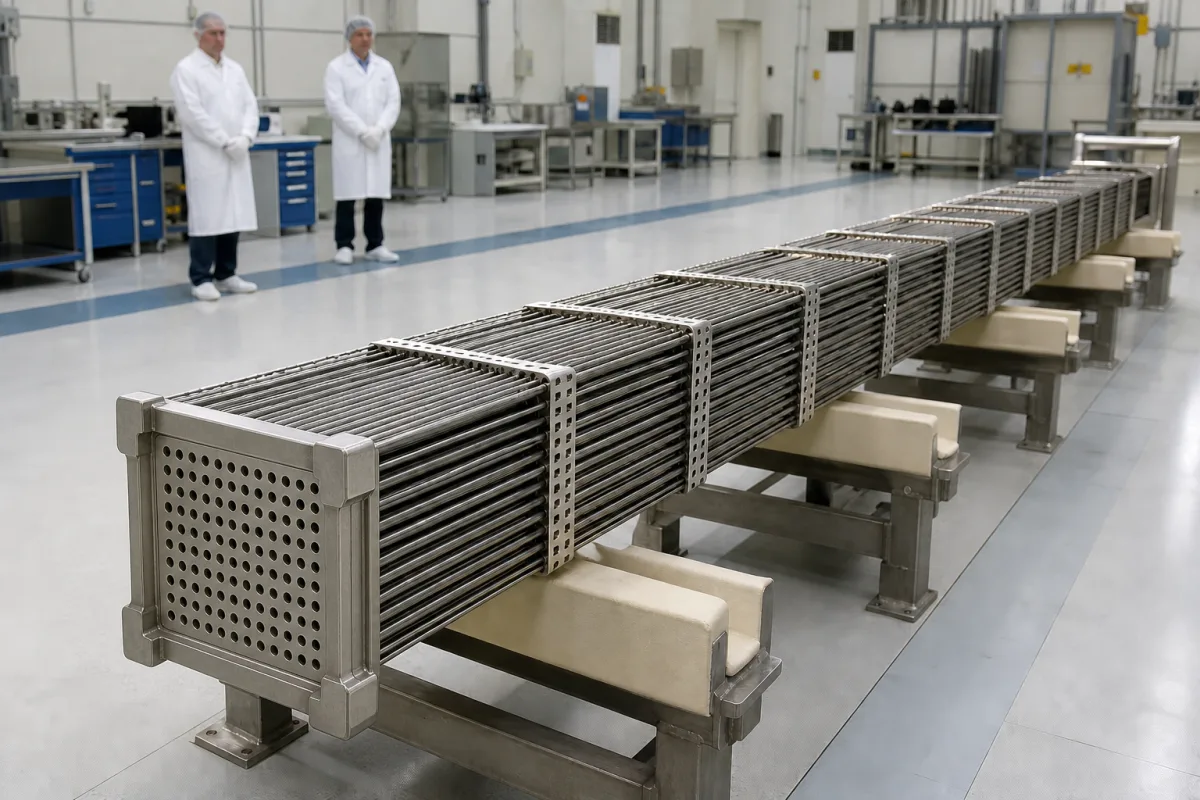
The image above shows a full-length square rod bundle of this type with spacer grids along it and a perforated end nozzle, resting on padded supports in a clean hall.
Explore company information and manufacturing capabilities, then discuss the scope of your project with a relevant supplier.
Share this page
Compiled and source-reviewed by the CNFX editorial team.
Each manufacturer above links to the page on that company's own website where the product is listed, with the date we checked it. How we source and review
· Page last updated 13 October 2026
Buyer questions
How many fuel rods are in a 17 × 17 PWR fuel assembly?
Westinghouse's patent describes 264 fuel rods, 24 guide thimbles and one instrumentation tube in the 289 positions; the UK EPR report gives 265 fuel rods, 24 guide thimbles and no instrumentation thimble. [2][1]
What is the diameter of a PWR fuel rod?
ORNL's NUREG/CR-7306 gives 9.50 mm cladding outside diameter for the Westinghouse RFA and 9.14 mm for the OFA on a 12.6 mm pitch; the EPR rod is 9.50 mm with 0.57 mm M5 cladding and an 8.19 mm pellet. [3][1]
How much uranium is in one fuel assembly?
The UK EPR report gives 598 kg of UO₂, or 527.5 kg of uranium, per assembly, with 241 assemblies in the core. [1]
Sources and what still needs a direct check
Sources checked 2026-10-13. Three sources from three publishers: EDF and AREVA's UK EPR pre-construction safety report, sub-chapter 4.1 (UKEPR-0002-041), for the EPR assembly and core; Westinghouse Electric's European patent application EP 0 193 923 for the conventional 17 × 17 layout and skeleton; and ORNL's NUREG/CR-7306 Rev. 1 (ORNL/TM-2023/2938) for Westinghouse RFA and OFA rod and tube dimensions and extended enrichment.