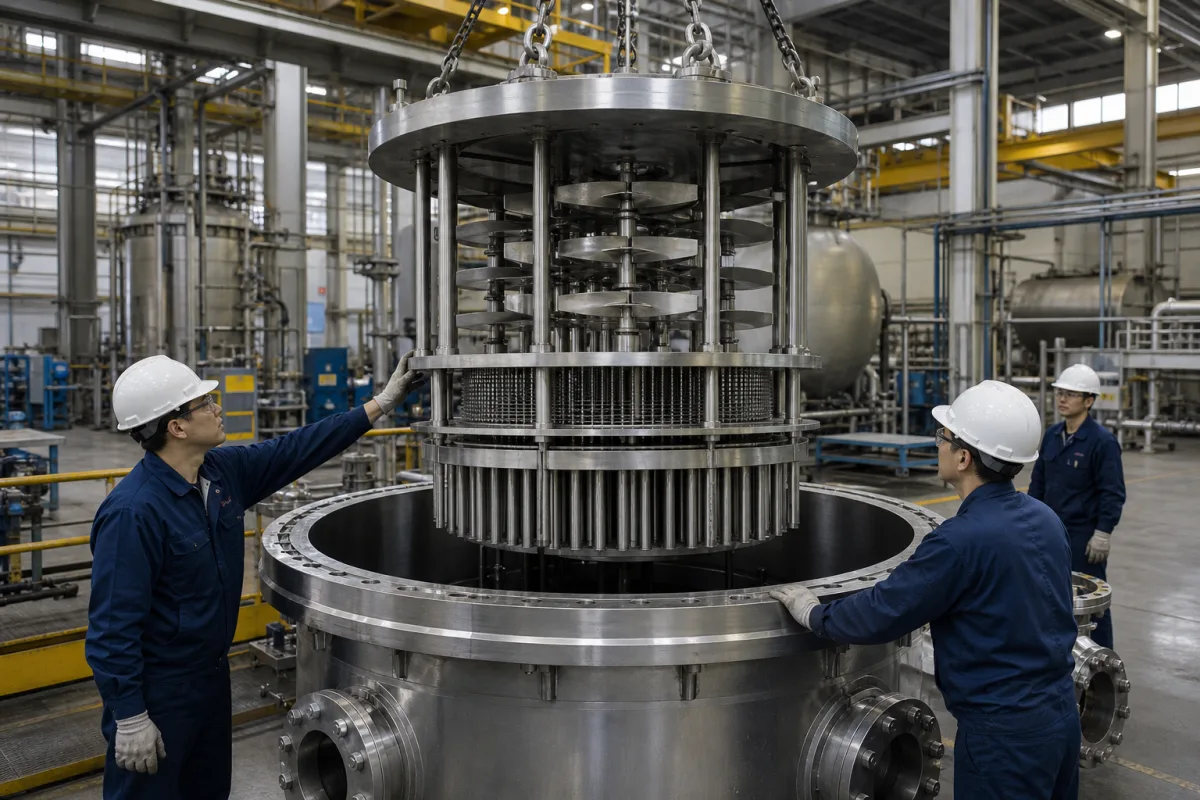
Reactor core (removable catalyst cartridge or basket assembly that holds the catalyst bed inside a reactor shell)
Removable catalyst internals for catalytic reactors · converter cartridges with catalyst baskets and interbed exchangers, axial-radial beds, static and spinning catalyst baskets for stirred test reactors
A reactor core here is the internal assembly that holds the solid catalyst inside a reactor shell and guides gas or liquid through it: in a synthesis converter, a cartridge of catalyst baskets with perforated distribution walls and heat exchangers between beds; in a laboratory or pilot stirred reactor, an annular mesh basket that stays still or spins with the stirrer. Ask three things first: what reactor shell and process the core goes into, how the catalyst bed is held and the flow passes through it, and how the core is loaded, lifted in and taken out.
Catalyst cartridges, modular catalyst baskets and their distribution walls and interbed exchangers for fixed-bed synthesis converters, and static or spinning catalyst baskets for stirred laboratory and pilot reactors. Complete jacketed stirred-tank reactors are covered on the Chemical reactor (jacketed stirred tank) page; electrical reactor (inductor) cores, nuclear reactor cores and catalysts themselves are outside this page.
CNFX editorial research · Sources checked October 12, 2026 · 6 sources
Specify the cartridge of a fixed-bed synthesis converter
A Casale patent describes a converter for catalytic synthesis under pressure, "particularly for ammonia and methanol", made of an external shell in a single piece and, inside it, a cartridge holding granular catalyst in one or more beds in modular baskets. Each modular cartridge has a solid outer wall that forms an airspace with the inner wall of the shell, a gas-permeable outer wall that distributes gas into the bed and contains the catalyst, a gas-permeable inner collecting wall, and a connection and support system at its ends so the modules can be stacked; the heat exchangers that control gas temperature sit in the centre of the beds. It notes that the exchanger flanges can be connected only after the upper bed has been emptied of catalyst and through manholes. [1]
An earlier Casale patent on axial-radial reactors describes catalyst beds held between a bottom and two concentric walls, the outer perforated for its whole axial length and the inner unperforated along a small part, so that gas flows "first axially and then radially" through the bed and collects in the centre; it says the inner cartridge can be built from stackable modular cartridges, light because only one wall is solid, assembled in situ, with open-top beds. [2]
In a 2021 reference, Casale reports delivering a new converter of more than 400 t to replace an old converter in a US ammonia plant, with a full-bore opening, single-wall "cold-wall" pressure vessel and a 3-bed cartridge with two interchangers, citing "better accessibility to the internal parts of the reactor". [3]
Give the cartridge maker the process (ammonia, methanol or other), shell inside diameter, height and closure (full-bore or manhole), design pressure and temperature, number of beds and flow pattern (axial, radial, axial-radial), catalyst type, particle size and volume per bed, interbed exchanger or quench arrangement, wall and screen materials and openings, thermocouple points, lifting and installation method, and whether the cartridge is new or a retrofit into an existing shell.
02
Choose static or spinning catalyst baskets for stirred test reactors
Parr offers catalyst baskets for its stirred reactors of 300 to 2000 mL in two interchangeable styles. In the static design the mesh basket stays still while impellers and baffles outside it drive reactants through the catalyst, with a gas entrainment impeller and a rigid bottom support that "permits high speed stirring without excessive vibration". In the dynamic design an annular mesh basket replaces the stirring shaft and serves as the impeller; it is available for 1000, 1800 and 2000 mL reactors and needs a motor of at least 1/4 hp. Its table lists catalyst volumes of 40 cm³ for 300-1200 mL reactors and 150 cm³ for 1000-2000 mL reactors, and notes that special heads, cooling coils, thermowells and dip tubes are needed to leave room for the basket. [4]
Zimco lists Parker Autoclave Engineers reactors with stationary, spinning or falling catalyst baskets, including Berty and Robinson-Mahoney stationary baskets, Mahoney-Robinson and Carberry spinning baskets and a Harshaw stationary and falling basket, for catalyst screening and characterization. [5] An NPTEL lecture explains that Carberry reactors with a rotating catalyst basket and Berty reactors with a fixed basket and internal circulation are used "to minimize the inherent mass and heat transfer limitations observed in fixed-bed reactors" when measuring kinetics and catalyst activity. [6]
Editorial calculation from Parr's table: 150 cm³ of catalyst in a 1000 mL reactor fills 15% of the vessel volume, and 40 cm³ in a 300 mL reactor about 13%. [4]
03
Solid wall, distribution and collector walls, basket supports and exchangers
In the converter cartridge every bed sits between a gas-permeable outer distribution wall and an inner collecting wall, inside a solid wall that leaves an airspace to the shell.
Explore company information and manufacturing capabilities, then discuss the scope of your project with a relevant supplier.
Share this page
Compiled and source-reviewed by the CNFX editorial team.
Each manufacturer above links to the page on that company's own website where the product is listed, with the date we checked it. How we source and review
· Page last updated 13 October 2026
Buyer questions
How is a reactor core different from a jacketed stirred reactor?
This page covers the internal catalyst cartridge or basket; the complete jacketed stirred-tank reactor is covered on the Chemical reactor (jacketed stirred tank) page. [1][4]
What is an axial-radial bed?
Casale's patent describes beds where gas flows first axially and then radially through the catalyst and collects in the centre. [2]
Static or spinning catalyst basket?
Parr's static basket stays still while impellers drive flow through it; its dynamic basket replaces the stirring shaft and acts as the impeller. [4]
Why use basket reactors for catalyst testing?
An NPTEL lecture says Carberry and Berty reactors minimize the mass and heat transfer limitations seen in fixed-bed reactors. [6]
Sources and what still needs a direct check
Sources checked 2026-10-12. Two Casale patents describe converter cartridges and axial-radial beds and a Casale news item describes a converter replacement; Parr publishes its catalyst baskets; Zimco lists Parker Autoclave Engineers basket reactors; an NPTEL lecture explains their use.