Editorial Technical Reference

Gear Housing

This page explains how Gear Housing is classified within Machinery and Equipment Manufacturing. Technical values and manufacturer relationships are research references; confirm the current specification and supplier evidence for each order.

Technical Definition & Core Assembly

The protective enclosure that houses and supports the gears, bearings, and other components of a main drive gearbox.
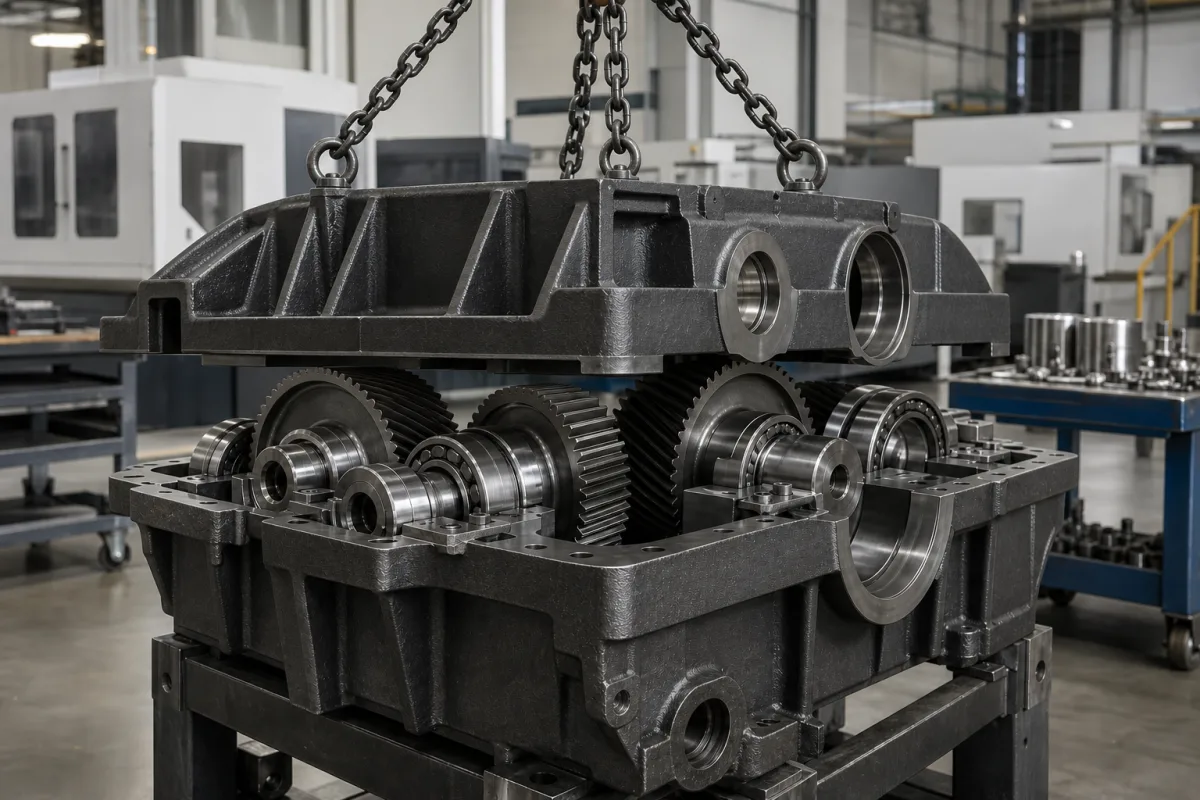
Representative product image. Confirm appearance and specifications with the manufacturer.

Product Specifications

Technical details and manufacturing context for Gear Housing

Definition
A gear housing is the structural component of a main drive gearbox that provides a sealed environment for the gear train, bearings, and lubrication system. It maintains precise alignment of internal components, contains lubricant, protects against contaminants, and often serves as a mounting point for the entire gearbox assembly within machinery. The housing is typically manufactured from cast iron, aluminum alloy, or steel, with material grade selections such as HT250 or QT450 depending on strength and cost requirements. Key parameters include rated torque (500–5000 N·m), gear ratio (5–100), input speed (500–3000 rpm), operating temperature (-20 to 80 °C), ingress protection (IP54–IP65), wall thickness (8–20 mm), weight (50–500 kg), machining tolerance (±0.05 mm), surface roughness (Ra 1.6–3.2 μm), pressure rating (1.0–1.6 MPa), and vibration level (≤4.5 mm/s). These values are reference ranges and must be verified for the specific model and application. The housing is designed to withstand operational loads such as torque, vibration, and thermal expansion while maintaining seal integrity. It is critical for bearing fits and sealing surfaces, and its design must consider factors like lubrication and cooling at higher speeds. The gear housing is a static component that provides rigid support and precise mounting locations for rotating shafts and bearings. It does not move but ensures the gearbox operates reliably under various conditions. For procurement, it is essential to confirm model-specific values and standards with the legal manufacturer or supplier, as the listed standards (e.g., ISO 6336, IEC 60529, GB/T 1348, ISO 2768-m, ISO 1302, ISO 10816) serve as verification references, not proof of certification or compliance.
Working Principle
The gear housing functions as a static structural frame. It does not move but provides rigid support and precise mounting locations for rotating shafts and bearings. It withstands operational loads (torque, vibration, thermal expansion) transmitted from the gears and maintains the sealed integrity necessary for proper lubrication and protection. The housing's design ensures that internal components remain aligned under load, preventing premature wear and failure. It also contains the lubricant, preventing leaks and keeping contaminants out. The housing's material and wall thickness are selected to provide sufficient rigidity and heat dissipation, while machining tolerances and surface roughness are critical for bearing fits and sealing surfaces. Ingress protection ratings indicate suitability for dusty or wet environments. Vibration levels above the specified limit may indicate misalignment or wear, signaling the need for inspection. The housing also serves as a mounting point, transferring loads to the supporting structure.
Common Materials
Cast Iron, Aluminum Alloy, Steel
Technical Parameters
ParameterTypical rangeNotes & selection driver
Rated Torque500–5000 N·mDetermines gearbox size and material selection.ISO 6336
Gear Ratio5–100Customizable per application.
Input Speed500–3000 rpmHigher speeds require better lubrication and cooling.
Operating Temperature-20–80 °COutside range may affect seal integrity and lubricant viscosity.
Ingress ProtectionIP54–IP65Higher IP for dusty or wet environments.IEC 60529
Material GradeHT250–QT450Cast iron for cost, ductile iron for strength.GB/T 1348
Wall Thickness8–20 mmThicker for higher pressure or rigidity.
Weight50–500 kgAffects installation and support structure.
Machining Tolerance±0.05 mmCritical for bearing fits and sealing surfaces.ISO 2768-m
Surface RoughnessRa 1.6–3.2 μmSmoother for sealing surfaces.ISO 1302
Pressure Rating1.0–1.6 MPa
Vibration Level≤4.5 mm/sHigher vibration indicates misalignment or wear.ISO 10816

Ranges are indicative industry figures for RFQ preparation, not a supplier commitment. Confirm every value and standard with the legal manufacturer before ordering.

Components / BOM
  • Mounting Flange Part
    Provides a bolting surface to attach the gearbox to the machine structure.
    Material: Same as housing (e.g., Cast Iron)
  • Bearing Seat Part
    Precision-machined surface that supports and locates the shaft bearings.
    Material: Same as housing
  • Inspection Cover Part
    Removable plate allowing access to internal components for maintenance.
    Material: Steel or Aluminum
  • Oil Drain Plug Part
    Fitting for draining used lubricant from the housing sump.
    Material: Steel
  • Housing Body
    The cast body itself — everything else is a feature machined into or bolted onto it.
  • Shaft Seals
    Keep the lubricant in and contaminants out where the shafts leave the housing.

Applied To / Applications

This component is essential for the following industrial systems and equipment:

Industrial Ecosystem & Supply Chain Structure

Complementary Systems
Downstream Applications
Specialized Tooling

Application Fit & Sizing Matrix

Operational Limits
pressure: Atmospheric to 2 bar (internal pressure from gear operation, venting required for higher)
other spec: Max shaft speed: 5000 RPM, Vibration limit: 5 mm/s RMS, IP rating: IP65 standard
temperature: -40°C to 150°C (operating range, dependent on seal and material selection)
Media Compatibility
✓ Industrial gear oils (ISO VG 68-320) ✓ Synthetic lubricants (PAO/ester based) ✓ Food-grade lubricants (H1 certified)
Unsuitable: High-concentration abrasive slurries (causes seal and bearing wear)
Sizing Data Required
  • Input shaft diameter and keyway dimensions
  • Gear arrangement and number of bearing locations
  • Maximum transmitted torque and service factor

Reliability & Engineering Risk Analysis

Failure Mode & Root Cause
Bearing fatigue failure
Cause: Inadequate lubrication leading to metal-to-metal contact, contamination ingress, or improper alignment causing uneven load distribution
Gear tooth pitting and spalling
Cause: Surface fatigue from cyclic loading exceeding material endurance limit, improper heat treatment, or lubricant breakdown causing insufficient film strength
Maintenance Indicators
  • Unusual high-frequency whining or grinding noises during operation
  • Visible oil leaks around seals or housing joints, especially with metallic particles in leaked fluid
Engineering Tips
  • Implement predictive maintenance with vibration analysis and oil condition monitoring to detect early-stage bearing and gear degradation
  • Establish strict contamination control protocols including proper breathers, seal maintenance, and regular oil analysis with scheduled changes based on operating conditions

Indicative industry ranges for design and RFQ preparation. Confirm the exact figures and applicable standard with the manufacturer before specifying.

Compliance & Manufacturing Standards

Applicable Standards
ISO 1328-1:2013 (Cylindrical gears - System of accuracy) ANSI/AGMA 2000-A88 (Gear Classification and Inspection Handbook) DIN 3961 (Tolerances for cylindrical gear teeth)

Quoted from the published standard.

Manufacturing Precision
  • Bore diameter: +/-0.025mm
  • Mounting surface flatness: 0.08mm
Quality Inspection
  • Dimensional verification with CMM (Coordinate Measuring Machine)
  • Pressure testing for leak detection

Manufacturers of Gear Housing

1 company lists this product among what they make. Company figures are quoted from each company's own website; every card states where the relationship came from.

Shenyang SHSCNC Precision Manufacturing Co., Ltd.
Shenyang, Liaoning, CN
Founded 202190+ staff30,000 m²
ISO 9001 CE
Also makes: Spindle, Drive Shaft, Pump Housing and 5 more
Managed by the manufacturer
Stated by the company

Manufacturer listings support early research and capability understanding. They are not certification, ranking, or transaction guarantees.

Technical documentation
Request current drawings, revision history, and a signed specification sheet.
Manufacturing capability
Verify equipment lists, process limits, capacity, and representative production evidence.
Inspection readiness
Confirm test methods, calibrated equipment, sampling plans, and traceable reports.
Supplier transparency
Check the legal entity, factory address, ownership, certifications, and direct contacts.

CNFX does not score or rank suppliers. Buyers must verify all claims and documents with the legal manufacturer before ordering.

Supply Chain Compatible Machinery & Devices

Hydraulic Press

Industrial machine using hydraulic pressure to compress, form, or assemble materials

Explore Specs →
Heavy-Duty CNC Plasma Cutting Machine

The Heavy-Duty CNC Plasma Cutting Machine is a standalone industrial device designed for cutting conductive metals such as steel, stainless steel, aluminum, and copper alloys.

Explore Specs →
Automated Powder Coating System

Integrated industrial system for applying dry powder coatings to metal substrates.

Explore Specs →
Centrifugal Pump Impeller

The centrifugal pump impeller is a critical rotating component that converts mechanical energy from the motor into kinetic energy in fluid systems.

Explore Specs →

Frequently Asked Questions

What materials are commonly used for gear housings?

Common materials include cast iron, aluminum alloy, and steel. Material grades such as HT250 or QT450 may be specified, depending on strength and cost requirements. The choice affects weight, rigidity, and thermal properties.

What is the typical operating temperature range for a gear housing?

The reference range is -20 to 80 °C. Outside this range, seal integrity and lubricant viscosity may be affected. Always verify the specific model's limits with the manufacturer.

How does ingress protection (IP) rating affect gear housing selection?

Higher IP ratings (e.g., IP65) are suitable for dusty or wet environments, providing better protection against contaminants. The required rating depends on the operating environment.

What does a vibration level above 4.5 mm/s indicate?

According to ISO 10816, a vibration level above 4.5 mm/s may indicate misalignment, wear, or other issues. It is a signal to inspect the gearbox and its mounting.

Data Basis

Editorial classification, named public sources where available, and source-reviewed manufacturer records.

Preliminary Technical Classification
This page supports structured research, RFQ preparation, and supplier evaluation. It does not replace buyer-led supplier qualification, standards review, or technical approval.
Buyer enquiry

Request manufacturing insight for Gear Housing

Ask for use case, specification boundaries, supplier type, and RFQ preparation information for this product.

Where it goes
Straight to the CNFX editorial desk, and to the manufacturer if this product is linked to a claimed profile. Nothing is broadcast to a supplier list.
Your details stay here
We do not sell or rent enquiry data, and we do not add you to a mailing list. Used only to answer this request.
No commission, no middleman
CNFX is a directory. We take no cut of any order and never negotiate on a supplier's behalf.
What we don't claim
A listing is not an endorsement. Qualify every supplier and verify every figure yourself before ordering.

Your business information is used only to process this request.

Thank you! Your message has been sent. We'll respond within 1–3 business days.
Sorry, we couldn't send your message. Please try again, or email us at contact@cnfx.com.

Need to Manufacture Gear Housing?

Compare manufacturer profiles with relevant product and process capability.

Previous Product
Z-axis Ram/Spindle
Last Product
Get QuotesChat