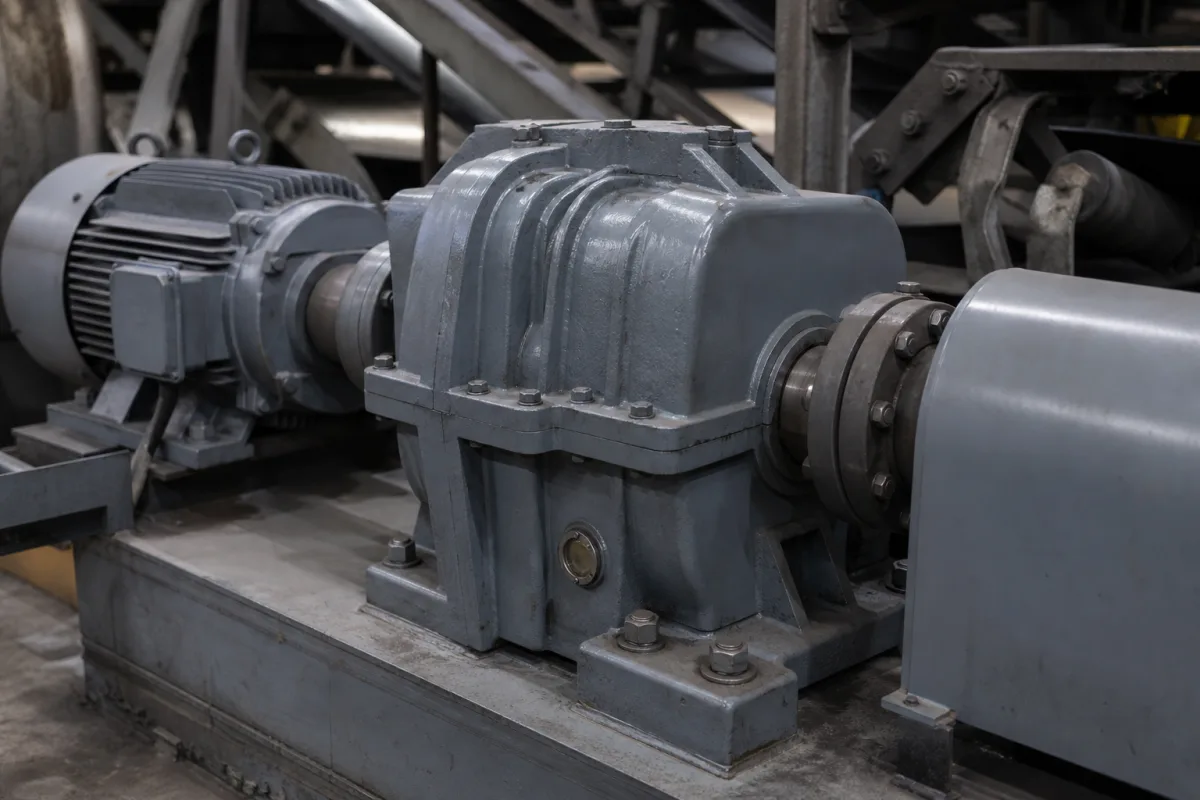
An industrial gear reducer has two ratings. The mechanical rating, checked with a service factor, says whether gears and bearings survive the torque; the thermal rating says how much power the unit can pass continuously before its oil runs too hot. On a large conveyor drive like the one illustrated, in a warm and dusty plant, the second one can decide the unit. This page follows the thermal check as SEW-EURODRIVE's X..e documentation and Elecon's EON catalogue set it out, each with a belt-conveyor example.
Covers the thermal check of industrial helical and bevel-helical gear reducers: thermal rating against operating power, correction factors for ambient temperature, altitude, air velocity, oil type, sump temperature limit and running time, and the cooling steps from fan to cooling coil and external oil cooler. Sizing by torque and AGMA service factor, overhung load and mounting is on Gear Reduction Unit (4534); gear-motor ratio, service factor and worm vs helical efficiency on Drive Assembly Gear Motor (4239); split-housing ZQ/ZSY reducers on Gearbox Speed Reducer (4786); conveyor backstops and fluid couplings on Drive Unit (3344); temperature de-rating of hot-air fans, a different machine, on Circulation Fans (4164).
CNFX editorial research · Sources checked October 13, 2026 · 6 sources
Thermal rating times its factors: at 40 °C on mineral oil, 54% of the 20 °C figure
SEW-EURODRIVE defines the thermal rating PT as the power a gear unit can transmit continuously without exceeding a specific oil temperature, and the operating power PK1 must not exceed it. Its selection tables apply only at 20 °C ambient, in a large hall with air velocity of at least 1.4 m/s, on a steel support structure, below 1000 m, with self-cooling or a fan [1]. Everything else is a factor.
SEW's altitude factor f1 is 1.00 up to 999 m, then 0.95, 0.91, 0.87 and 0.83 for each further 1000 m band to 5000 m [4]. Elecon's altitude factor B3 runs from 1.15 at sea level to 0.90 at 1500 m and 0.68 at 5250 m. SEW's ratings start from 20 °C and Elecon's from 25 °C, so one maker's factors are not applied to the other's ratings.
Oil choice is the largest lever in SEW's table. At 40 °C the synthetic oil keeps 0.70 against 0.54 for the mineral oil, 30% more thermal rating from the same housing (Editorial calculation) [3]. Stacked with altitude, a unit at 1500 m and 40 °C on mineral oil keeps 0.95 × 0.54 = 0.51 of its table value (Editorial calculation).
Elecon adds three factors SEW handles elsewhere: air velocity B2 (0.75 at 0.5 m/s or less, 1.00 up to 1.4 m/s, 1.40 above that, 1.90 at 3.7 m/s or more), the allowed sump temperature B4 (0.81 at 85 °C, 1.00 at 95 °C, 1.13 at 105 °C, with Elecon warning that running above 95 °C may shorten lubricant and seal life), and running time per hour ED (1.00 continuous, 1.05 at 80%, 1.35 at 40%, 1.80 at 20%).
Ambient °C
10
20
30
40
50
SEW fT, GearOil Base 320 (mineral)
0.92
0.80
0.67
0.54
0.41
SEW fT, GearOil Synth 320
1.15
1.00
0.85
0.70
0.55
Elecon B1, no extra cooling or fan (25 °C = 1.00)
1.15
1.07 (18 °C)
0.93
0.83
0.67
Elecon B1, with cooling coil
1.05
1.03 (18 °C)
0.97
0.87
0.81
SEW states that results from fT and fL are approximate and that exact values come from SEW; outdoors, direct sunlight has to be shielded or included in the calculation in kW/m².
02
Two belt-conveyor checks: 550 kW at 40 °C needs a cooling coil, 141.4 kW needs a fan
Both catalogues work their thermal example on a belt conveyor, and both conclude that the mechanically correct unit is too hot without help.
The gap is wide: the bare unit passes 232 kW thermally against 951 kW mechanically, so at 40 °C its thermal capacity is under a quarter of its mechanical one (Editorial calculation). Even if the conveyor ran only 40% of each hour, ED 1.35 would lift the bare unit to about 313 kW (244 × 0.95 × 1.35), still short of 550 (Editorial calculation).
SEW's X..e belt-conveyor example reaches the same verdict at a smaller size: operating power 141.4 kW against a thermal rating of 103 kW at 40 °C, so the unit is not sufficient without additional cooling, and the check passes once a fan is fitted [2].
Step (Elecon EON example)
Value
Drive
600 kW motor at 1500 rpm; heavy rubber-belt conveyor absorbing 550 kW at 60 rpm; 12 h/day, 1 start/h, ED 100%
In the Elecon example the fan case uses B1 = 0.87, which Table 4B gives for units with a cooling coil; Table 4A gives 0.83 for units with a fan. With 0.83 the fan case is 431 × 0.95 ≈ 410 kW (Editorial calculation), and the conclusion, a cooling coil, does not change.
03
Fan, cooling coil, both, then an oil cooler sized on power loss
Elecon lists the steps in order and gives each a thermal capacity at 25 °C and 100% running time: P1 without additional cooling, P2 with fan, P3 with built-in cooling coil, P4 with cooling coil and fan, and an external oil cooler when the absorbed power is still above P4 × FW.
SEW sizes circulation cooling from the power loss PV, worked out from the operating power at the high-speed shaft and the efficiency, and lists what else decides the choice: cooling-water temperature and flow, ambient temperature, and a ratio of oil quantity in the gear unit to the cooler's oil flow above 2 [5]. Read in litres and litres per minute, a unit holding 300 L of oil would take a circulation flow below 150 L/min (Editorial calculation).
Steps 3 to 5 bring water or extra pipework to the drive, so the step a duty needs is worth knowing before the site layout is fixed.
Step
Elecon condition
SEW options named
1. Natural cooling
Pe ≤ P1 × FW
Self-cooling, table value × factors
2. Fan
Pe ≤ P2 × FW
Fan cooling (also in the selection tables)
3. Cooling coil
Pe ≤ P3 × FW
Water cooling cover or water cooling cartridge
4. Coil and fan
Pe ≤ P4 × FW
—
5. External cooling
External oil cooler when Pe ≥ P4 × FW
Circulation cooling, sized so that the cooling capacity exceeds the gear unit's power loss PV
The 300 L figure is an example for the ratio only; take the oil quantity from the reducer's own data.
04
What a reducer quotation should state on heat
Paste it into your enquiry below or into an email to a maker, then replace every bracket.
Give absorbed power and speed, running time per hour, starts per hour, ambient temperature range, altitude, air speed or enclosure, sun exposure, and the oil you intend to use. Ask the supplier for the thermal rating with and without fan, cooling coil and oil cooler at your conditions, the correction factors applied, the maximum allowed sump temperature, the power loss at your operating point, and the water or oil flow any cooler needs.
12 companies list this product among what they make. Company figures are quoted from each
company's own website; every card states where the relationship came from.
Hangzhou ANG Drive Co., Ltd.
TBC
ANG Drive's NMRV page lists worm gear reducers alongside helical gearbox ranges. Thermal ratings and cooling options are not shown on the page; TBC. Location TBC.
FLK Drive's site offers helical gearmotors and parallel-shaft gear units among its gear reducer ranges. Whether thermal ratings with fan or cooling coil are published per size is TBC; location TBC.
HZPT's china-reducers.com lists speed reducers and gearboxes, among them helical, worm and planetary types and right-angle servo worm gearheads. Thermal data TBC; location TBC.
Dezhou Jinmai lists speed reducers (worm, cycloid and planetary types) next to screw jacks and agitators. Thermal ratings not stated; TBC. Location TBC.
SigGear's range is small gear motors, micro planetary gear motors and cycloidal pinwheel reducers, a size class well below the conveyor units discussed here. Ratings TBC; location TBC.
Guorui lists hydraulic valves, pumps and motors; its product pages also carry gearboxes including a Cyclo drive gear reducer. Ratings TBC; location TBC.
APEX Group lists reducers within its oilfield range of pumping units, top drives and mud pumps. Thermal and torque data for the reducers are TBC; location TBC.
Explore company information and manufacturing capabilities, then discuss the scope of your project with a relevant supplier.
Share this page
Compiled and source-reviewed by the CNFX editorial team.
Each manufacturer above links to the page on that company's own website where the product is listed, with the date we checked it. How we source and review
· Page last updated 13 October 2026
Buyer questions
What is the thermal rating of a gear reducer?
SEW-EURODRIVE defines it as the power the unit can transmit continuously without exceeding a specific oil temperature; operating power must not exceed it. [1]
How much does a 40 °C ambient cost?
In SEW's table the temperature factor at 40 °C is 0.54 with its mineral GearOil Base 320 and 0.70 with GearOil Synth 320, against 0.80 and 1.00 at 20 °C. [3]
Does altitude matter?
Yes. SEW's altitude factor drops from 1.00 below 1000 m to 0.83 at 4000–5000 m; Elecon's B3 drops from 1.15 at sea level to 0.68 at 5250 m on its own base condition. [4][6]
When does a reducer need a cooling coil instead of a fan?
In Elecon's heavy belt-conveyor example, 550 kW at 40 °C exceeds the fan-cooled capacity of 431 kW but not the 708 kW with a built-in cooling coil, so the K3-26A is supplied with the coil. [6]
How is an external oil cooler sized?
SEW sizes circulation cooling so its capacity exceeds the gear unit's power loss, and asks for a ratio of oil quantity in the unit to cooler oil flow above 2. [5]
What does SEW's own conveyor example show?
A belt-conveyor unit with 141.4 kW operating power and a 103 kW thermal rating at 40 °C fails without additional cooling and passes with a fan. [2]
Sources and what still needs a direct check
Sources checked 2026-10-13. Five pages of SEW-EURODRIVE's X..e series project-planning documentation and Elecon's EON series catalogue as hosted by Radicon.