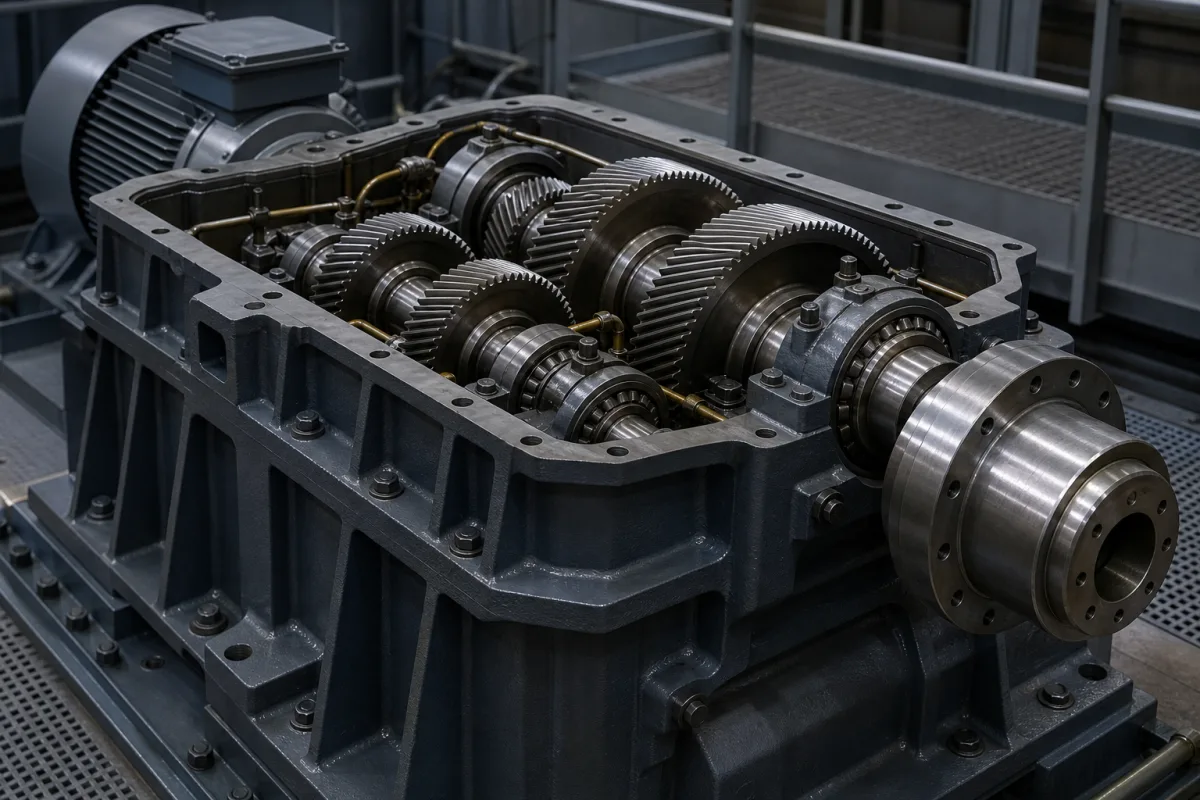
Horizontally split cast-iron gear reducers · ZQ/JZQ two-stage ratio series, soft-tooth versus carburised hard-tooth gearing, parting-face and contact-pattern checks, gear oil by pitch-line speed
A split-housing cylindrical gear reducer is a cast-iron box divided horizontally through the shaft centre lines, with two or three parallel shafts carrying spur or helical gears in rolling bearings. Lifting the cover exposes every gear and bearing, which is why the type is used where a reducer is repaired in place on a hoist, conveyor or mill. Chinese standard families include the older ZQ/JZQ soft-tooth series and the carburised and ground hard-tooth series such as ZSY. The buying questions are the nominal ratio and the input speed, the tooth hardness class, the pitch-line speed the gearing is rated for, the output shaft end, and how the unit is lubricated and cooled.
Horizontally split, foot-mounted two- and three-stage parallel-shaft cylindrical gear reducers of the ZQ/JZQ soft-tooth and ZSY-type hard-tooth families for lifting, conveying, mining and process drives. Modular helical and helical-bevel catalogue reducers supplied with or without a motor adapter are covered on the Gear reduction unit page; inline planetary reducers, hydraulic planetary winch drives, worm gear reducers and vehicle transmissions are separate products.
CNFX editorial research · Sources checked October 12, 2026 · 3 sources
ZQ/JZQ two-stage reducers: nine ratios from 8.23 to 48.57 and a 10 m/s pitch-line limit
Shuduo, a maker of the series, describes ZQ and JZQ cylindrical gear reducers as two-stage units for lifting, mining, chemical, textile and light-industry drives. There are nine assembly types; the input shaft end is conical, and the output shaft comes in three designs: cylindrical (Z type), gear type (CA/C type) and European coupling (F type). [1]
Editorial calculation: at the 1,500 r/min input limit, the standard ratios give output speeds from about 30.9 r/min (1,500 ÷ 48.57) to about 182 r/min (1,500 ÷ 8.23); the largest extended ratio, 317.28, gives about 4.7 r/min. A hoist or conveyor that needs an output speed outside that band at a 4-pole motor speed points to the extended three-stage version or a different reducer family.
The Shuduo page does not state the tooth hardness or the rated power for each size; ask for the gear material and heat treatment of pinion and wheel, and the power rating at your input speed and duty.
State the model size, nominal ratio, assembly type (which side the input and output shafts leave), output shaft end (Z, CA/C or F), input speed, motor power and the duty (hoist, conveyor, continuous or intermittent).
02
Soft-tooth ZQ gearing versus carburised and ground hard-tooth units
For its ZSY hard-tooth reducers the same maker states gears of low-carbon alloy steel, carburised, quenched and CNC ground to a tooth surface hardness of HRC 54 to 62, with a pitch-line speed of up to 20 m/s, twice the ZQ limit, at the same 1,500 r/min input limit and an ambient range of −40 to 50 °C, with the oil preheated when below 0 °C. [2][1]
A Chinese group standard for hard-tooth gear reducers, published as a 2025 consultation draft by the China Commercial Enterprise Management Association, draws the line at tooth hardness: it applies to reducers in which every transmitting gear has a tooth surface hardness above 35 HRC. It asks for HT250 grey-iron housings, gears and pinion shafts forged to at least 20CrMnTi properties, carburised and quenched gears, quenched-and-tempered shafts at 255 to 286 HB, ISO grade 5 tooth flank accuracy under GB/T 10095.1-2022 and a flank roughness of Ra 0.8 µm or less. [3]
The draft's limits on operation, a high-speed shaft of no more than 1,500 r/min, a pitch-line speed of no more than 20 m/s, ambient −40 to 45 °C and suitability for both directions, line up with the ZSY figures above. [3] Editorial note: because the draft is not yet a published standard, quote it as a reference for what to ask, and ask a supplier which standard its reducer is actually built and tested to.
Shuduo lists oil-bath lubrication with natural cooling for the ZSY, with circulating oil lubrication, or a fan and cooling coil, where the thermal power rating is not enough for the application. [2]
Ask for tooth surface and core hardness of each gear, the heat treatment route, the flank accuracy grade, and the thermal power rating at your ambient temperature.
03
Checks on the split line: parting-face gap, bearing bores on the joint, contact pattern and factory tests
The split housing is only as good as the fit of its two halves. The ACCEM draft sets assembly checks that apply to any horizontally split reducer: with cover and base resting freely together, a 0.05 mm feeler gauge must not enter the parting face, and where the reducer has a parting face the bearing bore centre lines must lie on it within 0.3 mm. [3]
The draft splits these into routine tests on every unit (appearance, parting face, lubrication, noise, no-load running) and type tests on a sample (gears and shafts, bearing clearance, backlash, contact pattern, temperature rise, cleanliness, efficiency and overload). [3] When buying, ask which of these are recorded for your unit and which only for the type.
Gear oil grade by pitch-line speed, temperature rise and the first oil change
In the ACCEM draft, gears and bearings are splash-lubricated from the oil sump with natural cooling, and the oil viscosity is chosen by the pitch-line speed V of the high-speed stage. [3]
The same draft limits surface temperature rise in operation to 45 K and oil temperature to 85 °C. [3] Editorial calculation: pitch-line speed is π × pitch diameter × speed ÷ 60,000; a high-speed pinion of 100 mm pitch diameter at 1,500 r/min runs at about 7.9 m/s, inside the 10 m/s ZQ limit and in the VG220/VG320 band. Use the actual pinion pitch diameter from the supplier's drawing.
Shuduo's maintenance instructions for its ZQ reducers are to check the oil level once a month or every 500 operating hours, change the oil first after 36 hours of running to remove running-in wear metal, and then every 2,000 to 5,000 hours or 6 to 12 months depending on environment and load, sooner in heat, dust or continuous heavy load. Sudden noise, vibration, temperature rise or severe oil leakage are reasons to stop the reducer for inspection. [1]
Ask for the oil grade and fill volume for your mounting, the expected oil temperature at your duty, and whether a cooling coil, fan or circulating oil system is needed.
05
Data for a split-housing gear reducer quotation
Paste it into your enquiry below or into an email to a maker, then replace every bracket.
Drive: [motor power kW; input speed r/min; required output speed or ratio]
Duty: [hoist, conveyor, mill or process; hours per day; starts per hour; reversing]
Reducer: [family (ZQ/JZQ, ZSY or other); size; assembly type; output shaft end]
Gearing: [tooth hardness class; heat treatment; flank accuracy grade]
Lubrication: [oil bath, cooling coil, fan or circulating oil; ambient temperature range]
Tests and documents: [parting-face and contact-pattern records; noise; efficiency; overload type test; standard built to]
Explore company information and manufacturing capabilities, then discuss the scope of your project with a relevant supplier.
Share this page
Compiled and source-reviewed by the CNFX editorial team.
Each manufacturer above links to the page on that company's own website where the product is listed, with the date we checked it. How we source and review
· Page last updated 13 October 2026
Buyer questions
What ratios do ZQ/JZQ reducers come in?
Shuduo lists nine standard ratios from 48.57 to 8.23 for the two-stage units, and extended ratios up to 317.28 by adding a high-speed stage. [1]
How do hard-tooth reducers differ from ZQ soft-tooth units?
Shuduo's ZSY hard-tooth gears are carburised, quenched and ground to HRC 54–62 and rated to 20 m/s pitch-line speed, against 10 m/s for its ZQ series; a 2025 group-standard draft defines hard-tooth reducers as those with every gear above 35 HRC. [2][1][3]
What is checked on a split housing?
The ACCEM draft requires that a 0.05 mm feeler not enter the parting face and that bearing bore centre lines lie on the joint within 0.3 mm, with a tooth contact pattern of at least 70% of height and 90% of length. [3]
Which gear oil does a split-housing reducer use?
The ACCEM draft chooses medium-load gear oil by high-speed stage pitch-line speed: VG320 in winter and VG460 in summer at up to 2.5 m/s, VG220 and VG320 above it. [3]
Sources and what still needs a direct check
Sources checked 2026-10-12. Shuduo is a Chinese reducer maker describing its own ZQ/JZQ and ZSY series. The ACCEM text is a 2025 consultation draft of a group standard for hard-tooth gear reducers, drafted by a reducer maker; its figures are proposed requirements, not a published standard.