Industry-Verified Manufacturing Data (2026)

Oscillation Drive Unit

Based on aggregated insights from multiple verified factory profiles within the CNFX directory, the standard Oscillation Drive Unit used in the Basic Metal Manufacturing sector typically supports operational capacities ranging from standard industrial configurations to heavy-duty production requirements.

Technical Definition & Core Assembly

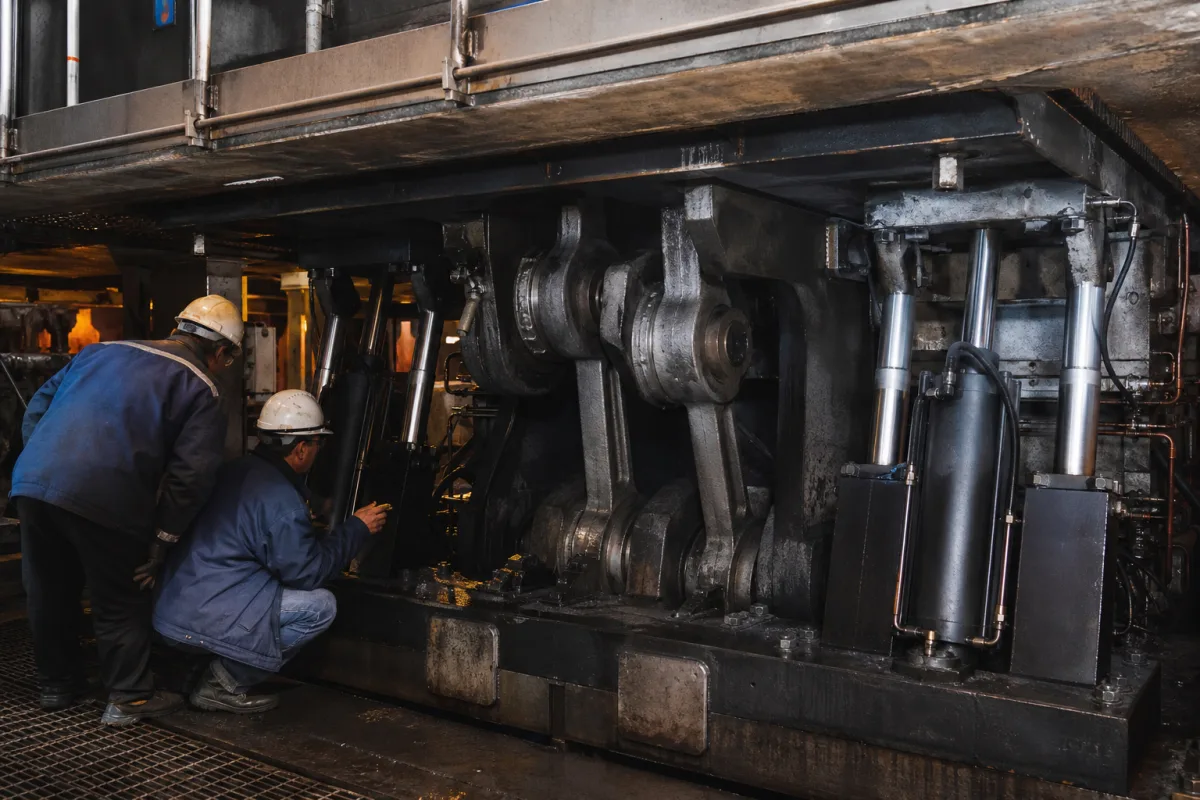
A canonical Oscillation Drive Unit is characterized by the integration of Drive Motor and Eccentric Shaft / Crank. In industrial production environments, manufacturers listed on CNFX commonly emphasize Alloy Steel construction to support stable, high-cycle operation across diverse manufacturing scenarios.

A mechanical or electromechanical assembly that generates and transmits controlled oscillatory motion to the mold in a continuous casting system.
Product Specifications

Technical details and manufacturing context for Oscillation Drive Unit

Definition
The Oscillation Drive Unit is a critical component of the Heavy-Duty Continuous Casting Mold Oscillator. Its primary function is to impart a precise, reciprocating motion to the continuous casting mold. This oscillation is essential for preventing the newly solidified steel shell from sticking to the mold's inner walls, ensuring smooth billet/slab withdrawal, improving surface quality, and extending mold life. The unit typically converts rotary input from a motor into the required linear or near-linear oscillatory output.
Working Principle
The unit operates by converting rotational power from an electric motor into controlled linear oscillation. This is commonly achieved through a crank or eccentric mechanism, often coupled with a lever arm or connecting rod system. The motor's rotation drives the crank, which in turn moves the lever arm connected to the mold table or mold itself, creating a sinusoidal or non-sinusoidal reciprocating motion. The stroke length and frequency are precisely controlled to match the casting speed and steel grade requirements.
Common Materials
Alloy Steel, Cast Iron, Bronze Bushings
Technical Parameters
  • Oscillation Stroke (peak-to-peak amplitude) (mm) Per Request
Components / BOM
  • Drive Motor
    Provides the rotational power input to the oscillation mechanism.
    Material: Various (Housing: Cast Iron/Steel)
  • Eccentric Shaft / Crank
    Converts the motor's rotary motion into an eccentric, off-center rotation to generate oscillation.
    Material: Forged Alloy Steel
  • Connecting Rod / Lever Arm
    Transmits the motion from the eccentric shaft to the mold table or mold holder.
    Material: Alloy Steel
  • Main Bearings
    Support the eccentric shaft and allow for smooth rotation under heavy load.
    Material: Bearing Steel with Bronze/PTFE Liners
  • Gearbox / Speed Reducer
    Adjusts the motor speed to achieve the required oscillation frequency and increases torque.
    Material: Cast Iron Housing, Alloy Steel Gears
Engineering Reasoning
0.5-3.0 Hz oscillation frequency, 10-100 mm amplitude, 20-80°C operating temperature
Bearing fatigue failure at 1×10^7 cycles (ISO 281 L10 life), gear tooth bending stress exceeding 400 MPa (AGMA 2001-D04), motor winding insulation breakdown at 150°C (IEC 60085 Class F limit)
Design Rationale: High-cycle fatigue from alternating torsional loads exceeding material endurance limit (σ_e = 0.5×σ_UTS per Goodman criterion), thermal degradation of lubricant viscosity below 68 cSt at 40°C (ISO VG 68 minimum)
Risk Mitigation (FMEA)
Trigger Lubricant film thickness reduction below 1 μm (Stribeck curve boundary lubrication regime)
Mode: Accelerated bearing wear with vibration amplitude exceeding 4.5 mm/s RMS (ISO 10816-3 severity threshold)
Strategy: Forced oil circulation system with 10 μm filtration and temperature control maintaining 40-60°C
Trigger Resonance excitation at 2.8 Hz matching system natural frequency (modal analysis identified)
Mode: Amplitude magnification exceeding 5× design limits causing structural fatigue cracks
Strategy: Tuned mass damper with 15% critical damping ratio and stiffness tuned to 2.5 Hz (10% below resonance)

Industry Taxonomies & Aliases

Commonly used trade names and technical identifiers for Oscillation Drive Unit.

Industrial Ecosystem & Supply Chain DNA

Complementary Systems
Downstream Applications
Specialized Tooling

Application Fit & Sizing Matrix

Operational Limits
pressure: 0 to 10 bar
temperature: -20°C to 120°C
stroke length: 0 to 30 mm
slurry concentration: Up to 60% solids by weight
oscillation frequency: 0 to 300 cpm
Media Compatibility
✓ Molten steel (continuous casting mold) ✓ Water-based mold fluxes ✓ Lubricating oils/greases (internal components)
Unsuitable: Highly corrosive chemical environments (e.g., strong acids, chlorides)
Sizing Data Required
  • Required oscillation frequency (cpm)
  • Required stroke length (mm)
  • Mold size/weight and required force (N)

Reliability & Engineering Risk Analysis

Failure Mode & Root Cause
Bearing fatigue and seizure
Cause: Inadequate lubrication leading to metal-to-metal contact, contamination ingress, or misalignment causing uneven load distribution and overheating.
Gear tooth pitting and spalling
Cause: Cyclic loading beyond design limits, improper meshing due to alignment issues, or surface fatigue from contaminated lubricant causing micro-cracks and material loss.
Maintenance Indicators
  • Abnormal high-frequency vibration or audible grinding noise during operation
  • Visible oil leaks around seals or housing, especially with metallic particles in leaked fluid
Engineering Tips
  • Implement condition-based lubrication with filtered oil and regular oil analysis to monitor wear metals and contamination levels
  • Use laser alignment tools during installation and periodic checks to ensure proper shaft alignment, reducing parasitic loads on bearings and gears

Compliance & Manufacturing Standards

Reference Standards
ISO 1940-1:2003 (Mechanical vibration - Balance quality requirements for rotors in a constant (rigid) state) ANSI/ASME B46.1-2009 (Surface Texture, Surface Roughness, Waviness, and Lay) DIN 5480-1:2006 (Splined connections with involute splines based on reference diameters - Part 1: Principles)
Manufacturing Precision
  • Bearing bore diameter: +/-0.015 mm
  • Shaft runout: 0.05 mm maximum
Quality Inspection
  • Vibration analysis test (to ISO 10816 series for operational vibration levels)
  • Hardness and material verification test (using Rockwell or Brinell methods per ASTM E18/E10)

Factories Producing Oscillation Drive Unit

Verified manufacturers with capability to produce this product in China

✓ 95% Supplier Capability Match Found

P Project Engineer from Brazil Feb 18, 2026
★★★★★
"Found 11+ suppliers for Oscillation Drive Unit on CNFX, but this spec remains the most cost-effective."
Technical Specifications Verified
S Sourcing Manager from Canada Feb 15, 2026
★★★★★
"The technical documentation for this Oscillation Drive Unit is very thorough, especially regarding technical reliability."
Technical Specifications Verified
P Procurement Specialist from United States Feb 12, 2026
★★★★★
"Reliable performance in harsh Basic Metal Manufacturing environments. No issues with the Oscillation Drive Unit so far."
Technical Specifications Verified
Verification Protocol

“Feedback is collected from verified sourcing managers during RFQ (Request for Quote) and factory evaluation processes on CNFX. These reports represent historical performance data and technical audit summaries from our B2B manufacturing network.”

5 sourcing managers are analyzing this specification now. Last inquiry for Oscillation Drive Unit from USA (10m ago).

Supply Chain Compatible Machinery & Devices

Vacuum Induction Melting Furnace

Industrial furnace for melting metals under vacuum using electromagnetic induction

Explore Specs →
Electroslag Remelting Furnace

Secondary refining furnace for high-quality metal ingots

Explore Specs →
Molten Metal Flow Control Valve

Precision valve for regulating molten metal flow in casting and pouring operations.

Explore Specs →
Molten Metal Temperature Measurement System

Automated system for continuous temperature monitoring of molten metals during processing.

Explore Specs →

Frequently Asked Questions

What is the primary function of an oscillation drive unit in continuous casting?

The oscillation drive unit generates and transmits controlled oscillatory motion to the mold in a continuous casting system, preventing the solidified metal shell from sticking to the mold walls and ensuring smooth casting operations.

What materials are typically used in oscillation drive unit construction?

Oscillation drive units are commonly constructed from alloy steel for structural components, cast iron for housings and frames, and bronze bushings for bearing surfaces to withstand high loads and continuous operation in metal manufacturing environments.

How does the eccentric shaft/crank component function in the oscillation drive unit?

The eccentric shaft or crank converts the rotary motion from the drive motor into controlled oscillatory motion through its offset design, working in conjunction with the connecting rod/lever arm to create the precise back-and-forth movement required for mold oscillation.

Can I contact factories directly on CNFX?

CNFX is an open directory, not a transaction platform. Each factory profile provides direct contact information and production details to help you initiate direct inquiries with Chinese suppliers.

Get Quote for Oscillation Drive Unit

Request technical pricing, lead times, or customized specifications for Oscillation Drive Unit directly from verified manufacturing units.

Your business information is encrypted and only shared with verified Oscillation Drive Unit suppliers.

Thank you! Your message has been sent. We'll respond within 1–3 business days.

Need to Manufacture Oscillation Drive Unit?

Connect with verified factories specializing in this product category

Add Your Factory Contact Us
Previous Product
Oscillation Actuator
Next Product
Oscillation Mechanism