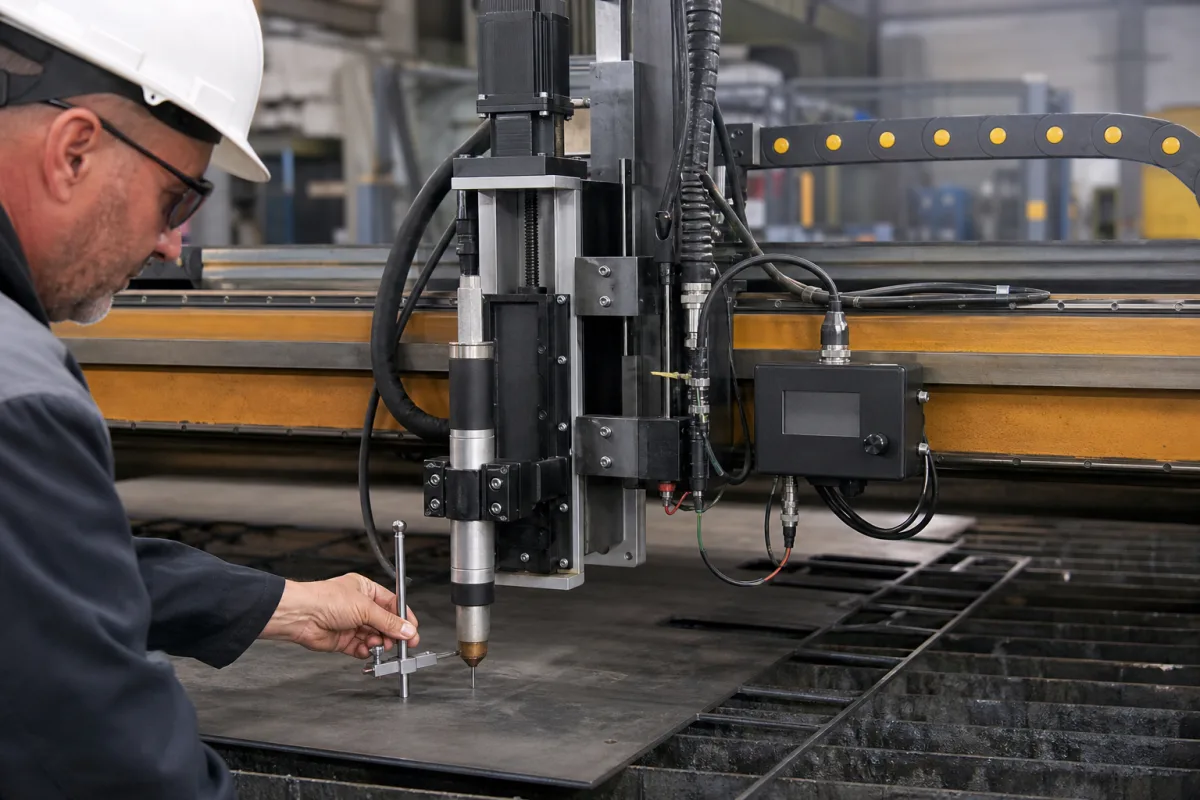
Plasma torch height controller: the arc-voltage control unit and Z lifter that keep the torch at cut height
Arc-voltage torch height control for CNC plasma cutting · set voltage and divider, initial height sensing, anti-dive locking at corners, and the Z lifter's stroke, speed and payload
A plasma arc gets longer as the torch rises and its voltage rises with it, so a controller that watches arc voltage can tell how high the torch is while it cuts. A torch height controller (THC) uses that: it finds the plate before the arc starts, raises the torch to pierce height, then drives a motorised Z slide up or down to keep the arc voltage at a set value. This page covers that control unit and its lifter as a component bought for, or retrofitted to, a cutting machine.
Torch height controllers for mechanized plasma cutting: arc-voltage control units with their voltage dividers, initial height sensing (ohmic, retaining-cap, proximity and float-switch), anti-dive logic, and the motorised Z lifters and breakaway mounts they drive. The complete machine with gantry, drives and cutting table is covered on the CNC gantry plasma cutting machine page; the power source on the Plasma power supply page; the torch and its consumables on the Cutting torch for CNC plasma machines page; slat beds and water or downdraft chambers on the Plasma cutting table page.
CNFX editorial research · Sources checked October 12, 2026 · 3 sources
Arc voltage as the height signal: set range, step size and the 50:1 divider
HYD's PTHC-200DC manual states that the set arc voltage decides the torch height during cutting — the higher the voltage, the higher the torch — and that it should be set from the plasma maker's parameters for the plate thickness and speed. The unit reads 35–250 V (adjustable) through a PTHC-DIV50 divider at 50:1, with an accuracy of ±1 V to ±2 V. [2]
Hypertherm says that conventional controls need the operator to adjust arc voltage from time to time as consumables wear, and that its Sensor THC samples arc voltage and adjusts the set voltage over the life of the consumables without operator input. [1] In LinuxCNC's QtPlasmaC, the same idea appears as Use Auto Volts: the cut voltage is sampled at the end of the THC delay and becomes the target. A Threshold sets how far the voltage may drift from target before the THC moves, and Height Per Volt sets the distance for one volt, used for manual height changes. [3]
Editorial calculation: at the 50:1 ratio of the PTHC-DIV50, a 150 V cutting arc arrives at the controller as 3 V, and the ±1 V accuracy claimed at the arc corresponds to 0.02 V at the divided signal. That small signal is why the HYD manual asks for shielded twisted-pair cable from the controller to the divider, with the shield connected at the controller end, and a ground resistance of 1 Ω or less. [2]
AC 24 V ±10% or DC 24 V (18–30 V); −10 to 60 °C [2]
Give the THC supplier the plasma system model and whether it has a built-in divided-voltage output, the arc voltage range of the cut charts you will run, the CNC model and its THC interface, and the cable length from the plasma source to the controller.
02
Finding the plate before the arc starts: ohmic, retaining-cap, proximity and float-switch sensing
Arc voltage only exists once the arc is cutting, so the controller first needs a separate way to find the plate. Hypertherm's Sensor THC does initial height sense (IHS) by ohmic contact or by position-error stall detection, and can skip IHS where the part geometry and plate allow. [1]
The PTHC-200DC runs IHS at two speeds: after the arc-start signal it lowers the lifter for 1 second (adjustable), then drops to a quarter of that speed to touch the plate, which the manual says raises IHS precision and protects the retaining cap. If the torch touches the plate at any time, in manual or auto mode, the unit lifts it back to IHS height. [2]
QtPlasmaC's setup notes give a worked figure for the float switch: if the switch takes 4 mm to activate, set the Z minimum to 5 mm plus an allowance for overrun, or allow 5 mm below the lowest slat. Its final probe-up speed defaults to 0.001 mm per servo cycle and can be raised by up to a factor of 10, at the cost of a slightly different final height that must be re-tested. [3]
IHS method
How it is described
Ohmic contact / torch retaining cap
Torch shield or cap touches the plate and closes a circuit; PTHC-200DC supports it with any HF plasma [2]
Proximity switch
NPN proximity switch, a backup for dirty or rusty plate in the PTHC-200DC kit [2]
Stall detection
Lifter servo detects position error when the torch stops on the plate [1]
Float switch
Torch mount slides on contact and trips a switch; in QtPlasmaC it doubles as breakaway when not probing [3]
Ask which IHS methods the controller supports with your torch, whether ohmic sensing works with your shields and water table, and what fallback it uses when ohmic contact fails on painted or rusty plate.
03
Stopping torch dive at corners, holes and voids
When the machine slows for a corner, arc voltage changes even though the torch height has not, and a controller that keeps correcting will drive the torch into the plate. HYD's manual says auto height control should only work when cutting speed is over 90% of full speed, and that the CNC should send a corner signal to freeze it at arc start, arc end, corners and acceleration. [2]
QtPlasmaC does not activate the THC until the velocity reaches 99.9% of the cut feed rate and any THC delay has run out, to let the arc voltage settle. If the cut velocity then falls below the Velocity Anti Dive (VAD) threshold, set as a percentage of cut feed rate, the THC locks until the velocity is back at 99.9%. A second lock, Void Anti Dive, trips on the rate of change of cut voltage, set in volts per second. [3]
Hypertherm lists automatic kerf crossing detection and a torch-height disable among the Sensor THC's programmable process parameters. [1] The HYD unit adds a fourth condition before auto mode engages: the actual arc voltage must not be more than 30 V above the set voltage. [2]
Editorial note: the 90% (HYD) and 99.9% (QtPlasmaC) figures are different products' thresholds for switching height control on, not a standard; ask the controller supplier how the lock is triggered — CNC corner signal, measured velocity, voltage slope — and whether it works without a corner signal from your CNC.
04
The Z lifter: 241 mm stroke and 15,200 mm/min on one, 1–4 m/min on another
Hypertherm's published Sensor THC lifter data give the mechanical limits of one industrial lifter. [1]
Editorial calculation: 15,200 mm/min is about 253 mm/s, so the Sensor lifter could run its full 241 mm stroke in about 0.95 s; a 50 mm retract takes about 0.20 s. At the PTHC-200DC's 4 m/min upper lifter speed (about 67 mm/s), the same 50 mm takes 0.75 s. Lifter speed therefore adds directly to the time between cuts on nested parts with a pierce for every contour, which is what Hypertherm's Rapid Part feature targets. [1][2]
1–4 m/min (contact supplier above 4 m/min); supports cutting speeds up to 12,000 mm/min [2]
State the torch model and its weight with leads, the stroke needed for pierce height plus clearance over tipped parts, the required retract speed, and the breakaway force wanted.
05
What to send for a torch height controller quote
Paste it into your enquiry below or into an email to a maker, then replace every bracket.
Plasma: [source model; divided arc voltage output yes/no; current range]
Torch: [model; mass with leads; mounting block size]
CNC: [model; THC interface; corner/THC-disable signal available]
IHS: [ohmic, retaining-cap, proximity or float switch]
Lifter: [stroke; speed; payload; breakaway]
Cutting: [plate thickness range; max cut speed]
Power and site: [24 V supply; cabinet temperature; cable lengths]
Explore company information and manufacturing capabilities, then discuss the scope of your project with a relevant supplier.
Share this page
Compiled and source-reviewed by the CNFX editorial team.
Each manufacturer above links to the page on that company's own website where the product is listed, with the date we checked it. How we source and review
· Page last updated 13 October 2026
Buyer questions
How does a plasma torch height controller measure height?
It compares arc voltage with a set value; HYD's PTHC-200DC manual says a higher set voltage gives a higher torch, and Hypertherm's Sensor THC works over 50–300 VDC in 0.5 V steps. [2][1]
Why does a THC need a voltage divider?
To bring arc voltage down to a signal level; the PTHC-200DC uses a 50:1 PTHC-DIV50 divider in the plasma or CNC cabinet. [2]
What is initial height sensing?
Finding the plate before the arc starts, by ohmic or retaining-cap contact, a proximity switch, a float switch or servo stall detection. [2][1][3]
What stops the torch diving into the plate at corners?
An anti-dive lock: HYD says auto height control should run only above 90% of full speed with a CNC corner signal; QtPlasmaC locks the THC below a set percentage of cut feed rate. [2][3]
Sources and what still needs a direct check
Sources checked 2026-10-12. Control-unit and lifter limits come from Hypertherm's Sensor THC product page and from the PTHC-200DC instruction manual (HYD THC, distributed by PureLogic); THC activation, anti-dive and probing settings from the LinuxCNC QtPlasmaC user guide.