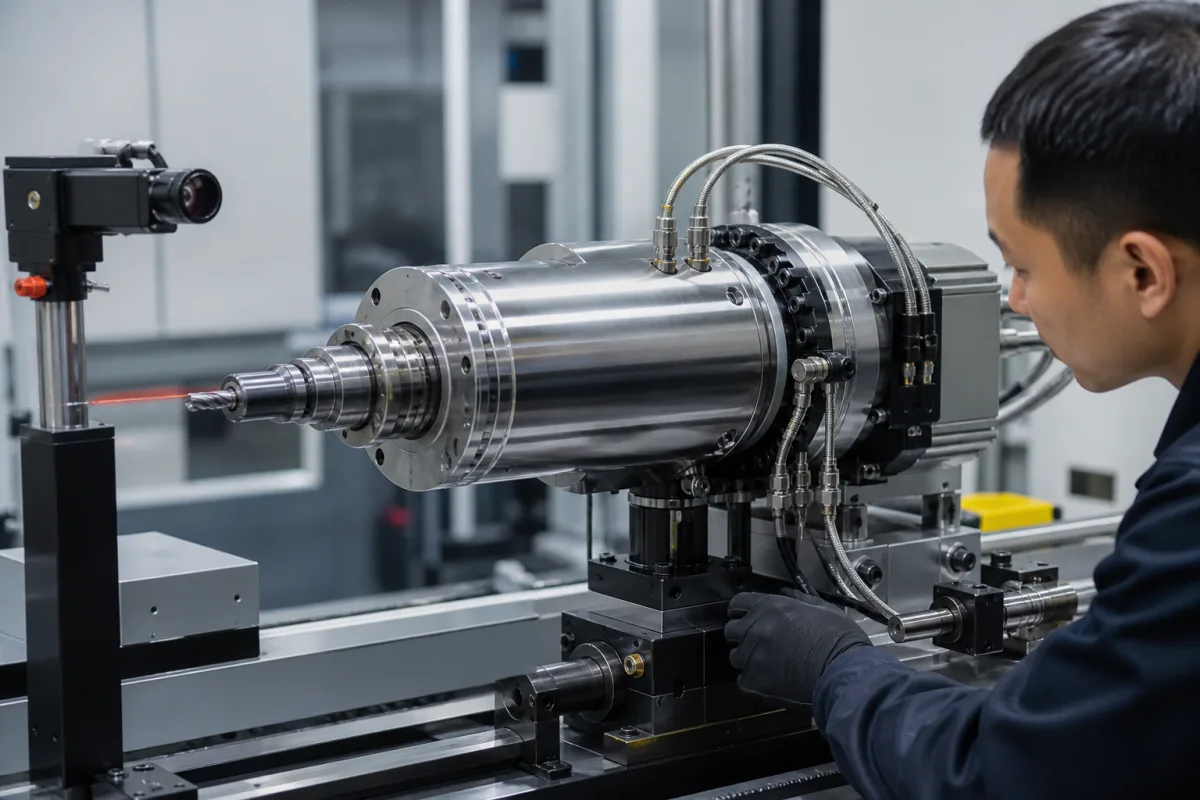
High-speed spindle (liquid-cooled motor spindle for machining centres and grinding machines, with automatic tool interface and vibration checks)
High-speed motor spindles for machining centres and grinding machines · HSK, SK and PSC tool interfaces, liquid cooling, through-spindle coolant, inverter drive, imbalance, critical speed and vibration monitoring
A high-speed spindle here means a motor spindle built into a machining centre or grinding machine: the motor rotor sits on the spindle shaft, a liquid cooling sleeve takes heat from motor and bearings, and the tool is clamped through a standard interface. Ask three things first: which tool interface and coolant feed the spindle has, how it is cooled and driven, and how imbalance, critical speed and vibration are checked with the tools you will run.
High-speed motor spindles for machining centres, milling heads and grinding machines with automatic or manual tool interfaces (HSK, SK, PSC), liquid cooling and optional coolant through the shaft, and their balancing and vibration checks. Router, engraving and PCB drilling spindle motors are covered on the Spindle motor page; spindle units driven by a separate motor are covered on the Spindle assembly and Main spindle unit with external belt or gear drive pages; built-in motor workpiece spindles for lathes are covered on the Built-in motor rotary spindle for CNC lathes page; complete machines are outside this page.
CNFX editorial research · Sources checked October 12, 2026 · 5 sources
Fix the tool interface, cooling, coolant feed and drive
GMN lists three tool interfaces for automatic tool change: hollow taper shank with flat contact face (HSK) to DIN 69893, steep taper with flat contact face (SK) to DIN 69871, and polygonal hollow taper with flat contact face (PSC) to ISO 26623-1; HSK-C is the form developed for manual tool change. [1] FISCHER lists milling motor spindles with diameters of 35-360 mm, speeds of up to 90,000 rpm, outputs of up to 200 kW and torque of up to 1,000 Nm, and says its CSC shaft cooling "minimizes the heating and expansion of the spindle shaft". [5]
GMN equips its high-speed spindles with a liquid cooling sleeve at the bearings and at the motor, and states that maximum performance is reached at a coolant temperature of 20 °C to 25 °C and that small coolant temperature differences reduce axial shaft displacement. For coolant through the shaft it offers low-pressure seals (sealing gas or air lock, up to 120,000 rpm, maximum 4 bar, filter fineness below 0.1 mm) and a high-pressure seal (touching sealing discs, up to 75,000 rpm, up to 50 bar depending on the spindle, minimum 3 bar, filter fineness below 0.01 mm, pressure surges must be avoided). [2]
GMN runs its motor spindles from inverters: without speed control by U/f characteristic up to 3,000 Hz output frequency with acceleration times in the range of 10 seconds, or with field-oriented control up to 1,400 Hz, speed constancy "approx. 0.5%" and acceleration in the range of 1 second, with a rotary encoder for C-axis positioning; it notes that maximum output frequency depends on the inverter maker. [3]
Editorial calculation: speed in min⁻¹ equals 60 × frequency ÷ pole pairs, so a motor with one pole pair at 1,400 Hz turns at 60 × 1,400 = 84,000 min⁻¹ and with two pole pairs at 42,000 min⁻¹ (synchronous speed; an induction motor runs slightly below it). The pole count is an assumed example; ask the spindle maker for the motor's pole number and frequency at maximum speed.
Give the spindle maker the machine (machining centre, milling head, grinder), mounting diameter, tool interface and size, maximum speed, power and torque curve, coolant through the shaft and pressure, cooling water temperature and flow available, drive (inverter type, encoder, C-axis), sensors required (temperature, vibration, clamp status), tool masses and lengths, and quantity.
02
Check imbalance, critical speed and vibration with your tools
GMN explains that unbalanced rotating parts (spindle shaft and tool) create imbalance vibrations that increase with speed, and that speed-intensive processes need an imbalance test and, if necessary, balancing of the tools; its residual imbalance guidance is "valid for short tools", and long cantilevered tools may need better balancing. [4]
GMN also notes that the natural frequencies of the rotating system cause critical speeds, and that tools can lower the critical speed range of the spindle-tool system and so the usable speed; it offers a calculation of static and dynamic behaviour for tools of exceptional size or weight. Vibration monitoring devices capture spindle movement, switch off at critical values and can show wear-related vibration in the bearings. [4]
FISCHER cites short start-up times and reliable tool changes for its motor spindles. [5] Ask for the run-in and acceptance data of the spindle you buy: speed steps, temperature rise, vibration and runout at the nose.
03
Rotor shaft, cooling sleeve, tool clamp, coolant seal and sensors
In a motor spindle the rotor sits on the shaft, so the cooling sleeve has to take heat from both the motor and the bearings.
Part
Role
Fix in the order
Shaft and rotor
Carries tool clamp and motor rotor; mass distribution limits imbalance. [4]
Balancing data.
Bearings
Support the shaft at speed; cooled by the sleeve. [2]
Type and lubrication.
Cooling sleeve
Removes bearing and motor heat; limits shaft growth. [2][5]
Explore company information and manufacturing capabilities, then discuss the scope of your project with a relevant supplier.
Share this page
Compiled and source-reviewed by the CNFX editorial team.
Each manufacturer above links to the page on that company's own website where the product is listed, with the date we checked it. How we source and review
· Page last updated 13 October 2026
Buyer questions
How is this different from a router spindle motor?
This page covers motor spindles for machining centres and grinding machines with HSK, SK or PSC interfaces, liquid cooling and through-shaft coolant; router and PCB spindle motors are on the Spindle motor page. [1][2]
Which tool interfaces are used for automatic tool change?
GMN lists HSK to DIN 69893, SK to DIN 69871 and PSC to ISO 26623-1. [1]
How much pressure can coolant through the shaft take?
GMN gives 4 bar for its low-pressure seal up to 120,000 rpm and up to 50 bar for its high-pressure seal up to 75,000 rpm, depending on the spindle. [2]
Why can a tool lower the usable speed?
GMN explains that tools change the natural frequencies of the spindle-tool system and can lower its critical speed range. [4]
Sources and what still needs a direct check
Sources checked 2026-10-12. GMN publishes its tool interfaces, cooling and coolant-feed seals, drive systems and imbalance and vibration guidance; FISCHER publishes its milling motor spindle range.