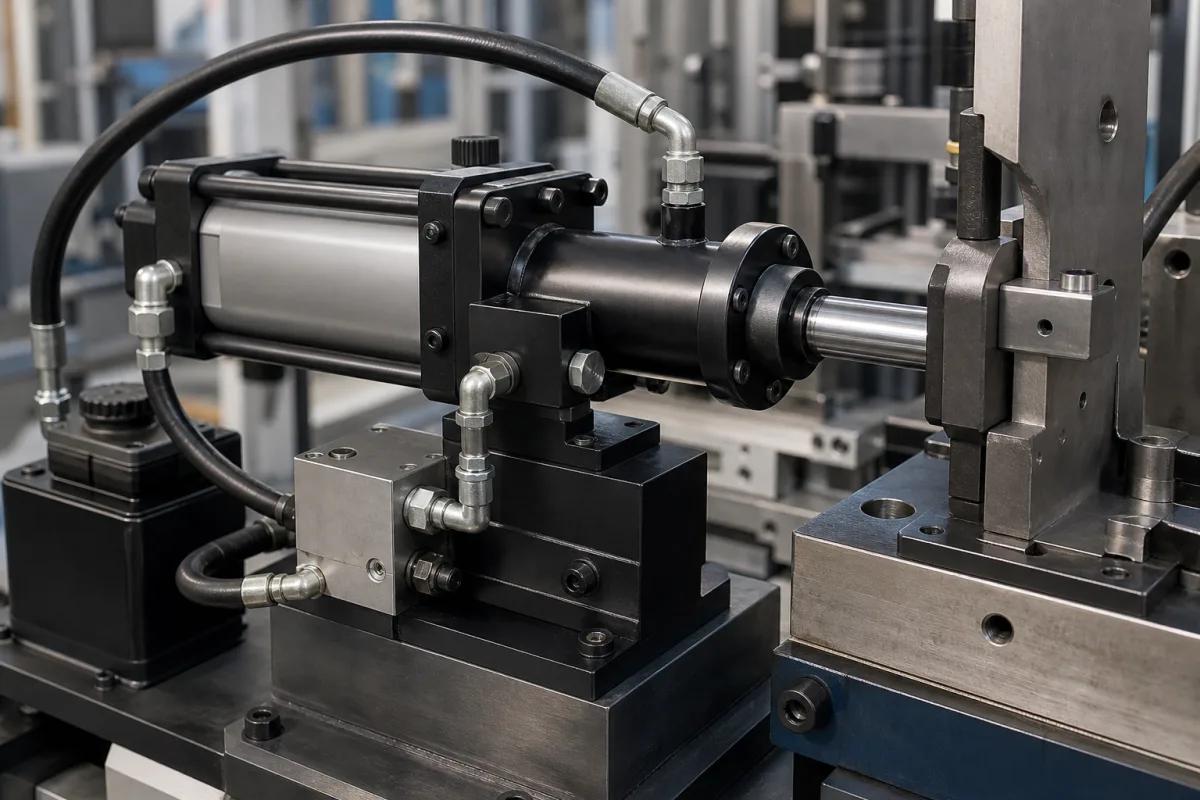
Hydro-pneumatic intensifier cylinder (air-over-oil press actuator with fast approach and intensified power stroke)
Air-over-oil intensifier cylinders · shop air drives a fast approach stroke, then an internal booster turns air pressure into hydraulic pressure for a short power stroke
A hydro-pneumatic intensifier cylinder is a self-contained actuator for pressing, punching, clinching, riveting and clamping. Compressed air first pushes oil onto the work piston so the rod travels quickly to the part at low force. When the rod meets resistance, a second air piston drives a small booster rod into the oil, multiplying the pressure for a short power stroke. The user connects only an air supply and valves; there is no hydraulic power unit, pump or motor. The buying questions are the press force at the available air pressure, the length of the power stroke, the oil volume that stroke consumes, and the cycle rate.
Air-over-oil (hydro-pneumatic) intensifier cylinders and split intensifier systems that convert shop compressed air into a hydraulic power stroke for presses, joining tools and workholding. Quarter-turn pneumatic valve actuators, rack-and-pinion and scotch-yoke, are covered on the Pneumatic actuator page; compressed-air circuits for production machines on the Pneumatic system for production machines page. Plain air cylinders and pump-fed tie-rod hydraulic cylinders are separate products (Pneumatic cylinder; Hydraulic/pneumatic cylinder).
CNFX editorial research · Sources checked October 12, 2026 · 3 sources
Fast approach at air pressure, then a booster piston intensifies the oil for the power stroke
Air-Hydraulics describes the operating sequence of its AH-Series hydropneumatic cylinder in three steps. A first valve pressurises port 1 and a float piston transfers oil from the oil chamber onto the work piston at air pressure, so the work rod extends at low pressure. When the rod meets the work, a second valve pressurises port 2 and the booster piston and rod extend, intensifying the pressure on the work piston and creating a high force. After the work is done both valves reverse and the cylinder retracts on air, without internal springs. [2]
TOX PRESSOTECHNIK makes the changeover from fast approach to power stroke automatic in its X-ES pressure intensifier, using what it calls the dynamic pressure principle; the changeover speed is set with a control throttle and the unit is switched by an ordinary 4/2 or 5/2-way valve, like a double-acting air cylinder. TOX lists absolute air-oil separation and a closed oil system among the intensifier's features, and states that its intensifiers are designed as standard for 6 bar air. [1]
At the small end, Jergens sells intensifier cylinders for workholding in which an air-powered cylinder is driven into a small oil reservoir, giving a nominal 8:1 or 30:1 power boost depending on air pressure and the cylinder used. Jergens rates them for fast action of 100 operations per minute where a short stroke and high power are needed, and they are recharged without disassembly. [3]
Editorial note: because the high force exists only while the booster rod is moving into the oil, the power stroke is short. The AH-Series rams have a 6 in maximum stroke, of which 0.500 in is power stroke [2]; the Jergens cylinders list a 1/4 in operating stroke [3]. Ask where in the ram travel the work is met, since the power stroke must cover the whole pressing, punching or clinching distance.
Give the supplier the force needed at the end of the stroke, the distance over which that force must act, the total ram travel, the lowest air pressure guaranteed at the machine, and the cycle rate.
02
Sizing from press force: oil pressure, required air pressure and oil volume per power stroke
TOX's data sheet for its X-KT system walks through a selection that applies to any intensifier: first the oil pressure, then the oil volume the power stroke consumes, then the air pressure. Its example needs 60 kN press force, 100 mm total stroke and 14 mm power stroke from two HZL hydraulic cylinders on one intensifier, with 800 mm hoses. [1]
Editorial calculation: the volume line checks out as 14 × 3.1 = 43.4 cm³, plus 6.9, plus 4.8 for 800 mm of hose, plus 1.5 for the coupling, which gives 56.6 cm³ per cylinder. The point of the step is that hose length and couplings consume part of the oil the booster can push, so a long hose run between a remote intensifier and the cylinder can use up power-stroke capacity.
The same arithmetic shows why the available air pressure governs the force: at a ratio of 40, every 1 bar drop in line pressure removes 40 bar of oil pressure. TOX warns that the maximum pressure and press force of the cylinder must not be exceeded when the air pressure is raised. [1]
Step in the TOX example
Inputs
Result
Oil pressure
60 kN required; chosen cylinder gives max. 76 kN at max. 250 bar [1]
4.9 bar; TOX advises about 20% more for high stroke rates, 5.9 bar [1]
Ask the supplier for the boost ratio, the maximum oil pressure, the oil volume available for the power stroke, and the calculation for your hose length and number of cylinders.
03
Published force, boost ratio and stroke for self-contained intensifier cylinders
Self-contained units put the air cylinder, oil reservoir and booster in one body bolted in line with the ram. The figures below are as the makers list them; the force column depends directly on line pressure.
Air-Hydraulics defines the ratio as the number that, multiplied by line pressure in psi, gives the approximate force. For the AH9 the listed 18.5:1 does not match its 18,500 lb at 100 psi, which implies 185:1; confirm the ratio with the maker before using it. [2] Editorial calculation: 8,750 lb is about 38.9 kN, and 65,100 lb about 290 kN, both at 100 psi (6.9 bar) air.
The same AH table lists return forces of 679 lb for the AH4 and 2,335 lb for the AH30, output rod diameters from 1.375 in to 2.500 in, and air use per full cycle from 0.426 to 2.510 (listed in scfm). [2] Return force matters when the punch or tool has to strip out of the part.
One intensifier feeding up to six cylinders: split systems with hydraulic couplings
Where the cylinders must be compact or more than one press point closes at once, TOX separates the intensifier from the drive cylinders. Its X-KT system combines one X-ES intensifier with up to six drive cylinders, connected by hydraulic hoses and Hydrosplit couplings, and is configured to the required press force, dimensions and cycle time. TOX states press forces of 2 to 1,700 kN and 10 million cycles within 12 months without shift restrictions. [1]
Two drive cylinder types are offered. The HZL hydraulic cylinder has its fast approach and return strokes conducted by the intensifier, so the return stroke runs on air pressure only, at a minimum of 3 bar. The X-AT working cylinder takes compressed air for approach and return directly, giving higher approach and return forces and shorter cycle times, while the intensifier supplies only the power stroke. [1]
Editorial note: a split system adds hose and coupling volume to the oil the booster must displace, which is why the TOX sizing in the section above counts hose length and couplings; a self-contained cylinder has no such losses but carries the full intensifier length on the ram axis.
For split systems, state the number of cylinders, hose lengths, coupling type, mounting orientation and whether stroke monitoring or a travel transducer is needed on each cylinder.
05
Data for a hydro-pneumatic intensifier cylinder quotation
Paste it into your enquiry below or into an email to a maker, then replace every bracket.
Force: [press force needed; at what point in the stroke]
Strokes: [total ram travel; power stroke length; return force needed]
Air: [minimum guaranteed line pressure; air treatment]
Layout: [self-contained in-line or split intensifier with drive cylinders; number of cylinders; hose length]
Cycle: [strokes per minute; shifts per day]
Mounting: [flange or other; orientation; anti-rotation]
Monitoring: [stroke monitoring; linear transducer; load cell; oil pressure port]
Explore company information and manufacturing capabilities, then discuss the scope of your project with a relevant supplier.
Share this page
Compiled and source-reviewed by the CNFX editorial team.
Each manufacturer above links to the page on that company's own website where the product is listed, with the date we checked it. How we source and review
· Page last updated 13 October 2026
Buyer questions
How does an air-over-oil intensifier cylinder produce hydraulic force from shop air?
Air first moves oil onto the work piston for a low-force approach; when the rod meets the work, a booster piston drives a rod into the oil and intensifies its pressure for the power stroke. [2]
What air pressure do intensifier systems assume?
TOX designs its X-ES intensifiers for 6 bar as standard; Air-Hydraulics and Jergens list force at 100 psi and other line pressures. [1][2][3]
How long is the power stroke?
It is short: the AH-Series lists 0.500 in power stroke within a 6 in ram stroke, and Jergens lists a 1/4 in operating stroke. [2][3]
Can one intensifier drive more than one cylinder?
TOX connects up to six drive cylinders to one X-ES intensifier through hoses and Hydrosplit couplings, more on request. [1]
Sources and what still needs a direct check
Sources checked 2026-10-12. TOX PRESSOTECHNIK, Air-Hydraulics and Jergens are makers describing their own intensifier products; force and ratio figures are their catalogue statements at the stated air pressures.