Industry-Verified Manufacturing Data (2026)

Infeed/Outfeed Conveyor

Based on aggregated insights from multiple verified factory profiles within the CNFX directory, the standard Infeed/Outfeed Conveyor used in the Machinery and Equipment Manufacturing sector typically supports operational capacities ranging from standard industrial configurations to heavy-duty production requirements.

Technical Definition & Core Assembly

A canonical Infeed/Outfeed Conveyor is characterized by the integration of Drive Motor & Gearbox and Conveyor Belt. In industrial production environments, manufacturers listed on CNFX commonly emphasize Stainless Steel (AISI 304 or 316L) construction to support stable, high-cycle operation across diverse manufacturing scenarios.

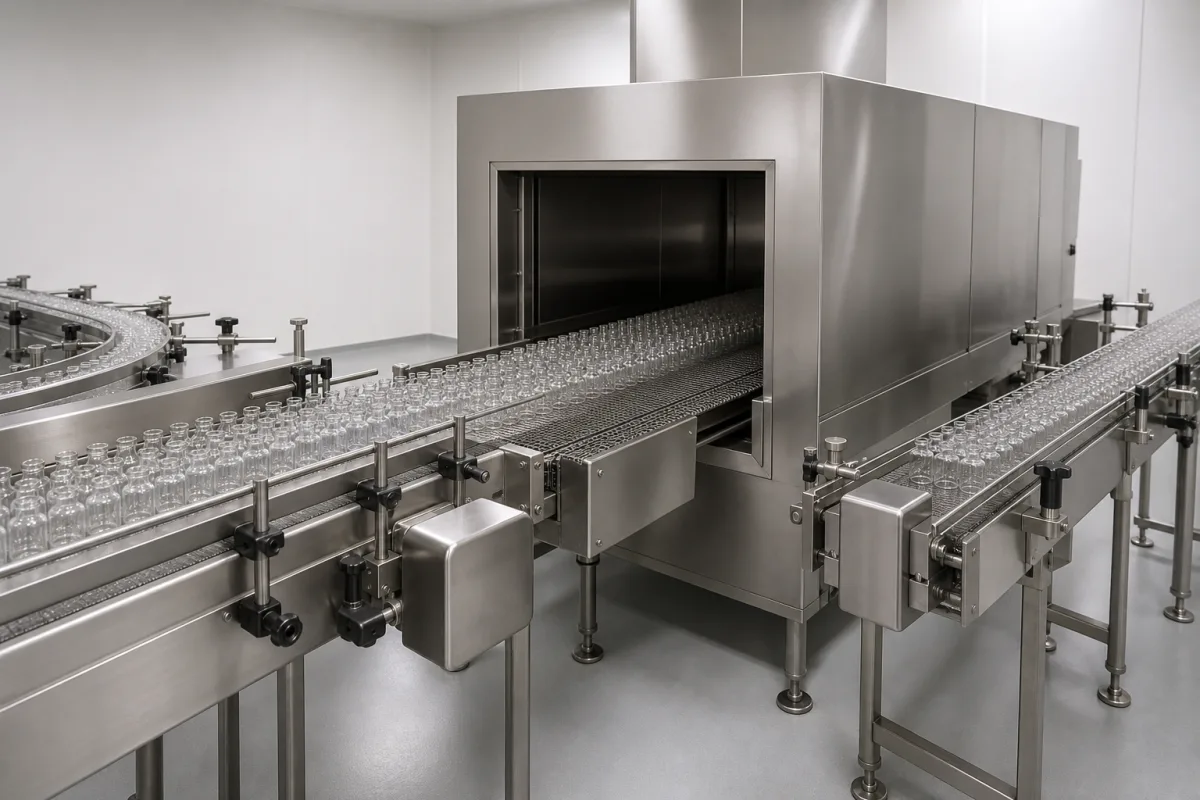
A conveyor system component of a depyrogenation tunnel responsible for the automated loading (infeed) and unloading (outfeed) of containers or vials.
Product Specifications

Technical details and manufacturing context for Infeed/Outfeed Conveyor

Definition
The Infeed/Outfeed Conveyor is an integral mechanical subsystem of a Depyrogenation Tunnel, designed to automate the material handling process. Its primary role is to precisely transfer containers (such as glass vials, syringes, or ampoules) into the tunnel's heating zones for the depyrogenation (pyrogen removal) process and subsequently convey the treated items out of the tunnel for further downstream processing like filling or capping. It ensures a continuous, controlled flow of materials, maintaining the tunnel's sterile barrier and process efficiency.
Working Principle
The conveyor typically operates using a motor-driven belt or chain mechanism. For the infeed section, it receives containers from an upstream source (e.g., a washer), aligns them, and transfers them at a controlled speed into the tunnel entrance. The outfeed section receives the depyrogenated containers from the tunnel's exit, often cooling section, and transfers them to the next station. Speed is synchronized with the tunnel's main conveyor to maintain proper spacing and prevent jams. Systems often include sensors for position detection, jam prevention, and integration with the tunnel's control system.
Common Materials
Stainless Steel (AISI 304 or 316L), Food-grade conveyor belt material (e.g., silicone, PTFE-coated fabric)
Technical Parameters
  • Conveyor belt width, crucial for determining the maximum container size or number of lanes that can be accommodated. (mm) Standard Spec
Components / BOM
  • Drive Motor & Gearbox
    Provides the mechanical power to move the conveyor belt at a controlled speed.
    Material: Steel housing, copper windings
  • Conveyor Belt
    The continuous moving surface that carries the containers. Designed to withstand high temperatures near the tunnel.
    Material: Stainless steel mesh or PTFE-coated fabric
  • Guide Rails
    Side rails that keep containers aligned and centered on the belt during transfer.
    Material: Stainless Steel
  • Sensor Array (e.g., photoelectric sensors)
    Detects container presence, monitors for jams, and ensures proper spacing for tunnel entry/exit.
    Material: Stainless steel housing, glass/plastic lens
Engineering Reasoning
0.5-2.0 m/s linear speed, 0.1-1.0 kN belt tension, 20-60°C ambient temperature
Belt tension exceeding 1.2 kN causes permanent deformation of polyurethane belt material, motor torque exceeding 15 N·m causes gearbox shear failure, linear speed below 0.3 m/s causes container jamming
Design Rationale: Polyurethane belt material undergoes plastic deformation at tensile stress > 3.5 MPa (Hooke's Law elastic limit exceeded), gear teeth experience Hertzian contact stress > 1.8 GPa causing subsurface fatigue cracks, insufficient kinetic energy (KE=½mv²) at low speeds prevents overcoming static friction coefficients > 0.4
Risk Mitigation (FMEA)
Trigger AC motor phase imbalance exceeding 5% causes 120% current in remaining phases
Mode: Motor winding insulation breakdown at 155°C Class F thermal limit
Strategy: Three-phase current monitoring relay with 2% imbalance trip threshold and PTC thermistor embedded in stator windings
Trigger Belt tracking misalignment > 3mm causes edge loading on 6204-2RS bearings
Mode: Bearing cage fracture from asymmetric radial loads exceeding 4.5 kN dynamic capacity
Strategy: Laser-aligned tracking rollers with 0.5mm precision and vibration monitoring accelerometers detecting > 4.0 mm/s RMS velocity

Industry Taxonomies & Aliases

Commonly used trade names and technical identifiers for Infeed/Outfeed Conveyor.

Applied To / Applications

This component is essential for the following industrial systems and equipment:

Industrial Ecosystem & Supply Chain DNA

Complementary Systems
Downstream Applications
Specialized Tooling

Application Fit & Sizing Matrix

Operational Limits
pressure: Atmospheric (non-pressurized system)
other spec: Max load capacity: 50 kg/m, Speed range: 0.1-1.0 m/s, Cleanliness: ISO Class 5 (GMP Grade A/B)
temperature: Ambient to 350°C (depyrogenation tunnel operating range)
Media Compatibility
✓ Glass vials/ampoules ✓ Stainless steel containers ✓ Polypropylene trays
Unsuitable: Corrosive chemical environments (acid/alkali exposure)
Sizing Data Required
  • Container dimensions (L×W×H)
  • Production throughput (units/hour)
  • Tunnel interface specifications (height/width/speed synchronization)

Reliability & Engineering Risk Analysis

Failure Mode & Root Cause
Belt misalignment and tracking failure
Cause: Improper tensioning, worn or damaged pulleys/bearings, material buildup on rollers, or structural misalignment of conveyor frame causing belt to drift off-center
Roller bearing seizure and premature wear
Cause: Contamination from dust/debris ingress, inadequate lubrication, moisture exposure leading to corrosion, or excessive loading beyond design specifications
Maintenance Indicators
  • Audible grinding, squealing, or scraping noises from rollers or drive components indicating bearing failure or misalignment
  • Visible belt tracking issues such as edge damage, fraying, or material spillage along conveyor sides suggesting alignment problems
Engineering Tips
  • Implement precision laser alignment procedures during installation and maintenance to ensure proper pulley, roller, and frame alignment, reducing uneven wear and tracking issues
  • Establish a proactive lubrication program with sealed or shielded bearings where possible, using appropriate lubricants at correct intervals, and install protective covers to prevent contamination ingress

Compliance & Manufacturing Standards

Reference Standards
ISO 5304:2023 - Conveyor belts - Specification for rubber- or plastics-covered conveyor belts ANSI/CEMA 402-2003 - Belt Conveyors DIN 22101:2011-12 - Continuous conveyors - Belt conveyors for loose bulk materials - Basics for calculation and dimensioning
Manufacturing Precision
  • Belt tracking alignment: +/- 3 mm
  • Roller concentricity: +/- 0.05 mm
Quality Inspection
  • Non-destructive testing (NDT) for weld integrity
  • Load testing to 125% of rated capacity

Factories Producing Infeed/Outfeed Conveyor

Verified manufacturers with capability to produce this product in China

✓ 94% Supplier Capability Match Found

S Sourcing Manager from United Arab Emirates Feb 13, 2026
★★★★★
"Great transparency on the Infeed/Outfeed Conveyor components. Essential for our Machinery and Equipment Manufacturing supply chain."
Technical Specifications Verified
P Procurement Specialist from Australia Feb 10, 2026
★★★★☆
"The Infeed/Outfeed Conveyor we sourced perfectly fits our Machinery and Equipment Manufacturing production line requirements. (Delivery took slightly longer than expected, but technical support was excellent.)"
Technical Specifications Verified
T Technical Director from Singapore Feb 07, 2026
★★★★★
"Found 16+ suppliers for Infeed/Outfeed Conveyor on CNFX, but this spec remains the most cost-effective."
Technical Specifications Verified
Verification Protocol

“Feedback is collected from verified sourcing managers during RFQ (Request for Quote) and factory evaluation processes on CNFX. These reports represent historical performance data and technical audit summaries from our B2B manufacturing network.”

12 sourcing managers are analyzing this specification now. Last inquiry for Infeed/Outfeed Conveyor from Vietnam (59m ago).

Supply Chain Compatible Machinery & Devices

Heavy-Duty CNC Plasma Cutting Machine

Industrial machine for precision metal cutting using plasma arc technology

Explore Specs →
Automated Assembly Line System

Integrated production system for sequential component assembly operations

Explore Specs →
Automated Powder Coating System

Integrated industrial system for applying dry powder coatings to metal substrates.

Explore Specs →
Centrifugal Pump Impeller

Rotating component that transfers energy to fluid in centrifugal pumps.

Explore Specs →

Frequently Asked Questions

What materials are used in your infeed/outfeed conveyors for depyrogenation applications?

Our conveyors feature AISI 304 or 316L stainless steel construction with food-grade conveyor belt materials such as silicone or PTFE-coated fabric, ensuring compliance with pharmaceutical and food safety standards.

How does the sensor array improve conveyor operation in depyrogenation tunnels?

The photoelectric sensor array provides precise detection and positioning of containers/vials, enabling automated loading/unloading, preventing jams, and ensuring smooth integration with depyrogenation processes.

Can your infeed/outfeed conveyors handle different container sizes in pharmaceutical applications?

Yes, with adjustable guide rails and customizable conveyor belt configurations, our systems accommodate various vial and container sizes while maintaining precise handling throughout the depyrogenation cycle.

Can I contact factories directly on CNFX?

CNFX is an open directory, not a transaction platform. Each factory profile provides direct contact information and production details to help you initiate direct inquiries with Chinese suppliers.

Get Quote for Infeed/Outfeed Conveyor

Request technical pricing, lead times, or customized specifications for Infeed/Outfeed Conveyor directly from verified manufacturing units.

Your business information is encrypted and only shared with verified Infeed/Outfeed Conveyor suppliers.

Thank you! Your message has been sent. We'll respond within 1–3 business days.

Need to Manufacture Infeed/Outfeed Conveyor?

Connect with verified factories specializing in this product category

Add Your Factory Contact Us
Previous Product
Infeed Starwheel
Next Product
Infrared Emitter Array