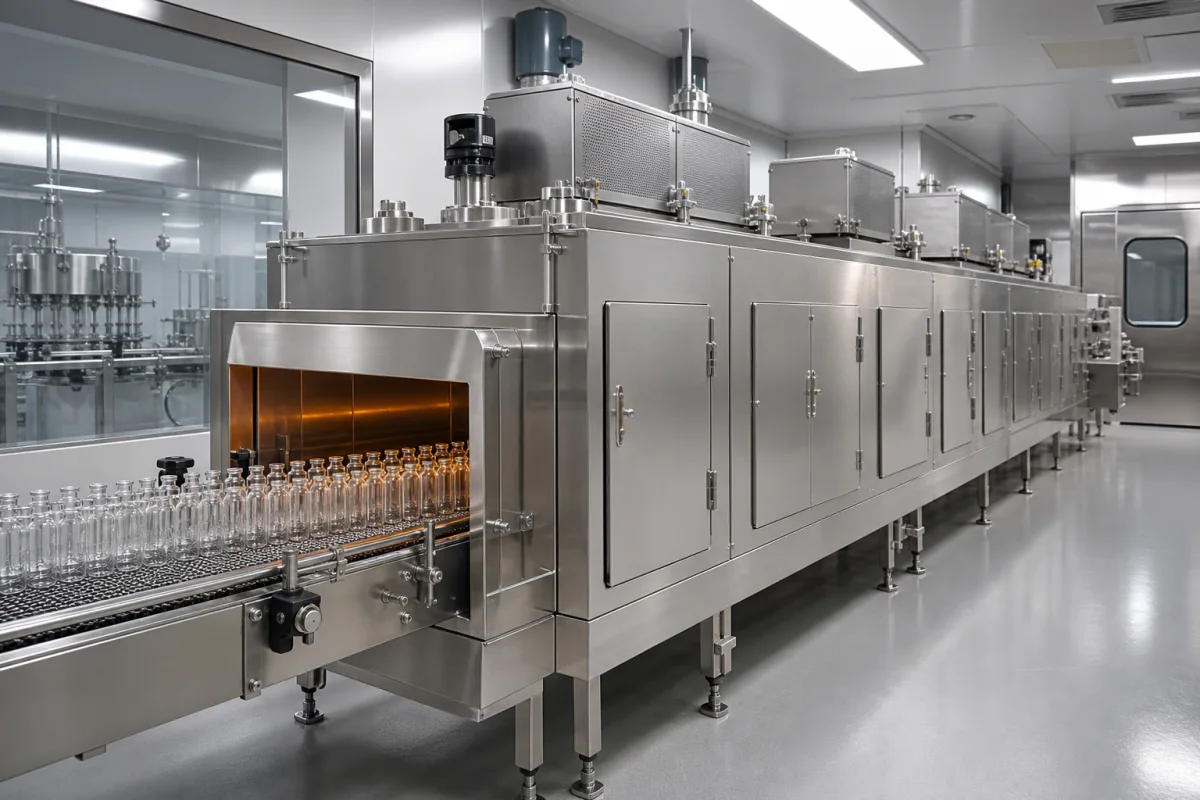
Dry-heat depyrogenation tunnels for glass vials and containers · 3-log endotoxin reduction, belt speed and dwell, temperature and heat penetration, HEPA air and pressure profiles, validation
A depyrogenation tunnel is a continuous dry-heat oven that carries washed glass vials or containers on a belt through a hot sterilising zone into the Grade A filling area, destroying endotoxins and sterilising the containers on the way. Settle three things before ordering: the validation targets (endotoxin reduction and heat lethality) for your containers, the belt speed, dwell, temperature profile and capacity, and the HEPA air handling, pressure balance and cleanroom interface.
Continuous dry-heat sterilising and depyrogenation tunnels for glass vials, ampoules, cartridges and bottles in aseptic filling lines, and batch dry-heat depyrogenation ovens where compared. Hot-water spray tunnel pasteurisers and sterilisers for filled containers, vial washers and filling machines are outside this page; tunnel pasteurisers/sterilisers have their own page.
CNFX editorial research · Sources checked October 12, 2026 · 4 sources
EU GMP Annex 1 (2022) describes dry-heat sterilisation as of particular use for thermally removing robust contaminants such as endotoxin, operated in an oven or a continuous tunnel, for example to sterilise and depyrogenate glass containers. Where a thermal process is used for depyrogenation, validation must show a suitable Fh value and at least a 3-log₁₀ reduction in endotoxin, after which no separate demonstration of sterilisation is required. Validation uses containers spiked with endotoxin that represent the normal materials — composition, porosity, dimensions and nominal volume — with full reconciliation and demonstrated endotoxin recovery. [1]
FDA's guidance on sterile drug products produced by aseptic processing (2004) says “Subjecting glass containers to dry heat generally accomplishes both sterilization and depyrogenation”, that validation should include heat distribution and penetration studies with worst-case cycles, container characteristics such as mass and actual loading configurations, and that the process should reduce endotoxin by at least 99.9% (3 logs); once validated by endotoxin challenge, a separate biological-indicator sterilisation validation is not indicated. [2]
Editorial calculation: a 3-log reduction takes an endotoxin spike of 1,000 units down to 1 unit or less — 99.9% removal. [1][2]
Give the supplier the container types and sizes (diameter, height, mass), output in containers per minute, required endotoxin reduction and Fh, maximum and minimum zone temperatures, dwell time, cooling-zone exit temperature, line interface (washer infeed, filler outfeed), cleanroom grades and pressure cascade, utilities, HEPA filter access and test ports, qualification documents (DQ/IQ/OQ/PQ) and quantity.
02
Specify belt speed, heat profile and air handling
Annex 1 requires depyrogenation tunnels to be configured so that airflow protects the integrity of the Grade A sterilising zone by maintaining pressure differentials and airflow through the tunnel, with air pressure difference profiles assessed and the effect of any airflow change on the heating profile evaluated. All air supplied to the tunnel must pass at least a HEPA filter, with integrity tests at least twice a year, and tunnel parts touching sterilised components must be sterilised or disinfected. [1]
The critical process parameters it lists for validation and routine running include belt speed or dwell time in the sterilising zone, minimum and maximum temperatures, heat penetration into the articles, heat distribution and uniformity, and airflows determined from pressure-difference profiles correlated with the heat studies. [1] FDA notes that HEPA filters in dry-heat depyrogenation tunnels and ovens are among those to be leak tested, and that justified alternative methods may be used in their hot zones. [2]
Editorial note: ask the supplier to show the temperature map and pressure profile at your fastest belt speed and largest container, since both the 3-log result and the Grade A protection depend on them. [1]
One maker's data for a vial tunnel (Comecer TSL) show how these parameters appear in a specification: three zones (infeed, depyrogenation, cooling); filtered air at up to 350 °C set-point in vertical laminar flow, with bacterial reduction stated up to log 6; infeed air at about 0.4–0.5 m/s with air-speed measurement; high-temperature HEPA filters (to 350 °C) with differential-pressure monitoring and adjustable-speed fans; automatic balancing of internal pressures; 316L product-contact parts on a 304 frame; output up to 350 kg/h; noise below 75 dBA; height under 2 m; and 21 CFR Part 11-compliant PLC/HMI recording. The maker states that each vial type is run with its own time and temperature setting to reach the required depyrogenation without overheating the glass. [3]
Editorial note: a stated log 6 bacterial reduction is a sterilisation figure; the endotoxin target for depyrogenation is the separate 3-log reduction set by the regulators, so ask for the endotoxin-challenge result on your container at your belt speed. [3][2]
03
Sterilizing and drying tunnels on offer, and the validation evidence to request
Truking lists a sterilizing and drying tunnel on its website.
Ask any supplier for validation references with endotoxin-challenge results, heat-distribution data and HEPA test provisions for the hot zone. [1][2]
04
Ask what time and temperature the endotoxin reduction rests on
Tsuji and Harrison, in Applied and Environmental Microbiology (1978), measured the dry-heat destruction of lipopolysaccharide (endotoxin) from E. coli, Serratia marcescens and Salmonella typhosa at 170 to 250 °C. Their abstract reports that the destruction rate seems to follow second-order kinetics and gives D(3) values for E. coli lipopolysaccharide of 251 min at 170 °C, 99.4 min at 190 °C, 33.3 min at 210 °C, 12.3 min at 230 °C and 4.99 min at 250 °C, with a z value reported as 46.4. The values for the other two lipopolysaccharides were not significantly different from E. coli. [4]
Editorial calculation: the D(3) value falls about 50-fold between 170 °C and 250 °C (251 / 4.99 ≈ 50.3), so the coolest point of the hot zone and the slowest-heating container decide the dwell a tunnel needs. These are laboratory data; ask the supplier for the minimum container temperature at your belt speed and for the endotoxin-challenge result that shows the 3-log reduction on your containers. [4][1]
Hot-zone length, temperature map, dwell, HEPA airflow and pressure differential for a tunnel order
Chamber length and belt speed together set the dwell, and the coolest point decides how long that must be: Tsuji and Harrison's D(3) value for E. coli endotoxin is 251 min at 170 °C against 4.99 min at 250 °C. [1][4]
1 company lists this product among what they make. Company figures are quoted from each
company's own website; every card states where the relationship came from.
Explore company information and manufacturing capabilities, then discuss the scope of your project with a relevant supplier.
Share this page
Compiled and source-reviewed by the CNFX editorial team.
Published regulatory guidance sets expectations, not a supplier's validation results. Confirm the legal seller, maker and qualification data for your order. How we source and review
· Page last updated 13 October 2026
Buyer questions
How much endotoxin reduction must a depyrogenation tunnel achieve?
At least 3 logs (99.9%), per EU Annex 1 and FDA's aseptic processing guidance. [1][2]
What are the critical parameters of a depyrogenation tunnel?
Annex 1 lists belt speed or dwell, minimum and maximum temperature, heat penetration, heat distribution and airflow from pressure profiles. [1]
At what interval are tunnel HEPA filters tested?
Annex 1 requires integrity tests at least twice a year. [1]
Does depyrogenation also sterilise the containers?
Annex 1 and FDA say a validated 3-log endotoxin reduction removes the need to demonstrate sterilisation separately. [1][2]
What temperature does a depyrogenation tunnel run at?
One maker's vial tunnel uses filtered laminar air at up to a 350 °C set-point, with time and temperature set per vial type. [3]
How fast does dry heat destroy endotoxin?
Tsuji and Harrison (Applied and Environmental Microbiology, 1978) report D(3) values for E. coli lipopolysaccharide falling from 251 min at 170 °C to 4.99 min at 250 °C. [4]
Sources and what still needs a direct check
Sources checked 2026-10-12. EU GMP Annex 1 (2022) and FDA's 2004 aseptic processing guidance set expectations for dry-heat depyrogenation tunnels; Comecer's TSL data are one maker's specification, and Tsuji and Harrison (1978) report laboratory kinetics for endotoxin destruction.