Industry-Verified Manufacturing Data (2026)

Insertion Actuator

Based on aggregated insights from multiple verified factory profiles within the CNFX directory, the standard Insertion Actuator used in the Machinery and Equipment Manufacturing sector typically supports operational capacities ranging from standard industrial configurations to heavy-duty production requirements.

Technical Definition & Core Assembly

A canonical Insertion Actuator is characterized by the integration of Actuator Rod/Piston and Lead Screw or Ball Screw. In industrial production environments, manufacturers listed on CNFX commonly emphasize Stainless Steel construction to support stable, high-cycle operation across diverse manufacturing scenarios.

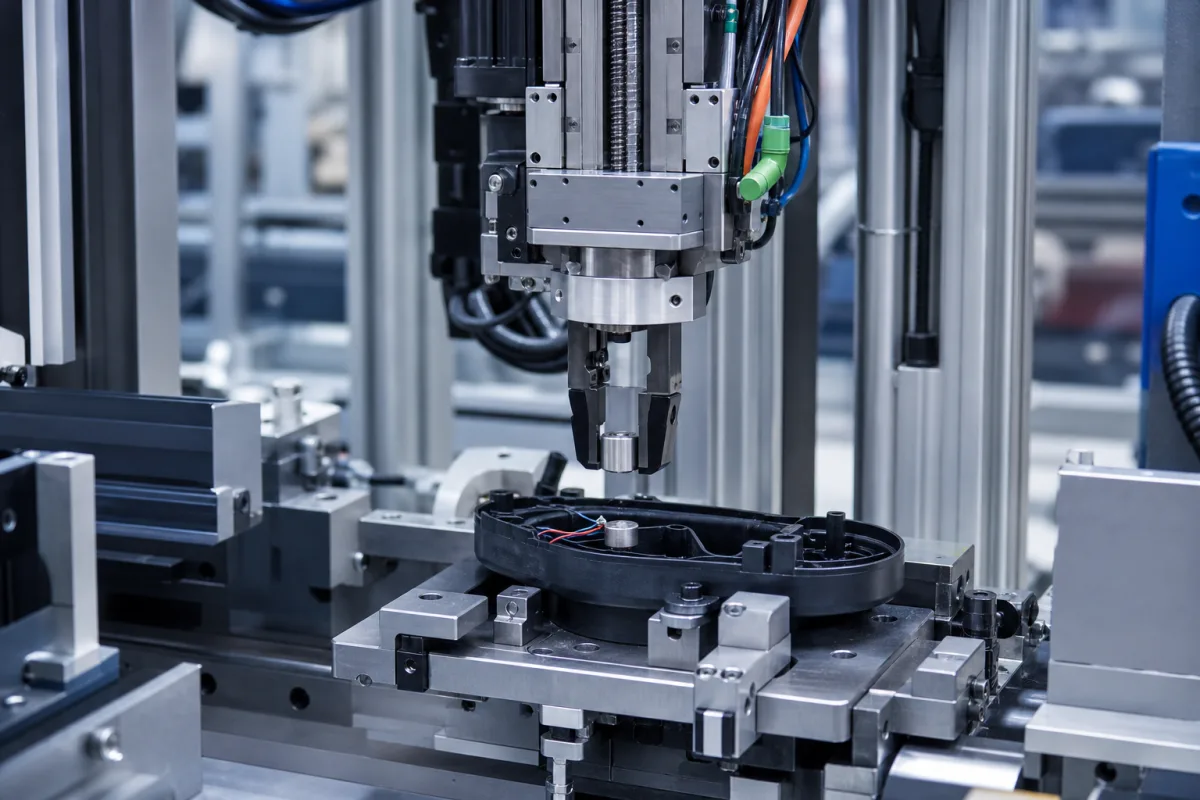
A precision mechanical component that provides controlled linear motion to insert vibration motors into assemblies.
Product Specifications

Technical details and manufacturing context for Insertion Actuator

Definition
The Insertion Actuator is a critical component within the Vibration Motor Insertion Unit, responsible for executing the precise, controlled linear movement required to place vibration motors into their designated housings or assemblies during automated manufacturing processes. It ensures accurate positioning and consistent insertion force.
Working Principle
Typically converts rotary motion from a motor (via a lead screw, ball screw, or rack and pinion) into precise linear motion. It is controlled by a system (often PLC-based) that dictates the stroke length, speed, and force of the insertion cycle.
Common Materials
Stainless Steel, Aluminum Alloy, Engineering Plastics
Technical Parameters
  • Stroke length, defining the maximum linear travel distance of the actuator. (mm) Customizable
Components / BOM
  • Actuator Rod/Piston
    The moving element that makes direct contact with or holds the vibration motor during insertion.
    Material: Stainless Steel
  • Lead Screw or Ball Screw
    Converts the rotary motion of the drive motor into the linear motion of the actuator rod.
    Material: Alloy Steel
  • Linear Guide Rails/Bearings
    Provides rigid, low-friction guidance to ensure straight, precise linear motion of the rod.
    Material: Hardened Steel
Engineering Reasoning
0.5-5.0 N linear force, 2-20 mm stroke length, 0.01 mm positioning accuracy
Exceeds 7.5 N static load, operates beyond 85°C ambient temperature, exceeds 100,000 cycles at maximum stroke
Design Rationale: Lead screw deformation at 250 MPa yield stress, ball bearing seizure at 120°C lubricant breakdown temperature, piezoelectric ceramic depolarization at 150°C Curie point
Risk Mitigation (FMEA)
Trigger Lead screw misalignment exceeding 0.05 mm/m
Mode: Backlash increases to 0.1 mm, causing 15% positioning error
Strategy: Integrate laser-aligned mounting fixtures with 0.01 mm tolerance
Trigger Piezoelectric driver voltage drop below 48 VDC
Mode: Actuator stalls at 2.5 N force, unable to complete insertion cycle
Strategy: Implement redundant power supply with automatic switchover at 50 VDC threshold

Industry Taxonomies & Aliases

Commonly used trade names and technical identifiers for Insertion Actuator.

Applied To / Applications

This component is essential for the following industrial systems and equipment:

Industrial Ecosystem & Supply Chain DNA

Complementary Systems
Downstream Applications
Specialized Tooling

Application Fit & Sizing Matrix

Operational Limits
pressure: 0 to 2 bar
other spec: Max insertion force: 50 N, Stroke accuracy: ±0.1 mm, Cycle rate: ≤60 cycles/min
temperature: -20°C to +80°C
Media Compatibility
✓ Clean dry air ✓ Lubricated mechanical assemblies ✓ Non-corrosive industrial environments
Unsuitable: High particulate or abrasive slurry environments
Sizing Data Required
  • Required insertion stroke length (mm)
  • Maximum insertion force needed (N)
  • Available mounting space and actuator envelope dimensions

Reliability & Engineering Risk Analysis

Failure Mode & Root Cause
Seal degradation and leakage
Cause: Exposure to contaminants, improper lubrication, or excessive heat leading to seal hardening, cracking, or wear, resulting in hydraulic fluid or pneumatic air leaks and loss of pressure.
Mechanical binding or jamming
Cause: Misalignment during installation, accumulation of debris or particulates in the actuator bore, or wear on internal components (such as bearings or guides) causing increased friction and preventing smooth linear motion.
Maintenance Indicators
  • Unusual grinding, scraping, or knocking noises during operation, indicating internal mechanical interference or component wear.
  • Visible fluid leaks around seals or fittings, or erratic/unsteady movement of the actuator rod during insertion cycles.
Engineering Tips
  • Implement a regular preventive maintenance schedule for lubrication and seal inspection, using manufacturer-recommended fluids and ensuring cleanliness to prevent contamination.
  • Ensure precise alignment during installation and use protective covers or bellows to shield the actuator rod from environmental debris and corrosive elements.

Compliance & Manufacturing Standards

Reference Standards
ISO 9001:2015 - Quality management systems ANSI/ASME B46.1-2019 - Surface Texture DIN 332 - Actuators for industrial valves
Manufacturing Precision
  • Stroke length: +/-0.05mm
  • Mounting surface flatness: 0.08mm
Quality Inspection
  • Dimensional verification with CMM
  • Pressure testing for leak detection

Factories Producing Insertion Actuator

Verified manufacturers with capability to produce this product in China

✓ 92% Supplier Capability Match Found

P Procurement Specialist from United States Jan 04, 2026
★★★★★
"Reliable performance in harsh Machinery and Equipment Manufacturing environments. No issues with the Insertion Actuator so far."
Technical Specifications Verified
T Technical Director from United Arab Emirates Jan 01, 2026
★★★★★
"Testing the Insertion Actuator now; the technical reliability results are within 1% of the laboratory datasheet."
Technical Specifications Verified
P Project Engineer from Australia Dec 29, 2025
★★★★★
"Impressive build quality. Especially the technical reliability is very stable during long-term operation."
Technical Specifications Verified
Verification Protocol

“Feedback is collected from verified sourcing managers during RFQ (Request for Quote) and factory evaluation processes on CNFX. These reports represent historical performance data and technical audit summaries from our B2B manufacturing network.”

6 sourcing managers are analyzing this specification now. Last inquiry for Insertion Actuator from Mexico (15m ago).

Supply Chain Compatible Machinery & Devices

Hydraulic Press

Industrial machine using hydraulic pressure to compress, form, or assemble materials

Explore Specs →
Heavy-Duty CNC Plasma Cutting Machine

Industrial machine for precision metal cutting using plasma arc technology

Explore Specs →
Automated Assembly Line System

Integrated production system for sequential component assembly operations

Explore Specs →
Automated Powder Coating System

Integrated industrial system for applying dry powder coatings to metal substrates.

Explore Specs →

Frequently Asked Questions

What materials are used in this insertion actuator?

This insertion actuator is constructed from high-quality stainless steel, aluminum alloy, and engineering plastics for durability and precision in industrial environments.

What applications is this insertion actuator designed for?

Specifically designed for controlled linear insertion of vibration motors into assemblies in machinery and equipment manufacturing, ensuring precise placement and automation efficiency.

What are the key components in the insertion actuator's BOM?

The bill of materials includes an actuator rod/piston, lead screw or ball screw for motion transmission, and linear guide rails/bearings for smooth, accurate movement.

Can I contact factories directly on CNFX?

CNFX is an open directory, not a transaction platform. Each factory profile provides direct contact information and production details to help you initiate direct inquiries with Chinese suppliers.

Get Quote for Insertion Actuator

Request technical pricing, lead times, or customized specifications for Insertion Actuator directly from verified manufacturing units.

Your business information is encrypted and only shared with verified Insertion Actuator suppliers.

Thank you! Your message has been sent. We'll respond within 1–3 business days.

Need to Manufacture Insertion Actuator?

Connect with verified factories specializing in this product category

Add Your Factory Contact Us
Previous Product
Input/Output Modules
Next Product
Insertion Mechanism