Industry-Verified Manufacturing Data (2026)

Joints with Actuators

Based on aggregated insights from multiple verified factory profiles within the CNFX directory, the standard Joints with Actuators used in the Machinery and Equipment Manufacturing sector typically supports operational capacities ranging from standard industrial configurations to heavy-duty production requirements.

Technical Definition & Core Assembly

A canonical Joints with Actuators is characterized by the integration of Actuator and Joint Housing. In industrial production environments, manufacturers listed on CNFX commonly emphasize Aluminum alloy construction to support stable, high-cycle operation across diverse manufacturing scenarios.

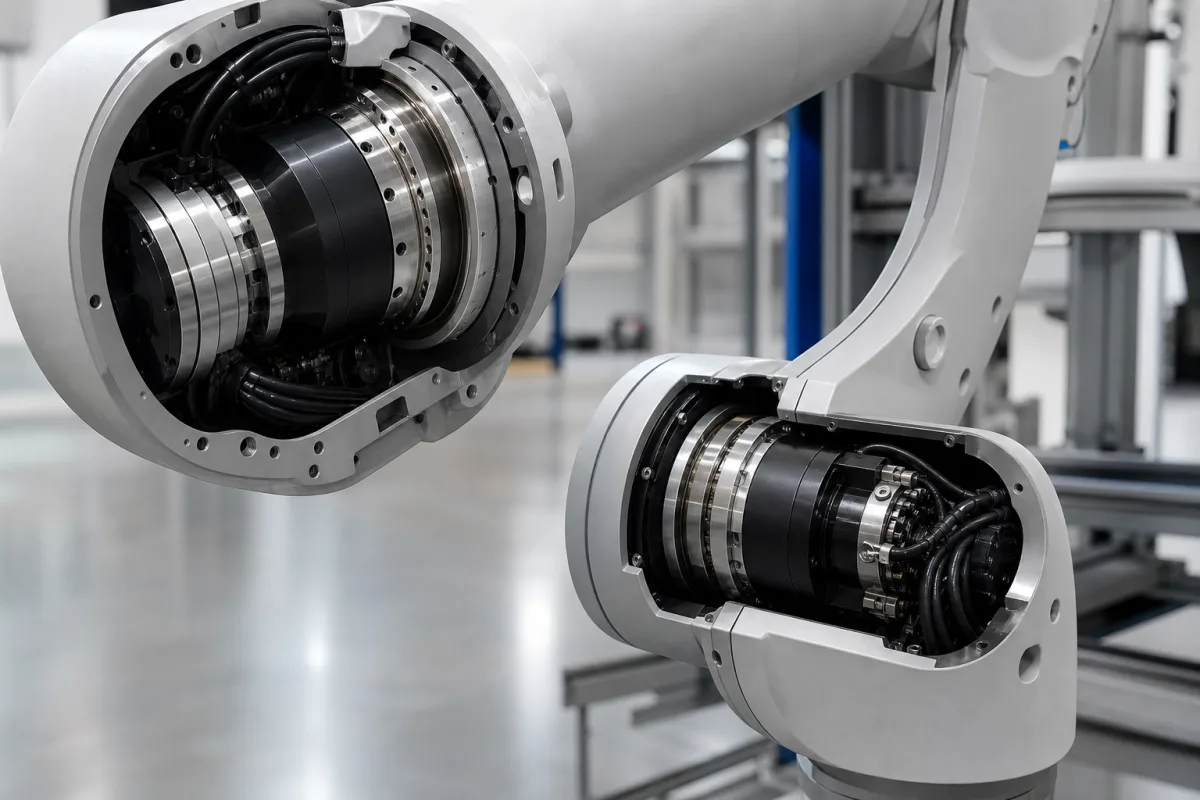
Robotic joints integrated with actuators that enable controlled movement and positioning in robotic manipulators.

Product Specifications

Technical details and manufacturing context for Joints with Actuators

Definition
Joints with actuators are critical components of robotic manipulators that combine mechanical articulation points with power sources (actuators) to create controlled motion. These assemblies enable the robotic arm to achieve precise positioning, orientation, and movement through various degrees of freedom. They serve as the fundamental building blocks that transform electrical or hydraulic energy into mechanical motion at specific articulation points along the manipulator structure.
Working Principle
Actuators (electric motors, hydraulic cylinders, or pneumatic systems) generate force/torque that is transmitted through mechanical linkages to rotate or translate the joint. Control systems regulate actuator output based on position, velocity, or torque feedback to achieve precise movement according to programmed trajectories.
Common Materials
Aluminum alloy, Steel, Composite materials
Technical Parameters
  • Maximum torque output of the joint actuator (Nm) Per Request
Components / BOM
  • Actuator
    Converts electrical/hydraulic/pneumatic energy into mechanical motion
    Material: Various (depends on type)
  • Joint Housing
    Provides structural support and protection for internal components
    Material: Aluminum alloy or steel
  • Bearing Assembly
    Enables smooth rotation while supporting axial and radial loads
    Material: Steel with polymer/composite elements
  • Feedback Sensor
    Measures joint position, velocity, or torque for closed-loop control
    Material: Electronic components with protective housing
Engineering Reasoning
0.1-100 Nm torque, -30 to 80°C ambient temperature, 0-100% relative humidity (non-condensing)
150% rated torque for 0.1 seconds, 125°C motor winding temperature, 10⁷ cycles at maximum load
Design Rationale: Permanent magnet demagnetization at 150°C Curie temperature, harmonic drive tooth fracture at 200 MPa stress concentration, bearing seizure at 0.5 μm particulate contamination
Risk Mitigation (FMEA)
Trigger Back-EMF voltage exceeding 600V during rapid deceleration
Mode: Insulation breakdown in motor windings
Strategy: Dynamic braking resistors sized for 2x kinetic energy dissipation
Trigger Lubricant shear thinning at 10⁵ s⁻¹ shear rate
Mode: Harmonic drive wave generator bearing seizure
Strategy: Synthetic perfluoropolyether lubricant with 0.8 mPa·s viscosity at 100°C

Industry Taxonomies & Aliases

Commonly used trade names and technical identifiers for Joints with Actuators.

Applied To / Applications

This component is essential for the following industrial systems and equipment:

Industrial Ecosystem & Supply Chain DNA

Complementary Systems
Downstream Applications
Specialized Tooling

Application Fit & Sizing Matrix

Operational Limits
pressure: 0 to 10 bar
other spec: Max Torque: 50 Nm, Max Speed: 100 RPM, IP Rating: IP65
temperature: -20°C to +80°C
Media Compatibility
✓ Industrial lubricants ✓ Clean air environments ✓ Non-corrosive hydraulic fluids
Unsuitable: High-concentration abrasive slurry environments
Sizing Data Required
  • Required torque output (Nm)
  • Maximum angular velocity (RPM)
  • Payload mass and moment arm (kg·m)

Reliability & Engineering Risk Analysis

Failure Mode & Root Cause
Actuator seal leakage
Cause: Wear from contamination ingress, thermal cycling, or improper installation leading to fluid loss and pressure drop
Joint bearing wear or seizure
Cause: Inadequate lubrication, misalignment, or overloading causing increased friction, play, or complete failure
Maintenance Indicators
  • Unusual grinding or knocking sounds during operation indicating internal component wear
  • Visible fluid leaks around actuator seals or joints suggesting seal failure
Engineering Tips
  • Implement regular lubrication schedules with manufacturer-specified lubricants and monitor contamination levels
  • Ensure proper alignment during installation and use alignment verification tools periodically to prevent premature wear

Compliance & Manufacturing Standards

Reference Standards
ISO 9409-1:2004 (Industrial automation systems and integration - Mechanical interface for robots - Part 1: Plates) ANSI/RIA R15.06-2012 (Industrial Robots and Robot Systems - Safety Requirements) DIN EN ISO 13849-1:2015 (Safety of machinery - Safety-related parts of control systems - Part 1: General principles for design)
Manufacturing Precision
  • Bore diameter: +/-0.01mm
  • Parallelism of mounting surfaces: 0.02mm
Quality Inspection
  • Dimensional verification with CMM (Coordinate Measuring Machine)
  • Functional testing under rated load and speed

Factories Producing Joints with Actuators

Verified manufacturers with capability to produce this product in China

✓ 95% Supplier Capability Match Found

T Technical Director from Brazil Feb 03, 2026
★★★★★
"Testing the Joints with Actuators now; the technical reliability results are within 1% of the laboratory datasheet."
Technical Specifications Verified
P Project Engineer from Canada Jan 31, 2026
★★★★☆
"Impressive build quality. Especially the technical reliability is very stable during long-term operation. (Delivery took slightly longer than expected, but technical support was excellent.)"
Technical Specifications Verified
S Sourcing Manager from United States Jan 28, 2026
★★★★★
"As a professional in the Machinery and Equipment Manufacturing sector, I confirm this Joints with Actuators meets all ISO standards."
Technical Specifications Verified
Verification Protocol

“Feedback is collected from verified sourcing managers during RFQ (Request for Quote) and factory evaluation processes on CNFX. These reports represent historical performance data and technical audit summaries from our B2B manufacturing network.”

19 sourcing managers are analyzing this specification now. Last inquiry for Joints with Actuators from Vietnam (46m ago).

Supply Chain Compatible Machinery & Devices

Automated Assembly Line System

Integrated production system for sequential component assembly operations

Explore Specs →
Automated Powder Coating System

Integrated industrial system for applying dry powder coatings to metal substrates.

Explore Specs →
Centrifugal Pump Impeller

Rotating component that transfers energy to fluid in centrifugal pumps.

Explore Specs →
High-Precision CNC Laser Cutting Machine

Computer-controlled industrial machine using focused laser beams to cut sheet metal with micron-level accuracy.

Explore Specs →

Frequently Asked Questions

What materials are used in these robotic joints with actuators?

Our robotic joints are constructed from high-strength aluminum alloy, durable steel components, and lightweight composite materials for optimal performance and longevity in industrial applications.

How do the feedback sensors improve robotic joint performance?

Integrated feedback sensors provide real-time position and movement data, enabling precise control, accurate positioning, and enhanced repeatability in robotic manipulator operations.

What industries benefit from these actuator-integrated robotic joints?

These joints are essential for machinery and equipment manufacturing, particularly in automation, assembly lines, material handling, and any application requiring controlled robotic movement and positioning.

Can I contact factories directly on CNFX?

CNFX is an open directory, not a transaction platform. Each factory profile provides direct contact information and production details to help you initiate direct inquiries with Chinese suppliers.

Get Quote for Joints with Actuators

Request technical pricing, lead times, or customized specifications for Joints with Actuators directly from verified manufacturing units.

Your business information is encrypted and only shared with verified Joints with Actuators suppliers.

Thank you! Your message has been sent. We'll respond within 1–3 business days.

Need to Manufacture Joints with Actuators?

Connect with verified factories specializing in this product category

Add Your Factory Contact Us
Previous Product
Joint Housing
Next Product
Joints/Actuators