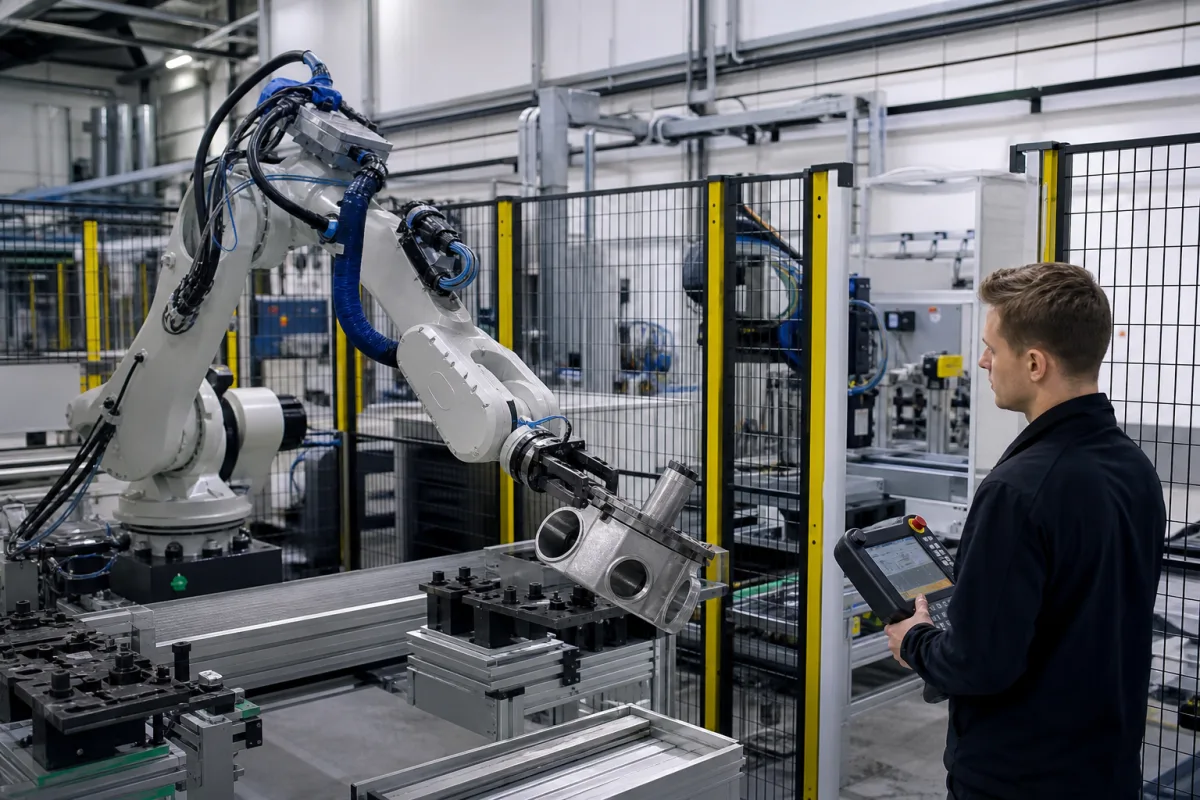
Robotic manipulator: six-axis articulated arm sized by wrist load and working envelope
Six-axis articulated arm (mechanical unit) · Wrist moment and inertia limits, joint ranges and speeds, payload class, protection rating
A robotic manipulator, in the sense used on this page, is the mechanical arm of an industrial robot: a base, a lower and upper arm and a three-axis wrist driven by servo motors through reducers, carrying a gripper or tool on its flange and moved by a separate controller. Buyers choosing the arm for handling, machine loading or heavy part transfer should check three things first: whether the gripper plus part stays within the wrist's allowable moment and inertia at its real centre-of-gravity offset, whether the joint ranges and reach cover every pick and place point including the rear of the arm, and what protection rating the body and wrist carry.
Six-axis (and five-axis) articulated arms specified as a mechanical unit by wrist load, reach, joint ranges, speed, mounting and protection, from tabletop arms around 12 kg payload to floor-mounted arms carrying hundreds of kilograms. Robots selected for assembly tasks such as screwdriving, insertion and dispensing, including SCARA, delta and collaborative types, are covered on the Assembly robot page. Cartesian gantries, welding and painting packages and robot controllers sold on their own are outside this page.
CNFX editorial research · Sources checked October 12, 2026 · 3 sources
Check the wrist load against moment and inertia limits, not payload alone
Arm datasheets give a payload in kilograms and, separately, the moment (torque) and moment of inertia each wrist axis can carry. Epson's C12XL lists a maximum payload of 12 kg but a rated payload of 3 kg, with allowable moments of inertia of 0.70 kg·m² on J4 and J5 and 0.20 kg·m² on J6. [1] HCNC's RJR650L, rated at 50 kg, lists allowable torque of 400 N·m on J4, 340 N·m on J5 and 330 N·m on J6, with allowable inertia of 32.7, 32.7 and 25 kg·m². [2] FANUC's M-900iB/280L, at 280 kg, lists 1700 N·m / 215 kg·m² on J4 and J5 and 950 N·m / 140 kg·m² on J6. [3]
Editorial calculation: a gripper and part totalling 50 kg with its centre of gravity 0.3 m from the J5 axis loads that axis with about 50 × 9.81 × 0.3 = 147 N·m, inside the 340 N·m HCNC lists for the RJR650L's J5. Treated as a point mass, the same load 0.3 m from the J6 axis gives an inertia of 50 × 0.3² = 4.5 kg·m², inside the listed 25 kg·m². A real gripper also has its own inertia about its centre of gravity, so ask the maker to check your gripper model against the arm's load diagram. [2]
Editorial calculation: on the Epson C12XL, 3 kg with its centre of gravity 0.2 m from the J6 axis gives about 3 × 0.2² = 0.12 kg·m², within the 0.20 kg·m² limit; moving the same 3 kg to 0.3 m gives 0.27 kg·m², above it. Small offsets on a long gripper finger change the answer. [1]
Give the supplier the gripper or tool mass and drawing, the heaviest part mass, the centre-of-gravity offset from the flange in all three directions, the pick and place points, the cycle target, and the mounting (floor, ceiling, wall or table).
02
Map joint ranges, reach and speed onto the cell layout
FANUC's M-900iB/280L datasheet gives a reach of 3103 mm, motion ranges of 370°, 151°, 224°, 720°, 250° and 720° for J1 to J6, and maximum speeds of 110, 105, 100, 125, 125 and 205 °/s; its drawing marks a rear-side interference area behind the arm. Repeatability is ±0.1 mm, stated as based on ISO 9283. [3]
HCNC's RJR650L lists a working radius of 2400 mm, J1 ±180°, J2 −160°/+70°, J3 +10°/+265°, J4 and J6 ±360° and J5 ±110°, with rated and maximum joint speeds given separately: J1 is 85 °/s rated and 127.5 °/s maximum. Repeatability is ±0.08 mm. [2] Epson's C12XL is a tabletop-mounted arm with 1400 mm reach to the wrist centre (1480 mm to the mounting face), J1 ±240°, J5 ±135°, J6 ±360° and repeatability of ±0.050 mm. [1]
Editorial calculation: turning the FANUC arm's base 180° at its 110 °/s maximum takes at least 180 / 110 = 1.6 s before any acceleration and deceleration time, so a cycle that swings between conveyors on opposite sides of the base needs that time budgeted. [3]
03
Compare arms by payload class
The arms in the reviewed sources span payload classes from 12 kg to 280 kg; compare arm mass, supply and protection alongside payload.
HCNC's RBR5110 page describes the arm as six-axis in its summary, while its parameter table lists five degrees of freedom and joints J1 to J5 only; confirm the axis count with the maker before ordering. [2]
Paste it into your enquiry below or into an email to a maker, then replace every bracket.
Load: [gripper mass and drawing; part mass; centre-of-gravity offset]
Path: [pick and place points; obstacles; cycle target]
Arm: [reach; axes; repeatability; mounting]
Environment: [temperature; dust, coolant or washdown; IP rating]
Supply: [voltage; power]
Control: [I/O; fieldbus; pendant cable length]
Explore company information and manufacturing capabilities, then discuss the scope of your project with a relevant supplier.
Share this page
Compiled and source-reviewed by the CNFX editorial team.
Each manufacturer above links to the page on that company's own website where the product is listed, with the date we checked it. How we source and review
· Page last updated 13 October 2026
Buyer questions
Is the rated payload enough to choose a manipulator?
No. The wrist also has allowable moment and inertia limits; Epson's C12XL lists 12 kg maximum but 3 kg rated and 0.20 kg·m² on J6. [1]
How do I estimate wrist moment?
Mass × 9.81 × centre-of-gravity offset; 50 kg at 0.3 m is about 147 N·m (editorial calculation), against 340 N·m listed for HCNC's RJR650L J5. [2]
What protection ratings do arms carry?
The sources list IP50 to IP54/IP56 bodies and IP65 or IP67 wrists. [2][3]
Sources and what still needs a direct check
Sources checked 2026-10-12. Epson, HCNC and FANUC are robot makers publishing data for their own arms; values are for those models only.