Position feedback · Closed-loop control, ballscrew heat, scale type, resolution and accuracy
A linear encoder measures the position of a machine slide directly along the axis. Ask three things first: what accuracy the axis must hold over a shift, what resolution and output the control needs, and how dirty and hot the mounting position is.
Optical (glass or steel tape) and magnetic linear encoders and scales for machine tools, stages and measuring equipment, including DRO scales. Rotary encoders, encoder magnets and complete machines are outside this page.
CNFX editorial research · Sources checked October 12, 2026 · 4 sources
Decide between semi-closed and closed-loop control
HEIDENHAIN, an encoder maker, explains that in a semi-closed loop the table position is derived from the ballscrew pitch and the motor encoder angle, so changes in the feed mechanism such as thermal expansion are not detected. At higher traversing speeds the ballscrew heats unevenly; in its thermal image peaks reached 50.5 °C, and it states positioning errors of up to 200 µm within a short time that cannot be compensated because the temperature distribution is unknown. A linear encoder on the slide puts the feed mechanism inside the loop. [1]
Renishaw, another encoder maker, measured one machine axis with a laser: in semi-closed loop the error grew by about 15 µm after one part and about 120 µm after 50 parts, falling to 80 µm after a 15-minute cool-down; with linear encoders enabled the axis stayed within about 15 µm after 50 parts and about 10 µm after cool-down. [2]
Editorial calculation: on that axis after 50 parts, 120 µm ÷ 15 µm = 8, so closing the loop cut the error to about one-eighth. [2] Results depend on the machine and duty; ask for test data on comparable axes.
Give the supplier the measuring length, required accuracy grade and resolution, control interface and signal type, traversing speed, mounting space, environment (coolant, chips, temperature), cable length and whether a DRO is needed.
02
Choose scale type, resolution and protection
Glass and magnetic scales are both sold for machine tools and digital readouts; one modular magnetic encoder resolves down to 0.5 µm and outputs SSI, BiSS-C, RS-422 or ABZ. [3][4]
Ask for the accuracy grade over the full length, the resolution after interpolation, the maximum traversing speed at that resolution, the sealing method and protection rating, and whether the scale is incremental with reference marks or absolute.
Check the supplier's mounting tolerances for the read head and how the scale is protected from coolant and chips at your mounting position.
03
Who sells glass, magnetic and optical scales
Yuheng lists linear encoders with rotary encoders and resolvers; Sino lists glass and magnetic linear encoders with digital readouts; OTV lists modular magnetic linear encoders; Scanner Optics lists optical linear encoders with galvanometer scanners; Gertech lists magnetic linear encoders with rotary encoders; Ostbridge distributes linear encoders from more than one brand; Yumo lists potentiometric linear position sensors described as linear encoders.
04
Scale, read head, seals and the cable to the control
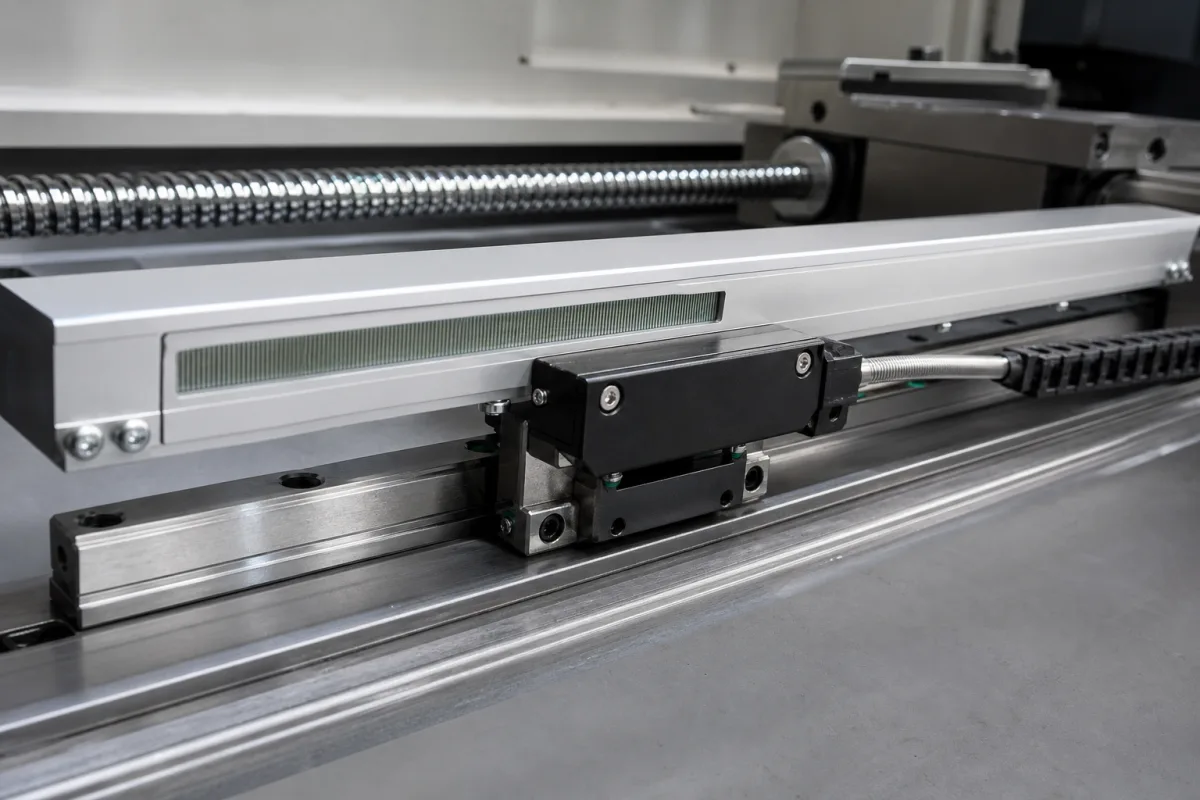
The read head and scale set the signal and resolution; the seals and brackets decide whether that holds up under coolant, chips and mounting error.
Measuring length, interpolated resolution and IP rating
Only resolution and output signal carry a published value here, both from OTV's magnetic encoder; every other row depends on your axis and control. [3]
Explore company information and manufacturing capabilities, then discuss the scope of your project with a relevant supplier.
Share this page
Compiled and source-reviewed by the CNFX editorial team.
Each manufacturer above links to the page on that company's own website where the product is listed, with the date we checked it. How we source and review
· Page last updated 13 October 2026
Buyer questions
Why add a linear encoder to a ballscrew axis?
In a semi-closed loop, ballscrew heating changes position without the control knowing; one test saw about 120 µm error after 50 parts without linear encoders and about 15 µm with them. [1][2]
What is semi-closed loop control?
Position is calculated from the motor encoder and ballscrew pitch, so thermal expansion of the screw is not measured. [1]
Glass or magnetic linear scale?
Both are offered for machine tools and readouts; compare resolution, accuracy grade, speed, sealing and output for your axis. [4][3]
Sources and what still needs a direct check
Sources checked 2026-10-12. HEIDENHAIN and Renishaw are encoder makers; their results describe their own tests. OTV and Sino are suppliers listed on this page.