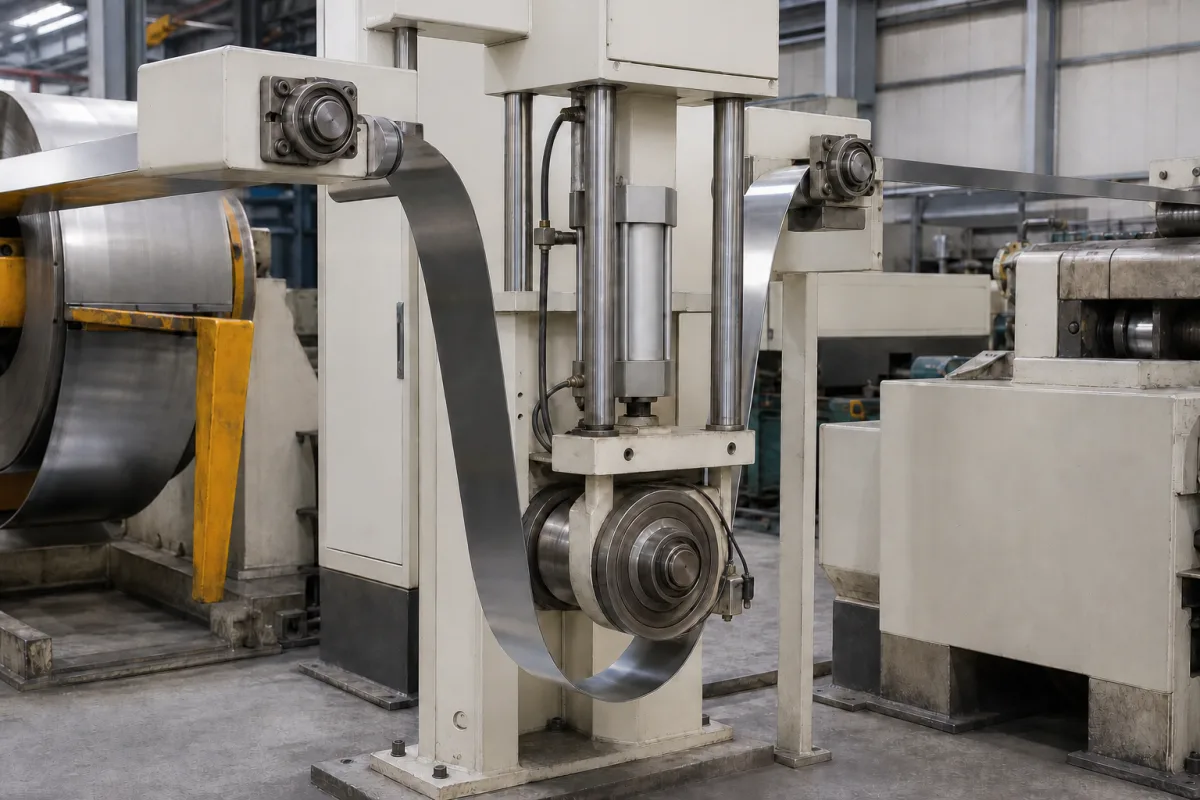
Loop control and dancer for coil-fed press lines: holding the strip loop between straightener and press feed
The strip loop between straightener and press feed on a coil-fed stamping line · dancer arm on a potentiometer, limit switches, ultrasonic or laser loop sensing, servo-driven looper rolls
On a stamping line fed from coil, the uncoiler and straightener move strip continuously, while the press feed advances it in steps timed to the press stroke. A loop of slack strip between the two machines absorbs that difference, and loop control keeps the loop between set upper and lower sizes. The loop is read either by a dancer arm resting on the strip or by a sensor looking at it, and the reading speeds up or slows down the straightener or a looper drive.
Loop control for coil-fed press and stamping lines: dancer or loop-follower arms, limit-switch loop controls, ultrasonic and laser loop sensors, and servo-driven looper rolls that keep the strip loop between uncoiler or straightener and the press feed. Web tension control on unwinds and rewinds, with load cells and dancers in converting and winding, is covered on the Tension control page. Press feeds, straighteners and uncoilers as machines, and accumulators of continuous strip-processing lines, are outside this page.
CNFX editorial research · Sources checked October 12, 2026 · 6 sources
Reading the loop: limit switches, a dancer roller on a potentiometer, or an ultrasonic sensor overhead
The three ways of reading the loop differ in what touches the strip and in whether the control gets a continuous signal or only high and low limits.
Minster's US 4,464,916 describes the simplest prior control as two limit switches, one near the floor that stops the straightener when the loop grows too large and one above the loop that starts it when the loop gets too tight; the patent notes that this supplies stock in a jerky fashion that can cause misfeeds and wears the straightener and its control through repeated starting and stopping. Its own loop follower is a pivoted control arm with a roller resting on the centre of the loop, linked to the shaft of a potentiometer through a timing belt or similar linkage that amplifies the arm's angle, so that the potentiometer output varies in proportion to loop size. [1]
Pepperl+Fuchs places a non-contact ultrasonic sensor such as its UC2000 analog model, or a laser sensor, above the centre of the sag loop; mounting from above keeps falling particles off the sensor, and the company writes that mechanical dancer arms can loosen, break, stick and wear out. [3] Its application report adds that the sensor can either report the distance to the loop continuously or switch at set high and low limits through two outputs, and that ultrasonic sensing is not affected by colour, surface gloss or swinging of the loop. [4]
The UC2000-30GM-IUR2-V15 data list a sensing range of 80 to 2,000 mm with a 0–80 mm dead band, 4–20 mA and 0–10 V outputs, resolution of the evaluation range divided by 4,000 but not finer than 0.35 mm, repeat accuracy ≤ 0.1% of full scale, a response delay of 65 ms minimum (195 ms factory setting) and temperature influence of ≤ 2% of full scale with temperature compensation or ≤ 0.2%/K without; it is IP65 and rated for −25 to 70 °C. [5] Editorial calculation: over a 1,000 mm evaluation range, 1,000/4,000 = 0.25 mm, so the 0.35 mm floor applies; without temperature compensation, a 10 K change could shift the reading by up to 2% of full scale.
State the strip width and thickness range, the surface (oiled, polished, pre-painted or perforated), the loop depth available above the floor or pit, the press speed and feed length, and whether the control should give a continuous signal or high and low limits.
02
What the loop signal drives: straightener speed, a servo looper, or the line layout
Each source closes the loop on a different drive, and the layout of the line sets how much loop there is to work with.
In Minster's control the potentiometer signal is compared with a reference the press setter can vary, and the result drives an eddy-current coupling between a constant-speed motor and the straightener rolls, which can range from complete decoupling to full drive; a three-digit thumbwheel divides maximum straightener speed into 999 parts, with a setting of 500 at about fifty percent of rated speed. The patent also lets the loop grow to a maximum size above its normal running size when the press stops, so that there is material to restart the straightener smoothly, and uses a cam-operated limit switch on the arm shaft to stop the straightener when the arm drops to a set position. [1]
Sankyo's US 5,392,977 targets high-speed presses, where repeated short feeds make the strip vibrate ('fluttering') in unpowered U- or S-shaped loopers and limit press speed. It places a pair of feed rollers driven by a servo motor near the intermittent feed device to push strip upward into the loop, with a position sensor above the rollers detecting the loop amount and a controller adjusting the servo to hold the loop; the patent states that this reduces fluttering and the load on the feed and lets a smaller loop shorten the press line. [2]
Bliss-Bret, a press maker in the HACO group, describes its control loop as compensating for the difference between the continuous straightening and the strip feed, fed from the straightener via a sensor, photocells or ultrasound. It warns that too much distance between straightener and feeder reduces loop reserve and affects feeder performance, and that the basket supporting the strip at the straightener exit must respect a minimum radius of curvature, depending on material strength and thickness, to avoid deforming the strip. Its standard decoiling lines cover strip widths from 50 to 1,000 mm and thicknesses from 0.4 to 7 mm, with ultrasonic or laser loop control and an optional laser probe to regulate loop height. [6]
03
Dancer arm, limit switches, ultrasonic sensor and servo looper compared
Explore company information and manufacturing capabilities, then discuss the scope of your project with a relevant supplier.
Share this page
Compiled and source-reviewed by the CNFX editorial team.
Each manufacturer above links to the page on that company's own website where the product is listed, with the date we checked it. How we source and review
· Page last updated 13 October 2026
Buyer questions
Why does a coil feed line need a loop before the press?
The straightener runs continuously while the press feed advances strip in steps; Minster's patent describes the loop as isolating the intermittent feed from the supply. [1]
Dancer arm or ultrasonic sensor for loop control?
A dancer arm rests on the strip and turns a potentiometer in proportion to loop size; Pepperl+Fuchs mounts an ultrasonic or laser sensor above the loop instead, avoiding contact and the wear of mechanical arms. [1][3]
How far can an ultrasonic loop sensor see?
Pepperl+Fuchs lists 80–2,000 mm for its UC2000-30GM-IUR2-V15, with a 0–80 mm dead band and 4–20 mA or 0–10 V outputs. [5]
Sources and what still needs a direct check
Sources checked 2026-10-12. Minster and Sankyo patents describe loop-follower and servo looper controls; Pepperl+Fuchs (sensor maker) and Bliss-Bret (press and line maker, HACO group) describe their own loop sensing and line layout.