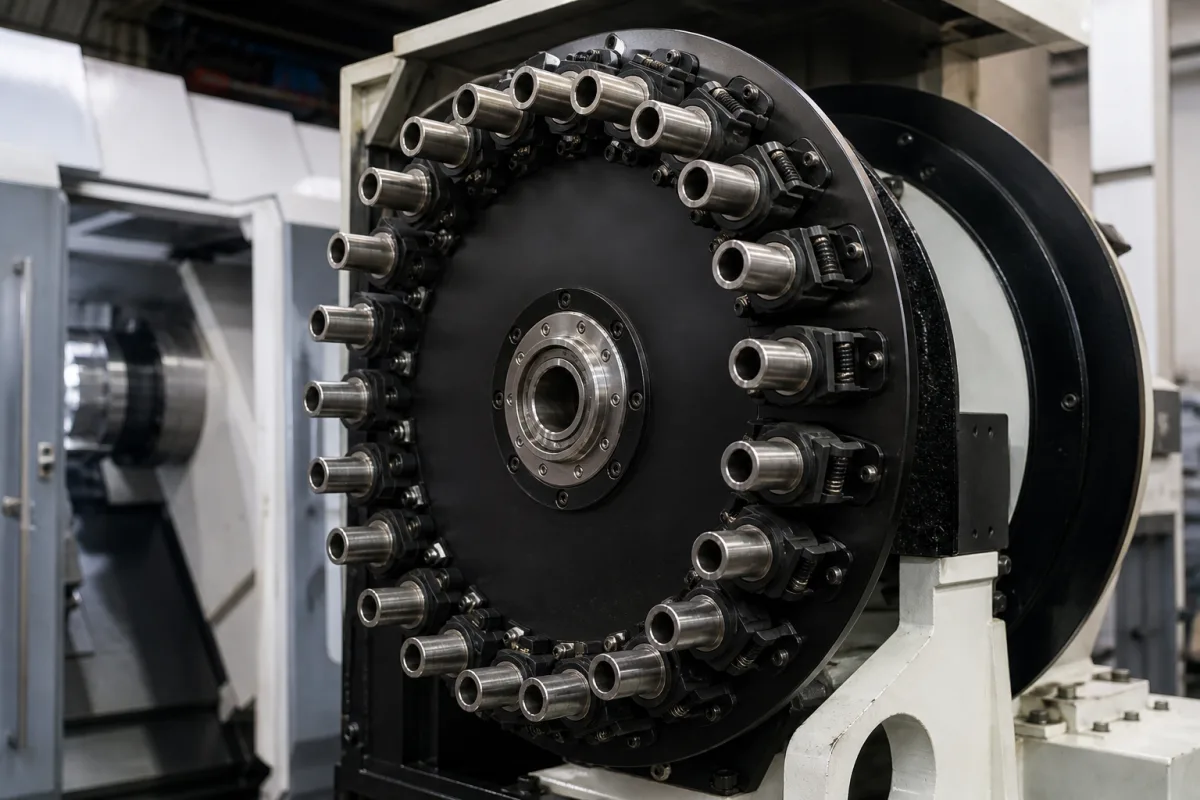
Tool magazine drum (carousel) and its tool pots: pocket count against tool length, ball-type pull-stud grips in each pot, and resin or metal pot construction
The rotating drum and the pots around its rim · how many pockets a drum can carry against tool length and diameter, how each pot grips a tool by its pull stud, and what the pots are made of
In a drum or carousel magazine the tools stand in pots (pockets) fixed around a rotating disc; the drum turns to bring a pot to the change position and must then hold every tool still while the machine accelerates, the drum indexes and the arm or spindle pulls a tool out. Buyers replacing a drum or its pots, or choosing between magazine sizes, are dealing with three things: how many pockets fit on the drum for a given tool length and diameter, how each pot holds the tool, and what the pot is made of.
Rotating drums (carousels, discs) of tool magazines for machining centres and their tool pots or pockets: pocket count and tool size limits, drum indexing and tool selection, pot gripping mechanisms (ball detents on the pull stud or shank) and pot materials. The magazine as a whole, with its sizing and total tool mass, is covered on the CNC tool magazine page; the double-gripper arm that exchanges tools between the drum and spindle on the Tool change arm page; cam indexers that step the drum on the Indexing mechanism page. Robot tool racks and lathe turrets are outside this page.
CNFX editorial research · Sources checked October 13, 2026 · 3 sources
More pockets, shorter tools: Brother's 14-, 21- and 28-pocket drums with 250 mm and 160 mm tool length and Ø110 mm tools
Brother's Speedio S300Xd1 and S500Xd1 compact machining centres use BT30 (MAS-BT30) tools in drum magazines of 14, 21 or 28 pockets; Brother describes the 28-tool unit as a compact drum type developed without losing tool change speed. Its specification table shows where adding pockets costs tool size:
Brother notes that actual tool weight limits differ with the configuration and the tool's centre of gravity, and that tools up to 3 kg are changed in the shortest time while 4 kg tools add a small amount of time. [1] Editorial calculation: with all 28 pockets used, the 35 kg total allows 1.25 kg per pocket on average, so a drum loaded with 3 kg tools reaches the total after 11 of them (33 kg); the per-pot rating and the drum's total rating are separate limits. [1]
Brother lists tool selection as the 'random shortcut method'. [1] Editorial note: with random selection the pot a tool returns to is not fixed to its tool number, so on a replacement drum the pot count, pot pitch and the controller's tool table have to agree.
Item (Brother specification table)
Value
Tool storage capacity
14 or 21 on one model column; 14, 21 or 28 on the other; the 28-tool magazine cannot be selected for the S300Xd1 [1]
Max. tool length
250 mm with the 14-tool magazine and 160 mm with the 21-tool magazine on the 14/21 column; 250 mm on the 14/21/28 column [1]
Tool to tool 0.6 s (14 or 21 tools) or 0.7 s (28 tools); chip to chip 1.2 s or 1.3 s [1]
Give the taper (BT30, BT40, HSK), pocket count, maximum tool length and diameter you need in every pocket, the heaviest tool and the total tool load, and whether the controller uses fixed or random pot assignment.
02
How a pot holds its tool: four spring-loaded balls on the pull stud, or a ball holder locked by a slide pin
Two patented pot designs show the two places a pot can hold a tool: at the pull stud behind the taper, or on the shank itself.
Tsubakimoto describes the earlier arrangement it replaced, in which a pin moving at right angles drove a separate ball pusher, as complicated to build and assemble and sensitive to the relative positions of pusher and pin. [3] Editorial note: in the AOI Seiko pot the holding comes from the coil springs behind the balls; in the Tsubakimoto pot the spring holds the slide pin in its clamped position and the change station must supply the push that releases it. [2][3]
The image above shows a drum of this kind: a black disc with metal pots around its rim, each with a spring clip at its side, on a stand beside the machine.
Pot design
How the tool is held
How it is released
AOI Seiko, US 7,094,190
A metal block at the bottom of the attachment hole carries four balls pushed toward the centre by coil springs; the balls grip the inserted pull stud and hold the tool with its taper shank against the pot's tapered inner wall [2]
Not detailed in the patent text reviewed
Tsubakimoto Chain, US 6,003,416
A ball holder fixed in the pot carries balls in radial holes; a spring pulls a slide pin back so its clamp cam surface forces the balls outward into a ball-engagement groove on the tool shank [3]
An external force pushes the slide pin forward, bringing an unclamp gap under the balls so they can retract and the tool can be removed [3]
Ask which part of the tool the pot grips (pull stud, shank groove or taper), what releases it at the change position, and whether pots and their springs or balls are sold as replacement parts.
03
What the pot is made of: unfilled nylon 66 against the tool, 30 % glass-fibre nylon outside
AOI Seiko's patent is about the pot body. It describes two earlier designs, a phenolic-resin inner wall inside a glass-fibre-filled ABS outer wall, and a single-layer pot moulded entirely from filled ABS, and the problem with the second: a rigid filler-laden inner wall can damage tools that are dislocated in the pot. [2]
Its own pot has an inner wall of thermoplastic with less than 5 weight % reinforcing filler toward the opening of the attachment hole, inside an outer wall with 5 to 60 weight % (preferably 15 to 60 %). In the embodiment both are nylon 66: the inner wall unfilled and the outer wall with 30 weight % glass fibre. [2] Below 5 % filler the outer wall does not stop the inner wall deforming; above 60 % the outer wall is difficult to mould. [2]
Because both walls are the same thermoplastic, the pot can be melted down and recycled, and AOI Seiko states that using recycled material can cut the pot's manufacturing cost to one quarter to one fifth. [2] Other resins named are ABS, polyacetal, polystyrene and polycarbonate, with carbon fibre, mica or calcium carbonate as alternative fillers. [2]
State the pot material wanted (steel or resin, and which resin and filler), and whether the inner surface that touches the tool taper must be softer than the tool holder.
04
Drum and pot details to send
Paste it into your enquiry below or into an email to a maker, then replace every bracket.
Drum: [pocket count; pitch; direction and drive]
Tools: [taper; max length; max diameter; heaviest tool; total load]
Selection: [fixed or random pot assignment]
Pots: [grip on pull stud or shank; release at change position]
Material: [steel or resin; filler; inner wall]
Spares: [pots; springs; balls; clips]
Explore company information and manufacturing capabilities, then discuss the scope of your project with a relevant supplier.
Share this page
Compiled and source-reviewed by the CNFX editorial team.
Each manufacturer above links to the page on that company's own website where the product is listed, with the date we checked it. How we source and review
· Page last updated 13 October 2026
Buyer questions
Does a bigger tool drum reduce the tool size it can take?
It can. On one Brother Speedio model column the 14-tool drum accepts 250 mm tools and the 21-tool drum 160 mm, while all sizes take Ø110 mm BT30 tools of 3 kg each. [1]
How does a tool pot hold the tool holder?
AOI Seiko's pot grips the pull stud with four spring-loaded balls; Tsubakimoto's pot pushes balls into a groove on the shank with a spring-loaded slide pin that is pushed forward to release. [2][3]
What are plastic tool pots made of?
AOI Seiko's patent describes an unfilled nylon 66 inner wall that touches the tool inside a nylon 66 outer wall with 30 weight % glass fibre. [2]
Sources and what still needs a direct check
Sources checked 2026-10-13. Three sources from three publishers: Brother Industries' specification page for the Speedio S500Xd1 and S300Xd1 drum magazines, AOI Seiko's US patent 7,094,190 on a two-wall resin tool pot with a four-ball pull-stud grip, and Tsubakimoto Chain's US patent 6,003,416 on a ball-holder pot released by a slide pin.