Industry-Verified Manufacturing Data (2026)

Orientation/Alignment Station

Based on aggregated insights from multiple verified factory profiles within the CNFX directory, the standard Orientation/Alignment Station used in the Machinery and Equipment Manufacturing sector typically supports operational capacities ranging from standard industrial configurations to heavy-duty production requirements.

Technical Definition & Core Assembly

A canonical Orientation/Alignment Station is characterized by the integration of Alignment Sensor Array and Servo-Driven Alignment Pusher. In industrial production environments, manufacturers listed on CNFX commonly emphasize Aluminum Alloy construction to support stable, high-cycle operation across diverse manufacturing scenarios.

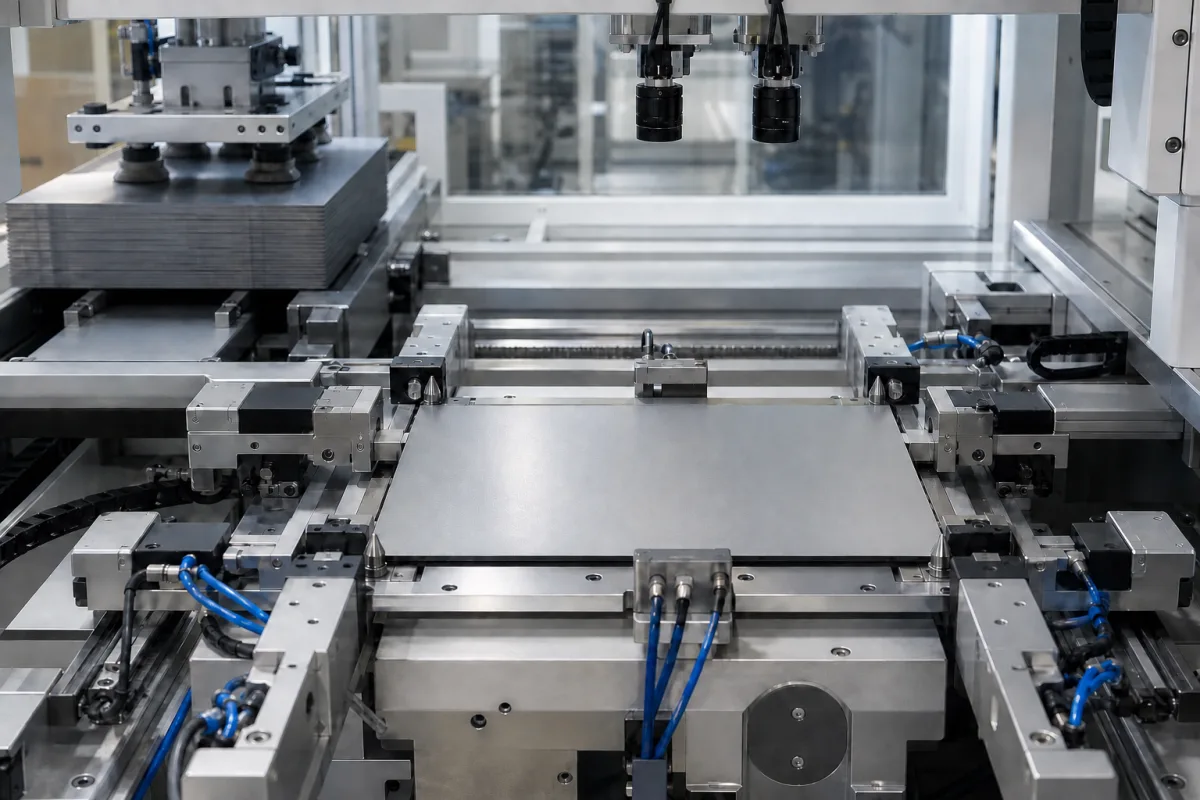
A station within a lamination module that precisely orients and aligns materials before stacking.
Product Specifications

Technical details and manufacturing context for Orientation/Alignment Station

Definition
The Orientation/Alignment Station is a critical component of the Lamination Feeding and Stacking Module. Its primary function is to receive incoming materials (e.g., sheets, films, or layers) and ensure they are correctly positioned and aligned according to the required orientation before being passed to the stacking or lamination stage. This ensures precise layer registration and prevents misalignment defects in the final laminated product.
Working Principle
The station typically uses a combination of mechanical guides, sensors (e.g., optical or edge sensors), and actuators (e.g., servo motors, pneumatic pushers, or rotating platforms). Sensors detect the position and orientation of the incoming material. Based on this feedback, the control system activates the actuators to make fine adjustments—such as shifting, rotating, or centering the material—until it meets the predefined alignment criteria. Once aligned, the material is released to the next stage of the module.
Common Materials
Aluminum Alloy, Stainless Steel, Engineering Plastics
Technical Parameters
  • Alignment accuracy/tolerance, e.g., ±0.5mm (mm) Standard Spec
Components / BOM
Engineering Reasoning
0.5-2.0 N·m torque, 0.01-0.05 mm positional accuracy, 15-25°C ambient temperature
Torque exceeding 2.5 N·m causes gearbox shear failure, positional error >0.1 mm triggers alignment rejection, temperature >40°C induces thermal expansion mismatch
Design Rationale: Gear tooth shear stress exceeds 250 MPa yield strength (AISI 4140 steel), cumulative positioning error from stepper motor's 1.8° step angle resolution, differential thermal expansion coefficient mismatch (aluminum: 23.1 μm/m·K vs steel: 11.7 μm/m·K)
Risk Mitigation (FMEA)
Trigger Servo motor encoder signal loss due to EMI exceeding 85 dBμV/m at 100 MHz
Mode: Uncontrolled rotation causing 0.5 mm positional drift per cycle
Strategy: Shielded twisted-pair cabling with ferrite chokes and differential signal conditioning
Trigger Vacuum gripper seal degradation from ozone exposure >0.1 ppm for 5000 hours
Mode: Gripping force reduction from -80 kPa to -40 kPa causing material slippage
Strategy: FKM fluorocarbon seals with 0.5 mm PTFE coating and UV-ozone resistant compound

Industry Taxonomies & Aliases

Commonly used trade names and technical identifiers for Orientation/Alignment Station.

Applied To / Applications

This component is essential for the following industrial systems and equipment:

Industrial Ecosystem & Supply Chain DNA

Complementary Systems
Downstream Applications
Specialized Tooling

Application Fit & Sizing Matrix

Operational Limits
pressure: Atmospheric to 0.5 bar gauge (light vacuum/holding)
other spec: Alignment accuracy: ±0.1 mm, Throughput: 100-500 parts/hour, Vibration tolerance: <0.1g RMS
temperature: 15-30°C (ambient controlled)
Media Compatibility
✓ Silicon wafers (100-300mm) ✓ Flexible polymer films (PET/PI) ✓ Glass substrates (0.1-1.1mm thickness)
Unsuitable: Abrasive slurry environments (e.g., CMP slurry with >5% solids)
Sizing Data Required
  • Maximum substrate dimensions (length x width x thickness)
  • Required alignment accuracy (in microns)
  • Production throughput (parts per hour)

Reliability & Engineering Risk Analysis

Failure Mode & Root Cause
Misalignment-induced wear
Cause: Improper initial alignment or thermal expansion causing excessive stress on bearings and guides, leading to premature failure.
Sensor drift/failure
Cause: Environmental contamination (dust, oil mist), vibration, or electrical interference affecting position feedback accuracy, resulting in incorrect orientation.
Maintenance Indicators
  • Increased vibration or audible knocking during operation indicating mechanical looseness or wear
  • Consistent orientation errors or repeated rejection of properly positioned parts signaling sensor or control system issues
Engineering Tips
  • Implement laser alignment verification during installation and periodic thermal growth compensation adjustments to maintain precision
  • Install protective enclosures with positive air pressure for sensors and use shielded cables with proper grounding to prevent electrical interference

Compliance & Manufacturing Standards

Reference Standards
ISO 9001:2015 Quality Management Systems ANSI/ASME B5.54-2005 Methods for Performance Evaluation of Computer Numerically Controlled Machining Centers DIN 8606:1990 Machine Tools; Test Conditions for Machining Centers; Geometric Tests
Manufacturing Precision
  • Angular Alignment: +/-0.01 degrees
  • Positional Repeatability: +/-0.005mm
Quality Inspection
  • Laser Interferometer Alignment Test
  • Coordinate Measuring Machine (CMM) Verification

Factories Producing Orientation/Alignment Station

Verified manufacturers with capability to produce this product in China

✓ 92% Supplier Capability Match Found

P Procurement Specialist from United States Feb 28, 2026
★★★★★
"Impressive build quality. Especially the technical reliability is very stable during long-term operation."
Technical Specifications Verified
T Technical Director from United Arab Emirates Feb 25, 2026
★★★★★
"As a professional in the Machinery and Equipment Manufacturing sector, I confirm this Orientation/Alignment Station meets all ISO standards."
Technical Specifications Verified
P Project Engineer from Australia Feb 22, 2026
★★★★★
"Standard OEM quality for Machinery and Equipment Manufacturing applications. The Orientation/Alignment Station arrived with full certification."
Technical Specifications Verified
Verification Protocol

“Feedback is collected from verified sourcing managers during RFQ (Request for Quote) and factory evaluation processes on CNFX. These reports represent historical performance data and technical audit summaries from our B2B manufacturing network.”

14 sourcing managers are analyzing this specification now. Last inquiry for Orientation/Alignment Station from USA (39m ago).

Supply Chain Compatible Machinery & Devices

Heavy-Duty CNC Plasma Cutting Machine

Industrial machine for precision metal cutting using plasma arc technology

Explore Specs →
Automated Assembly Line System

Integrated production system for sequential component assembly operations

Explore Specs →
Automated Powder Coating System

Integrated industrial system for applying dry powder coatings to metal substrates.

Explore Specs →
Centrifugal Pump Impeller

Rotating component that transfers energy to fluid in centrifugal pumps.

Explore Specs →

Frequently Asked Questions

What materials are used in the construction of the orientation/alignment station?

The station is constructed from durable materials including aluminum alloy for lightweight structural components, stainless steel for wear-resistant parts, and engineering plastics for precision guides and insulators.

How does the alignment sensor array ensure precise material positioning?

The sensor array uses multiple high-resolution sensors to detect material edges and reference points, providing real-time feedback to the servo-driven alignment pusher for micron-level positioning accuracy before stacking.

What industries typically use this type of orientation station?

This equipment is essential in machinery and equipment manufacturing, particularly in lamination processes for electronics, composite materials, packaging, and any application requiring precise layer alignment before bonding or stacking.

Can I contact factories directly on CNFX?

CNFX is an open directory, not a transaction platform. Each factory profile provides direct contact information and production details to help you initiate direct inquiries with Chinese suppliers.

Get Quote for Orientation/Alignment Station

Request technical pricing, lead times, or customized specifications for Orientation/Alignment Station directly from verified manufacturing units.

Your business information is encrypted and only shared with verified Orientation/Alignment Station suppliers.

Thank you! Your message has been sent. We'll respond within 1–3 business days.

Need to Manufacture Orientation/Alignment Station?

Connect with verified factories specializing in this product category

Add Your Factory Contact Us
Previous Product
Orientation Track/Selector
Next Product
Orientation/Selection Track