Overhead Conveyor System
View system integration details
This page explains how Overhead Track is classified within Machinery and Equipment Manufacturing. Technical values and manufacturer relationships are research references; confirm the current specification and supplier evidence for each order.
The structural rail system that supports and guides overhead conveyor trolleys or carriers.
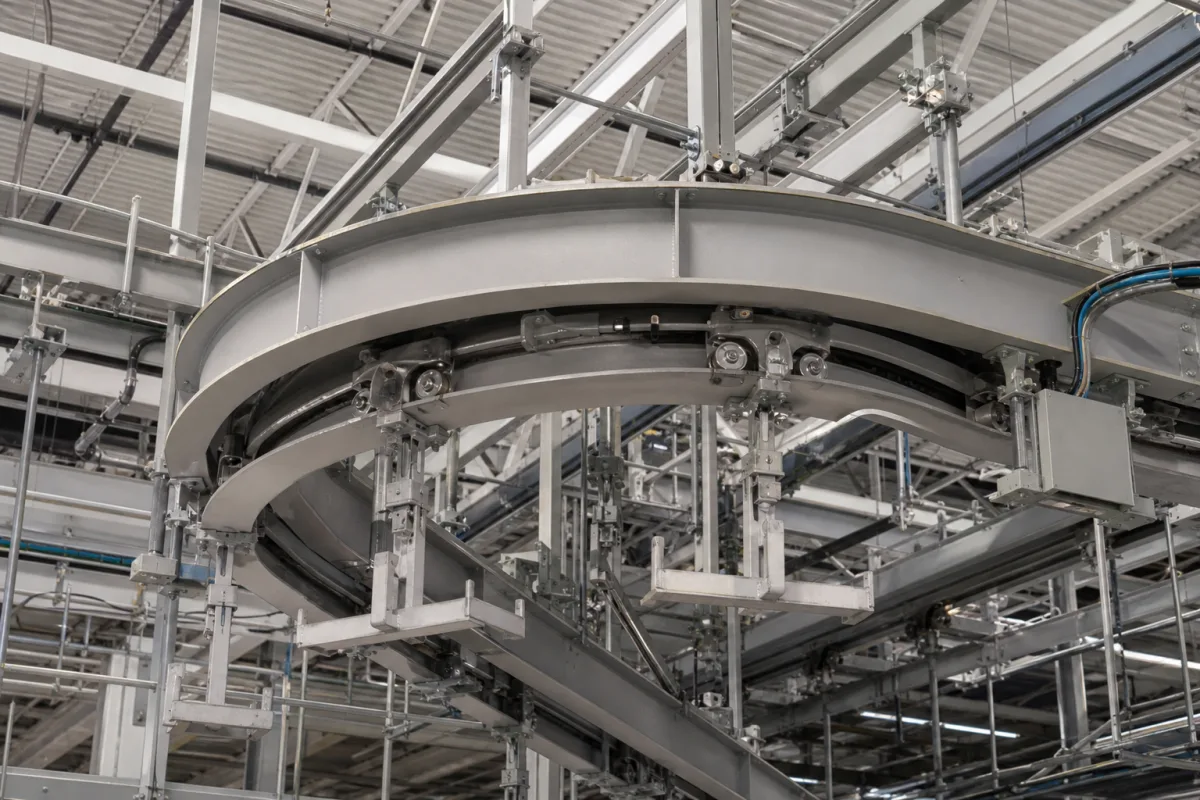
Technical details and manufacturing context for Overhead Track
| Parameter | Typical range | Notes & selection driver |
|---|---|---|
| Rail Section Height | 80–200 mm | Determines load capacity and stiffnessDIN 1025 |
| Rail Flange Width | 40–100 mm | Matches trolley wheel profileDIN 1025 |
| Rail Section Modulus | 50–500 cm³ | Resists bending under loadDIN 1025 |
| Maximum Trolley Load | 500–5000 kg | Per trolley; depends on rail size and support spacing |
| Support Spacing | 1.5–3.0 m | Closer spacing increases load capacity |
| Straightness Tolerance | ±1.5 mm/m | Ensures smooth trolley movementISO 12488-1 |
| Surface Roughness | Ra 3.2–6.3 μm | Affects wear and rolling resistanceISO 1302 |
| Material Grade | Q235B–Q355B | Higher grade for heavier loads or low-temperature serviceGB/T 700, GB/T 1591 |
| Surface Treatment | Hot-dip galvanized | Corrosion protection for outdoor or humid environmentsISO 1461 |
| Operating Temperature | -20–80 °C | Below -20°C may require low-temperature steel |
| Rail Weight | 15–60 kg/m | Affects structural support designDIN 1025 |
Ranges are indicative industry figures for RFQ preparation, not a supplier commitment. Confirm every value and standard with the legal manufacturer before ordering.
| speed range: | 0.1 to 60 m/min |
| temperature: | -20°C to 80°C |
| load capacity: | Up to 500 kg per trolley |
Indicative industry ranges for design and RFQ preparation. Confirm the exact figures and applicable standard with the manufacturer before specifying.
Quoted from the published standard.
A practical evidence checklist for RFQ preparation and supplier evaluation.
Compare the published product scope and source details, then include your specifications and quantity in an enquiry.
Manufacturer profiles associated with Overhead Track.
Explore company information and manufacturing capabilities, then discuss the scope of your project with a relevant supplier.
Ask for use case, specification boundaries, supplier type, and RFQ preparation information for this product.
The maximum trolley load is listed as 500–5000 kg per trolley, depending on rail size and support spacing. This is a reference range; the actual capacity for a specific track model must be confirmed with the manufacturer.
Relevant standards include DIN 1025 for rail dimensions, ISO 12488-1 for straightness tolerance, ISO 1302 for surface roughness, ISO 1461 for hot-dip galvanizing, and GB/T 700 and GB/T 1591 for material grades. These are verification references, not proof of certification.
Closer support spacing increases load capacity by reducing bending stress. The reference range is 1.5–3.0 m. The optimal spacing depends on the rail size and expected loads, and should be determined by engineering analysis.
Regular inspection for wear, deformation, and corrosion is recommended. Check the rail surface for roughness and straightness. Ensure that support structures are secure. Any damage should be repaired or the track replaced to maintain safe operation.
This component is essential for the following industrial systems and equipment:
Editorial classification, named public sources where available, and source-reviewed manufacturer records.
Compare manufacturer profiles with relevant product and process capability.