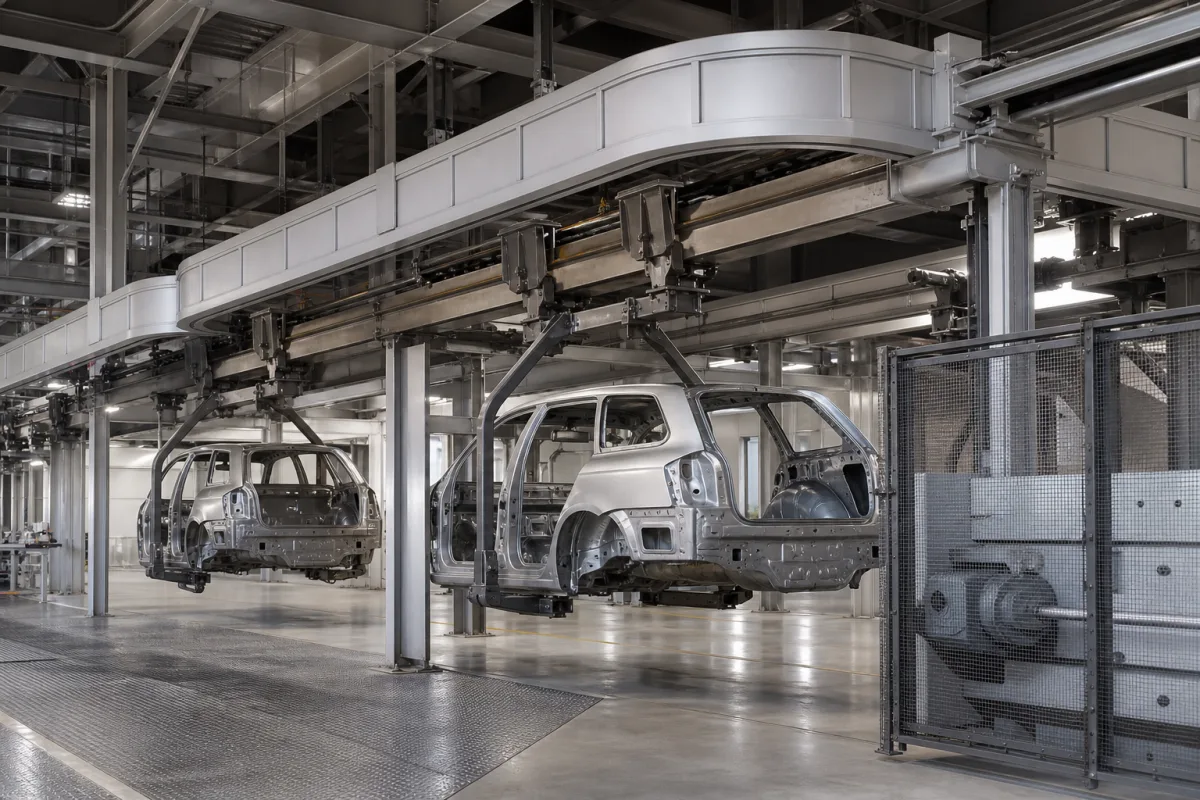
Overhead power-and-free conveyor with load carriers for vehicle body, paint and assembly shops
Overhead power-and-free conveyors · Enclosed track versus I-beam, X-348/X-458/X-678 rivetless chain, carrier load, accumulation for body and paint shops
An overhead power-and-free conveyor carries loads on trolleys that run in a free track beneath a powered chain track: dogs on the chain push the free trolleys, and stops disengage them so carriers can wait, queue or switch lines without stopping the chain. In vehicle plants it moves bodies and parts through body, paint and assembly shops. Ask three things first: the track system and the load per carrier it is rated for, the chain size and its strength, and where carriers must stop, accumulate, transfer or lift.
Overhead chain-driven power-and-free and I-beam trolley conveyors with load bars, hangers or body carriers, for vehicle body, paint and final assembly shops and for coating lines. Conveyor systems as a plant-wide category (belt, roller, chain, screw and modular, with guarding rules) are covered on the Conveyor systems page. Floor skid conveyors, automated guided vehicles, electrified monorails sold without chain, and conveyor chain sold alone are outside this page except where compared.
CNFX editorial research · Sources checked October 12, 2026 · 4 sources
Pick the track system and chain for the load per carrier
Jervis B. Webb Company's announcement of its Unibilt 348 system, reported by Material Handling & Logistics in 2004, describes a power-and-free conveyor that runs X-348 rivetless power chain in Unibilt enclosed track with a four-wheel steel trolley engaging heavy-duty free trolleys. It offers the same 1,500 lb (680 kg) load capacity as conventional 3 in I-beam power-and-free conveyors, with a more compact profile and cleaner, quieter running, and supports unassisted chain-to-chain transfers. [1]
Hangzhou Color Powder Coating Equipment, a Chinese coating-line maker, lists two overhead conveyor families: a lightweight track conveyor with single-point loads under 100 kg, and X348, X458 and X678 I-beam heavy-duty conveyors for 100–500 kg loads, with rivetless chain drop-forged from high-strength carbon steel. It names rails or I-beam, chain, drive unit, hangers, trolleys and a tension device as the parts of a complete system. [2]
USA Roller Chain's table lists pitch, ultimate strength and weight for these chains: X348 3.031 in pitch, 24,000 lb, 2.2 lb/ft; X458 4.031 in, 48,000 lb, 3.2 lb/ft; X678 6.031 in, 85,000 lb, 6.7 lb/ft. It notes the chain is used in automotive manufacturing, trolley systems and overhead conveying. [3]
Editorial calculation: those pitches are about 77.0, 102.4 and 153.2 mm, and the strengths about 106.8, 213.5 and 378 kN (1 lbf = 4.448 N). The 1,500 lb carrier rating is 1/16 of X-348's 24,000 lb ultimate strength, but chain pull depends on the total loaded length, curves and drives, so ask the supplier for the chain-pull calculation, not the carrier rating alone. [1][3]
Give the supplier the load (body or part, mass, centre of gravity, size), carriers needed and pitch between them, the route with curves, inclines and elevation changes, the stations where carriers must stop, queue, transfer, lift or lower, line rate, ambient (including paint ovens), drive and tension positions, the controls interface and the plant's safety rules for overhead loads.
02
Plan where carriers stop, queue and transfer
Hanna Technology's product page describes a power-and-free overhead conveyor as one that can transport and temporarily store workpieces on the line, stopping workpieces from continuing and adjusting their spacing and movement; it lists an automatic lift system for loading and unloading and automatic fast and slow chain-speed transfer. [4]
Webb's enclosed-track version is described as offering unassisted chain-to-chain transfers and longer runs with fewer drives. [1] Editorial note: list every station where a carrier must stop and every buffer the line needs, because stops, switches and lifts are where power-and-free cost and controls differ from a simple I-beam trolley conveyor that moves all carriers at chain speed.
03
Light track, I-beam or enclosed-track power-and-free: load per carrier
The four overhead types differ first in how much one carrier may hang, from under 100 kg on light track to 680 kg on Webb's enclosed-track power-and-free.
Two Chinese coating-line builders with overhead and power-and-free conveyors
Hangzhou Color and Hanna Technology both build these conveyors as part of powder coating lines; neither page shown here describes a body-shop or final-assembly installation.
The listings kept come from coating-line builders; ask each for the track and chain sizes, carrier rating and chain-pull calculation for your loads.
05
Track, X-series chain, drives, trolleys, body carriers and stops
Hangzhou Color names rails or I-beam, chain, drive unit, hangers, trolleys and a tension device as a complete system; power-and-free adds the stops, switches and lifts Hanna describes.
Part
Role
Fix in the order
Overhead track
Enclosed track or I-beam carrying trolleys. [1][2]
Overhead conveyor quotation: carrier rating, chain pitch and stop positions
Carrier ratings come from Webb and Hangzhou Color, and chain pitch from the chain table; drive power, speed and stop repeatability depend on your route and must come from the supplier's chain-pull calculation.
Field
What it means and published values
Ask the supplier for
Rated Load Capacity (kg)
680 kg per load (Unibilt 348); 100–500 kg I-beam; <100 kg light track. [1][2]
Rating per carrier and trolley.
Chain Speed (m/min)
Fast and slow transfer speeds on power-and-free. [4]
Explore company information and manufacturing capabilities, then discuss the scope of your project with a relevant supplier.
Share this page
Compiled and source-reviewed by the CNFX editorial team.
Each manufacturer above links to the page on that company's own website where the product is listed, with the date we checked it. How we source and review
· Page last updated 13 October 2026
Buyer questions
What does power-and-free mean?
Loads ride on free trolleys pushed by a powered chain; Hanna's page describes the system storing workpieces on the line and adjusting their spacing. [4]
How much can a power-and-free carrier hold?
Jervis B. Webb's Unibilt 348 and conventional 3 in I-beam power-and-free are both described at 1,500 lb (680 kg). [1]
How strong is X-348 chain?
USA Roller Chain lists 24,000 lb ultimate strength and 3.031 in pitch; X-458 is 48,000 lb and X-678 85,000 lb. [3]
Sources and what still needs a direct check
Sources checked 2026-10-12. The Webb description is a maker announcement reported by Material Handling & Logistics; USA Roller Chain lists chain data; Hangzhou Color and Hanna Technology describe their own conveyors.