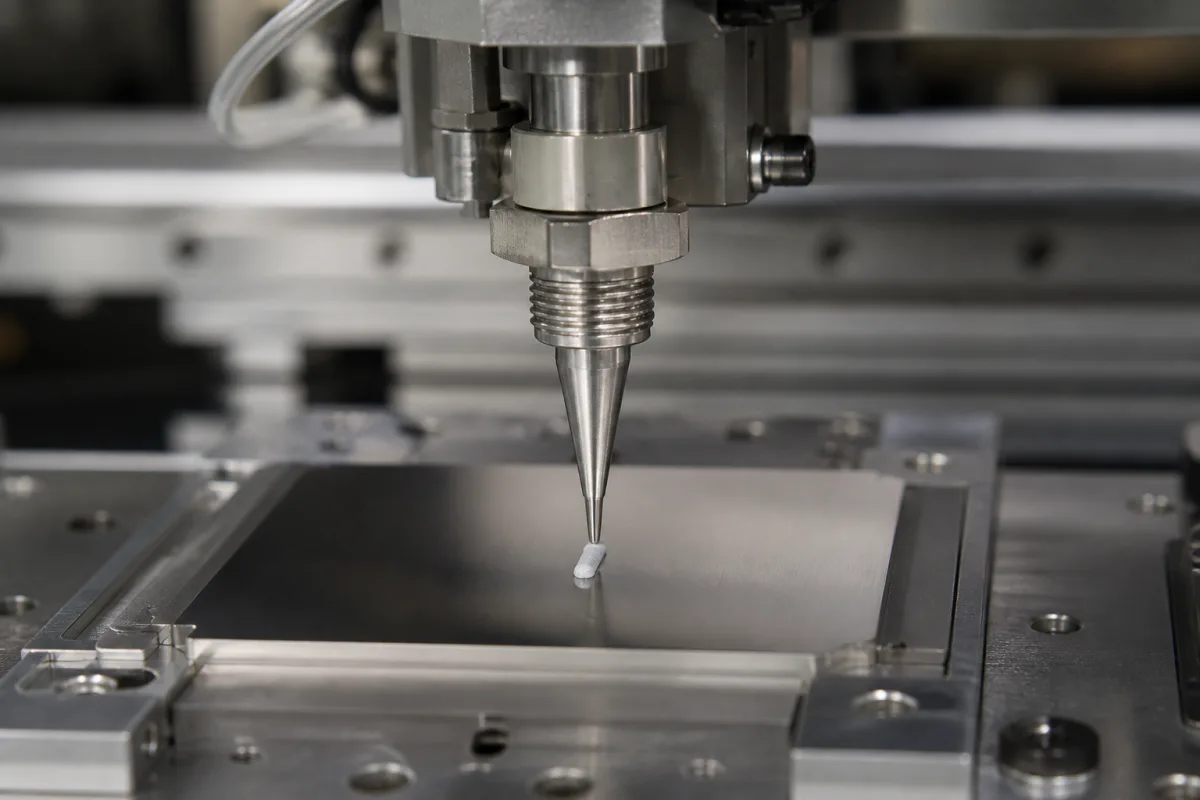
Precision dispensing nozzle: the orifice and hardened insert at the outlet of a dispensing or jet valve
Valve-mounted dispensing nozzles and nozzle inserts · orifice diameter, extended tip length, ceramic, carbide and hardened-steel inserts against seat and orifice wear
A precision dispensing nozzle is the replaceable outlet of a dispensing or jet valve: a threaded or clamped body, and inside it the seat, discharge passage and exit orifice that every dot of adhesive or paste, thermal paste included, passes through. Its orifice diameter and tip length fix what drop or bead the valve can place and where it can reach; the hardness of the insert that carries the seat and orifice fixes how long the drop volume stays within limits before the nozzle has to be replaced.
Replaceable nozzles, nozzle plates and orifice inserts for automated dispensing and jet valves: orifice size, tip geometry, insert and hub materials, and wear. Choosing the valve itself (needle, diaphragm, jetting, auger or rotor-stator) is covered on the Dispensing valve for adhesives and assembly fluids page; syringe barrels with their pistons and luer-lock tips are covered on the Dispensing syringe barrel page. Spray nozzles, filling nozzles for beverage and liquid fillers and 3D-printer nozzles are outside this page.
CNFX editorial research · Sources checked October 12, 2026 · 3 sources
Orifice diameter and tip reach: from 15 µm ceramic bores to 700 µm jet nozzles
A Nordson patent on jet dispenser nozzles states that the dimensions of the nozzle at least in part influence the volume of each ejected droplet, so the orifice is chosen with the dot, not after it. [1]
Editorial calculation from Graco's range: the largest 700 µm orifice is 14 times the diameter of the smallest 50 µm orifice and (700/50)² = 196 times its cross-sectional area, so one valve body can be moved from fine dots to heavy beads by changing the nozzle plate alone. [2]
The extended tips matter on populated boards and housings: Graco describes them for getting close to targets inside vias or cavities and around obstacles, which a flat nozzle plate held at a stand-off cannot reach. [2] Graco also notes that its newer nozzle plates replace consumable rubber o-rings with built-in metal diaphragm o-rings, which changes what has to be stocked as spares. [2]
Published nozzle range
Orifice or bore
Material
Other stated figures
Graco Advanjet standard flat nozzles (diaphragm jet valve)
Made by ceramic injection moulding for batch-to-batch reproducibility in high quantities [3]
Give the supplier the dot or bead size you need, the fluid's viscosity and filler, the stand-off or reach into the part, and the valve model the nozzle must fit.
02
Insert hardness against seat and orifice wear: alumina, tungsten carbide, tool steel or stainless
Nordson's patent US 2009/0095825 describes the wear problem directly: the valve member strikes the seat for every droplet, the nozzle is in continuous contact with material at elevated temperature and pressure, and once droplet-volume variation reaches the quality limit the nozzle is replaced. Its answer is a two-part nozzle, a machinable hub holding a harder insert that carries the seat, discharge passage and exit orifice. [1]
Editorial calculation from the patent's figures: an 85% alumina insert at 800–900 HV is about 5.3–6 times as hard as the 150 HV stainless hub, and a hardened tool-steel insert at 700 HV about 4.7 times. The patent also lists surface treatments for a metal seat instead of a separate ceramic part: heat treatment or work hardening, chrome plating, HVOF-sprayed metallic carbide coatings, PaCVD, ion implantation and diffusion processes. [1]
The patent states that a harder insert decreases both short-term and long-term variation in droplet volume, cuts material consumption and downtime, and that these savings may more than offset the higher cost of the insert. It also keeps the volume between seat and exit orifice to a minimum. [1] Graco makes the same material choice at the plate level, offering its jet nozzles in tungsten carbide or wear-resistant ceramic, and SPT moulds nozzles in zirconia, zirconia-hardened alumina and ruby. [2][3]
Ask which material forms the seat and the orifice (not only the body), its hardness, whether the orifice is ground or moulded, and the replacement interval the supplier expects for a filled paste at your temperature and cycle rate.
03
Describe the dot, the fluid and the valve the nozzle fits
Paste it into your enquiry below or into an email to a maker, then replace every bracket.
Valve: [make and model; jet, needle or diaphragm; thread or clamp]
Orifice: [diameter µm; tolerance; ground or moulded]
Tip: [flat plate or extended tip; length mm; stand-off]
Insert: [ceramic, tungsten carbide, ruby or hardened steel; hardness]
Fluid: [adhesive or paste; viscosity cP; filler type and size; temperature]
Output: [dot diameter or bead width; cycle rate Hz; drop-volume tolerance]
Wear: [expected cycles per nozzle; spare-part list]
1 company lists this product among what they make. Company figures are quoted from each
company's own website; every card states where the relationship came from.
Small Precision Tools Co. Ltd.
Manufacturing site to be confirmed for the order
Lists ceramic precision nozzles made by ceramic injection moulding in zirconia, zirconia-hardened alumina and polycrystalline ruby, with hole diameters from 15 µm and tolerances from 1 µm.
Explore company information and manufacturing capabilities, then discuss the scope of your project with a relevant supplier.
Share this page
Compiled and source-reviewed by the CNFX editorial team.
Each manufacturer above links to the page on that company's own website where the product is listed, with the date we checked it. How we source and review
· Page last updated 13 October 2026
Buyer questions
What orifice sizes do jet-valve nozzles come in?
Graco lists its Advanjet nozzles from 50 to 700 µm in tungsten carbide or ceramic; SPT moulds ceramic nozzle bores from 15 µm. [2][3]
Why do dispensing nozzles wear out?
Nordson's patent explains that the valve member strikes the seat on every droplet while the nozzle is in contact with material at elevated temperature and pressure; the nozzle is replaced when drop-volume variation reaches the quality limit. [1]
How much harder is a ceramic nozzle insert than stainless steel?
The Nordson patent gives about 800–900 HV for 85% alumina against about 150 HV for annealed 300-series stainless, roughly 5–6 times (editorial calculation). [1]
What is an extended tip nozzle for?
Graco offers 3, 6 and 10 mm extended tips for jetting into vias, cavities and tight spaces or around obstacles. [2]
Sources and what still needs a direct check
Sources checked 2026-10-12. Nordson's patent explains nozzle wear and insert materials in jet dispensers; Graco's product page gives orifice sizes, materials and tip lengths for its jet-valve nozzles; SPT's page states the bore sizes and ceramics it moulds.