Precision Stamping Module
View system integration details
This page explains how Precision Press Frame is classified within Machinery and Equipment Manufacturing. Technical values and manufacturer relationships are research references; confirm the current specification and supplier evidence for each order.
The structural foundation of a precision stamping module that provides rigidity, stability, and alignment for stamping operations.
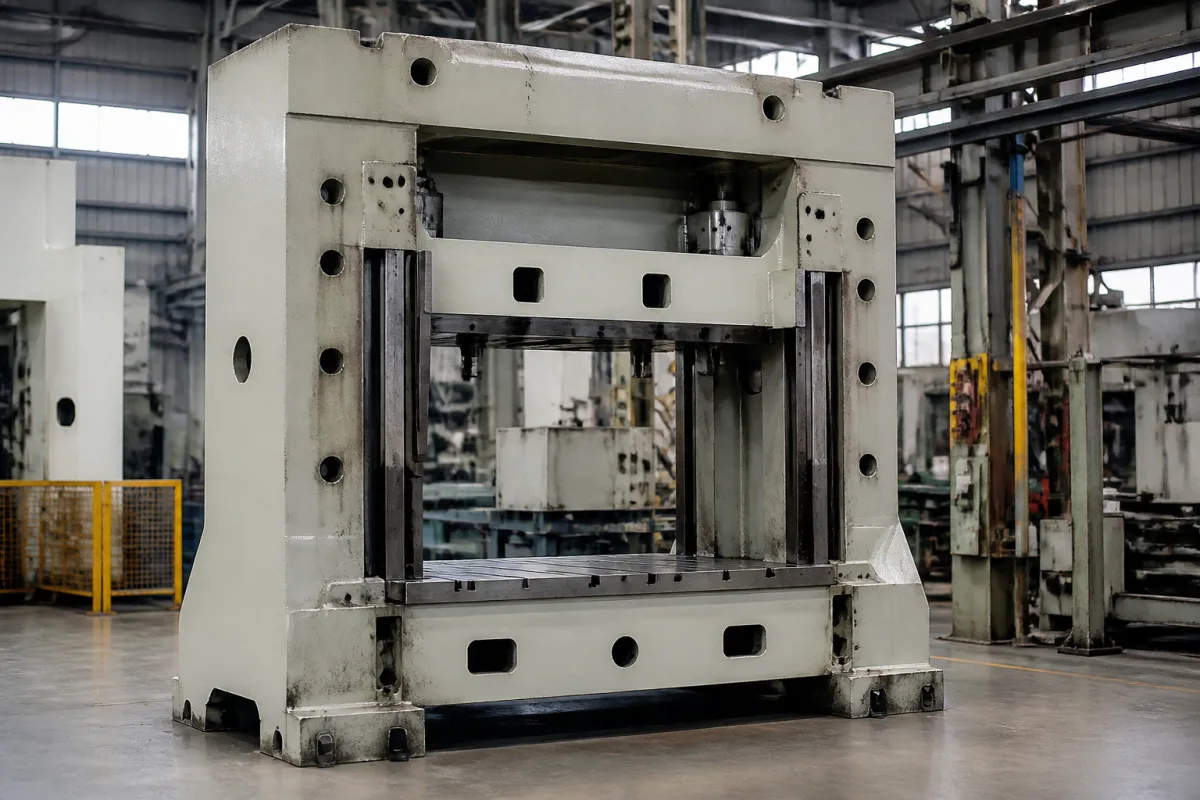
Technical details and manufacturing context for Precision Press Frame
| Parameter | Typical range | Notes & selection driver |
|---|---|---|
| Rated Capacity | 100–500 kN | Determines maximum stamping force. |
| Stroke Length | 50–200 mm | Affects part size and die clearance. |
| Shut Height | 200–500 mm | Must match die height. |
| Parallelism | ±0.02 mm | Ensures uniform stamping pressure.ISO 1101 |
| Flatness | ±0.05 mm | Critical for die mounting.ISO 1101 |
| Operating Pressure | 1.0–1.6 MPa | |
| Supply Voltage | 380 ±10% V AC | Three-phase, 50/60 Hz.IEC 60038 |
| Operating Temperature | -10–50 °C | Outside this range, seals may fail. |
| Ingress Protection | IP54–IP65 | Protects against dust and water jets.IEC 60529 |
| Frame Material | HT250–HT300 | Gray cast iron for rigidity and damping.GB/T 9439 |
| Net Weight | 1500–8000 kg | Heavier frames provide better stability. |
| Footprint (L×W×H) | 1200×800×2000–2500×1500×3500 mm | Check floor space and ceiling height. |
Ranges are indicative industry figures for RFQ preparation, not a supplier commitment. Confirm every value and standard with the legal manufacturer before ordering.
| pressure: | Up to 500 MPa |
| other spec: | Maximum deflection under load: ≤0.05 mm/m |
| temperature: | -20°C to 150°C |
Indicative industry ranges for design and RFQ preparation. Confirm the exact figures and applicable standard with the manufacturer before specifying.
Quoted from the published standard.
A practical evidence checklist for RFQ preparation and supplier evaluation.
Compare the published product scope and source details, then include your specifications and quantity in an enquiry.
Manufacturer profiles associated with Precision Press Frame.
Explore company information and manufacturing capabilities, then discuss the scope of your project with a relevant supplier.
Ask for use case, specification boundaries, supplier type, and RFQ preparation information for this product.
The frame is available in cast iron (grades HT250–HT300 per GB/T 9439) or welded steel. Cast iron offers rigidity and damping, while welded steel may provide different weight and fabrication characteristics. Confirm the material grade with the supplier.
The rated capacity is listed as 100–500 kN. This determines the maximum stamping force the frame can withstand. Verify the exact capacity for your specific model to ensure it meets your application requirements.
The frame's parallelism is specified as ±0.02 mm and flatness as ±0.05 mm, both per ISO 1101. These tolerances are critical for die mounting and uniform stamping pressure. Confirm these values with the manufacturer for your model.
The operating pressure is 1.0–1.6 MPa per and the operating temperature range is -10 to 50 °C. Outside these ranges, seals may fail or performance may degrade. Always verify these parameters with the supplier.
This component is essential for the following industrial systems and equipment:
Editorial classification, named public sources where available, and source-reviewed manufacturer records.
Compare manufacturer profiles with relevant product and process capability.