Industry-Verified Manufacturing Data (2026)

Bed

Based on aggregated insights from multiple verified factory profiles within the CNFX directory, the standard Bed used in the Machinery and Equipment Manufacturing sector typically supports operational capacities ranging from standard industrial configurations to heavy-duty production requirements.

Technical Definition & Core Assembly

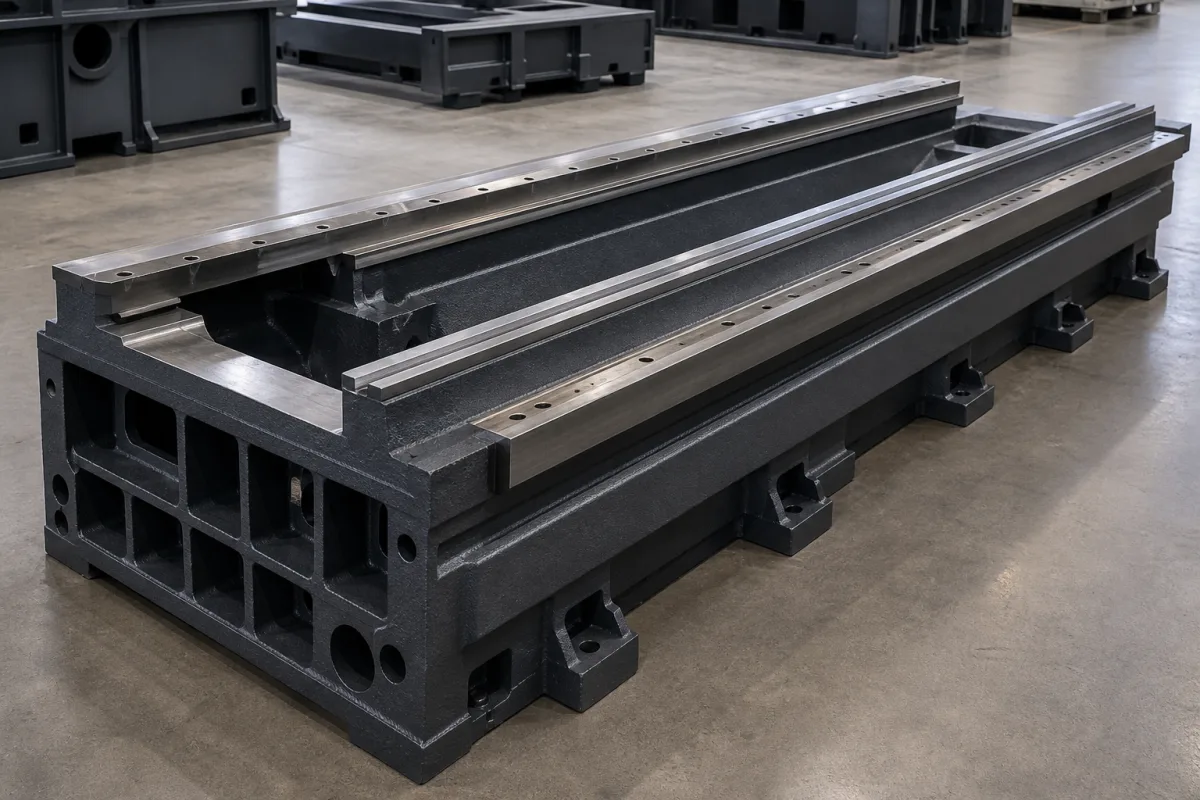
A canonical Bed is characterized by the integration of Guideways and Ribs/Webbing. In industrial production environments, manufacturers listed on CNFX commonly emphasize Cast Iron (Gray Iron or Ductile Iron) construction to support stable, high-cycle operation across diverse manufacturing scenarios.

The main structural foundation of a CNC lathe that provides rigidity, stability, and precision alignment for all moving components.
Product Specifications

Technical details and manufacturing context for Bed

Definition
In a Universal CNC Lathe, the bed is the primary structural component that forms the machine's backbone. It serves as the mounting platform for the headstock, tailstock, carriage, and other critical assemblies. Its primary function is to maintain geometric accuracy and absorb cutting forces during machining operations, ensuring dimensional stability and precision across the entire workpiece. The bed's design directly influences the lathe's rigidity, vibration damping characteristics, and overall machining accuracy.
Working Principle
The bed operates as a static, rigid foundation. It is designed with precision guideways (typically hardened and ground) along which the carriage and tailstock slide. Its mass and structural integrity absorb vibrations generated during cutting, preventing deflection and maintaining the precise spatial relationship between the tool and workpiece. The flatness, straightness, and parallelism of the bed's surfaces are critical for ensuring the lathe's accuracy over its entire working range.
Common Materials
Cast Iron (Gray Iron or Ductile Iron), Welded Steel
Technical Parameters
  • Bed length, which determines the maximum distance between centers (workpiece length capacity) of the lathe. (mm) Customizable
Components / BOM
  • Guideways
    Precision-machined surfaces that provide a smooth, accurate path for the carriage and tailstock to slide along.
    Material: Hardened Steel or Cast Iron with surface treatment
  • Ribs/Webbing
    Internal structural reinforcements within the bed casting that increase rigidity and dampen vibrations.
    Material: Cast Iron
  • Mounting Surfaces
    Precision-machined flats and bores for attaching the headstock, tailstock, and other major assemblies.
    Material: Cast Iron
  • Chip Tray/Guard Mounting Points
    Features for attaching chip management systems and safety guards.
    Material: Cast Iron or Steel
Engineering Reasoning
0.5-2.0 mm maximum deflection under 10 kN cutting force
3.0 mm permanent deformation at 15 kN static load or 0.02 mm/m thermal distortion gradient
Design Rationale: Exceeding yield strength of cast iron (250 MPa) or thermal expansion mismatch (11.8 μm/m·°C for cast iron vs 23.6 μm/m·°C for steel ways)
Risk Mitigation (FMEA)
Trigger Resonant vibration at 85-120 Hz matching machine natural frequency
Mode: Surface finish degradation to Ra > 3.2 μm and dimensional tolerance loss > 0.05 mm
Strategy: Damping coefficient optimization to ζ > 0.15 through constrained layer damping and mass tuning
Trigger Thermal gradient exceeding 15°C across bed length during 8-hour operation
Mode: Geometric accuracy loss with straightness error > 0.01 mm/300 mm
Strategy: Symmetrical heat source distribution and forced convection cooling maintaining ΔT < 5°C

Industry Taxonomies & Aliases

Commonly used trade names and technical identifiers for Bed.

Applied To / Applications

This component is essential for the following industrial systems and equipment:

Industrial Ecosystem & Supply Chain DNA

Complementary Systems
Downstream Applications
Specialized Tooling

Application Fit & Sizing Matrix

Operational Limits
pressure: N/A (structural component, not pressure-bearing)
other spec: Vibration tolerance: <5 μm amplitude, Flatness tolerance: 0.02 mm/m, Thermal stability: <0.01 mm/°C deflection
temperature: 10°C to 40°C (operating environment)
Media Compatibility
✓ Machine tool coolant (water-soluble oils) ✓ Cutting lubricants (mineral-based) ✓ Factory ambient air (clean, controlled environment)
Unsuitable: Corrosive chemical exposure (acids, chlorides, high humidity without protection)
Sizing Data Required
  • Maximum workpiece weight and dimensions (kg, mm)
  • Required machine accuracy class (ISO 10791 or similar)
  • Foundation/floor loading capacity and vibration isolation requirements

Reliability & Engineering Risk Analysis

Failure Mode & Root Cause
Structural Fatigue Failure
Cause: Cyclic loading from repeated weight application and movement exceeding material endurance limit, often exacerbated by poor weld quality or undersized structural members
Joint Loosening and Connection Failure
Cause: Vibration-induced fastener back-off, thermal cycling causing expansion/contraction differentials, or improper torque application during assembly
Maintenance Indicators
  • Visible frame deformation or permanent sagging exceeding 1/300 of span length
  • Audible creaking, popping, or cracking sounds during normal use indicating structural distress
Engineering Tips
  • Implement periodic torque verification program for all critical fasteners using calibrated tools and manufacturer-specified torque values
  • Establish routine visual inspection protocol focusing on weld integrity, joint connections, and load-bearing surfaces with documentation of any deformation progression

Compliance & Manufacturing Standards

Reference Standards
ISO 7175: Safety of children's cots and folding cots for domestic use ANSI/BIFMA X5.9: Bedding Products - Test Methods and Recommended Practices DIN EN 1725: Domestic furniture - Beds and mattresses - Safety requirements and test methods
Manufacturing Precision
  • Frame squareness: +/- 2mm per meter
  • Mattress support flatness: 3mm maximum deviation
Quality Inspection
  • Static load test: 200kg distributed load for 24 hours
  • Edge and corner impact test: 10kg pendulum impact at critical points

Factories Producing Bed

Verified manufacturers with capability to produce this product in China

✓ 94% Supplier Capability Match Found

S Sourcing Manager from United Arab Emirates Jan 24, 2026
★★★★★
"As a professional in the Machinery and Equipment Manufacturing sector, I confirm this Bed meets all ISO standards."
Technical Specifications Verified
P Procurement Specialist from Australia Jan 21, 2026
★★★★☆
"Standard OEM quality for Machinery and Equipment Manufacturing applications. The Bed arrived with full certification. (Delivery took slightly longer than expected, but technical support was excellent.)"
Technical Specifications Verified
T Technical Director from Singapore Jan 18, 2026
★★★★★
"Great transparency on the Bed components. Essential for our Machinery and Equipment Manufacturing supply chain."
Technical Specifications Verified
Verification Protocol

“Feedback is collected from verified sourcing managers during RFQ (Request for Quote) and factory evaluation processes on CNFX. These reports represent historical performance data and technical audit summaries from our B2B manufacturing network.”

17 sourcing managers are analyzing this specification now. Last inquiry for Bed from Vietnam (34m ago).

Supply Chain Compatible Machinery & Devices

Hydraulic Press

Industrial machine using hydraulic pressure to compress, form, or assemble materials

Explore Specs →
Heavy-Duty CNC Plasma Cutting Machine

Industrial machine for precision metal cutting using plasma arc technology

Explore Specs →
Automated Assembly Line System

Integrated production system for sequential component assembly operations

Explore Specs →
Automated Powder Coating System

Integrated industrial system for applying dry powder coatings to metal substrates.

Explore Specs →

Frequently Asked Questions

What materials are best for CNC lathe beds?

Cast iron (gray or ductile) offers superior vibration damping and thermal stability, while welded steel provides high strength-to-weight ratio and design flexibility for custom applications.

How does bed design affect CNC lathe precision?

The bed's rigidity, guideway alignment, and mounting surfaces directly impact machining accuracy by minimizing deflection, maintaining component alignment, and ensuring stable tool and workpiece positioning.

What features should I look for in a quality lathe bed?

Look for reinforced ribbing/webbing for stiffness, precision-ground guideways, integrated chip management features, and proper mounting points for guards and accessories to ensure long-term accuracy and durability.

Can I contact factories directly on CNFX?

CNFX is an open directory, not a transaction platform. Each factory profile provides direct contact information and production details to help you initiate direct inquiries with Chinese suppliers.

Get Quote for Bed

Request technical pricing, lead times, or customized specifications for Bed directly from verified manufacturing units.

Your business information is encrypted and only shared with verified Bed suppliers.

Thank you! Your message has been sent. We'll respond within 1–3 business days.

Need to Manufacture Bed?

Connect with verified factories specializing in this product category

Add Your Factory Contact Us
Previous Product
Bearings
Next Product
Bed / Die