Industry-Verified Manufacturing Data (2026)

Precision Stamping Module

Based on aggregated insights from multiple verified factory profiles within the CNFX directory, the standard Precision Stamping Module used in the Machinery and Equipment Manufacturing sector typically supports operational capacities ranging from standard industrial configurations to heavy-duty production requirements.

Technical Definition & Core Assembly

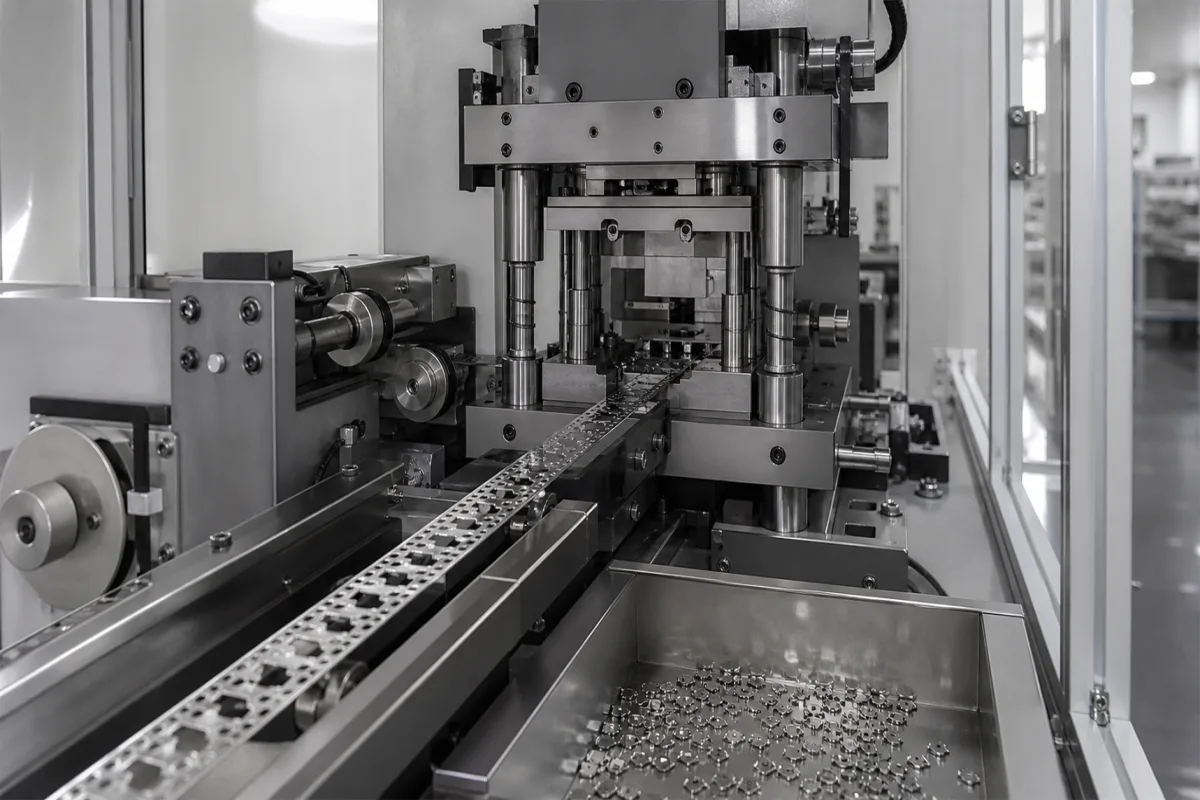
A canonical Precision Stamping Module is characterized by the integration of Precision Press Frame and Stamping Die Set. In industrial production environments, manufacturers listed on CNFX commonly emphasize Tool steel construction to support stable, high-cycle operation across diverse manufacturing scenarios.

A specialized module within an integrated production system that performs high-accuracy metal stamping operations

Product Specifications

Technical details and manufacturing context for Precision Stamping Module

Definition
The Precision Stamping Module is a critical component of the Integrated Metal Forming and Finishing Production System, responsible for transforming metal sheets or blanks into precise components through controlled deformation processes. It operates as part of a larger automated system, receiving materials from upstream modules and delivering stamped parts to downstream finishing operations.
Working Principle
Utilizes mechanical or hydraulic force applied through precision dies to cut, bend, or shape metal sheets with high dimensional accuracy. The module typically includes a precision press, automated feeding system, die set, and ejection mechanism, all controlled by programmable logic for consistent operation.
Common Materials
Tool steel, High-strength alloy steel, Carbide inserts
Technical Parameters
  • Stamping accuracy tolerance range (mm) Standard Spec
Components / BOM
  • Precision Press Frame
    Provides structural support and maintains alignment during stamping operations
    Material: High-strength cast steel
  • Stamping Die Set
    Tooling that shapes the metal through cutting, bending, or forming operations
    Material: Tool steel with carbide inserts
  • Feeder Mechanism
    Automatically positions metal sheets or blanks for stamping
    Material: Stainless steel and aluminum alloy
  • Ejection System
    Removes stamped parts from the die after forming
    Material: Steel and polyurethane
Engineering Reasoning
150-450 kN stamping force, 0.01-0.05 mm positional accuracy, 40-120 strokes per minute
Die clearance exceeds 0.08 mm, punch-die misalignment >0.03 mm, tool steel hardness drops below 58 HRC
Design Rationale: Progressive die wear causes clearance expansion beyond material shear tolerance, leading to burr formation exceeding 0.1 mm height and material springback exceeding elastic recovery limits
Risk Mitigation (FMEA)
Trigger Tool steel tempering at 250-300°C due to insufficient cooling flow below 15 L/min
Mode: Punch edge radius increases from 0.005 mm to >0.02 mm, causing material rollover and dimensional deviation exceeding ±0.015 mm
Strategy: Integrate closed-loop coolant system with 25 L/min minimum flow and 20°C temperature control, plus infrared thermal monitoring at punch tip
Trigger Servo motor encoder resolution degradation below 0.001 mm/step from particulate contamination exceeding ISO 4406 18/16/13
Mode: Ram position repeatability error exceeds ±0.008 mm, producing inconsistent stamping depths varying by >0.02 mm
Strategy: Install IP67-rated absolute encoder with 0.0005 mm resolution and positive-pressure purge system maintaining 0.5 bar clean air barrier

Industry Taxonomies & Aliases

Commonly used trade names and technical identifiers for Precision Stamping Module.

Industrial Ecosystem & Supply Chain DNA

Complementary Systems
Downstream Applications
Specialized Tooling

Application Fit & Sizing Matrix

Operational Limits
pressure: Up to 25 MPa hydraulic system pressure
other spec: Maximum stamping force: 200 kN, Stroke rate: 30-120 SPM, Positioning accuracy: ±0.01 mm
temperature: 15°C to 40°C (operating ambient)
Media Compatibility
✓ Cold-rolled steel sheets (0.5-3.0 mm thickness) ✓ Aluminum alloys (series 1000-6000) ✓ Copper and brass alloys
Unsuitable: Corrosive chemical environments or abrasive slurry applications
Sizing Data Required
  • Required stamping force (kN) based on material and thickness
  • Production rate (parts per minute) and stroke length
  • Tooling dimensions and required positioning accuracy

Reliability & Engineering Risk Analysis

Failure Mode & Root Cause
Die wear and misalignment
Cause: Progressive abrasive wear from high-cycle stamping operations, compounded by thermal expansion and mechanical stress, leading to dimensional inaccuracies and increased clearance between punch and die.
Hydraulic system failure
Cause: Contamination of hydraulic fluid (particulates, moisture) causing valve sticking, pump cavitation, and seal degradation, often due to inadequate filtration or improper fluid maintenance.
Maintenance Indicators
  • Audible knocking or grinding noises during stamping cycles, indicating misalignment, excessive clearance, or bearing failure.
  • Visible metal shavings or excessive lubricant around the die area, suggesting accelerated wear or seal breakdown.
Engineering Tips
  • Implement a predictive maintenance program using vibration analysis and thermal imaging to detect early-stage misalignment, bearing wear, and hydraulic issues before catastrophic failure.
  • Establish strict contamination control protocols for hydraulic systems, including scheduled fluid analysis, high-efficiency filtration, and moisture removal systems to extend component life.

Compliance & Manufacturing Standards

Reference Standards
ISO 9001:2015 - Quality Management Systems ISO 2768-1:1989 - General Tolerances for Linear and Angular Dimensions CE Marking - Conformity with EU Directives (e.g., Machinery Directive 2006/42/EC)
Manufacturing Precision
  • Bore Diameter: +/-0.02mm
  • Flatness: 0.1mm per 100mm length
Quality Inspection
  • Dimensional Verification with CMM (Coordinate Measuring Machine)
  • Hardness Testing (e.g., Rockwell or Vickers)

Factories Producing Precision Stamping Module

Verified manufacturers with capability to produce this product in China

✓ 92% Supplier Capability Match Found

P Procurement Specialist from United States Feb 28, 2026
★★★★★
"Impressive build quality. Especially the technical reliability is very stable during long-term operation."
Technical Specifications Verified
T Technical Director from United Arab Emirates Feb 25, 2026
★★★★★
"As a professional in the Machinery and Equipment Manufacturing sector, I confirm this Precision Stamping Module meets all ISO standards."
Technical Specifications Verified
P Project Engineer from Australia Feb 22, 2026
★★★★★
"Standard OEM quality for Machinery and Equipment Manufacturing applications. The Precision Stamping Module arrived with full certification."
Technical Specifications Verified
Verification Protocol

“Feedback is collected from verified sourcing managers during RFQ (Request for Quote) and factory evaluation processes on CNFX. These reports represent historical performance data and technical audit summaries from our B2B manufacturing network.”

12 sourcing managers are analyzing this specification now. Last inquiry for Precision Stamping Module from USA (1h ago).

Supply Chain Compatible Machinery & Devices

Heavy-Duty CNC Plasma Cutting Machine

Industrial machine for precision metal cutting using plasma arc technology

Explore Specs →
Automated Assembly Line System

Integrated production system for sequential component assembly operations

Explore Specs →
Automated Powder Coating System

Integrated industrial system for applying dry powder coatings to metal substrates.

Explore Specs →
Centrifugal Pump Impeller

Rotating component that transfers energy to fluid in centrifugal pumps.

Explore Specs →

Frequently Asked Questions

What materials are compatible with the Precision Stamping Module?

The module is designed for stamping various metals, particularly compatible with tool steel and high-strength alloy steel components, using carbide inserts for enhanced durability.

How does the ejection system improve stamping operations?

The integrated ejection system ensures reliable part removal after stamping, reducing downtime and preventing damage to stamped components or the die set.

What maintenance is required for the feeder mechanism?

Regular lubrication and inspection of the feeder mechanism are recommended to maintain consistent material feeding and prevent misalignment in high-accuracy stamping operations.

Can I contact factories directly on CNFX?

CNFX is an open directory, not a transaction platform. Each factory profile provides direct contact information and production details to help you initiate direct inquiries with Chinese suppliers.

Get Quote for Precision Stamping Module

Request technical pricing, lead times, or customized specifications for Precision Stamping Module directly from verified manufacturing units.

Your business information is encrypted and only shared with verified Precision Stamping Module suppliers.

Thank you! Your message has been sent. We'll respond within 1–3 business days.

Need to Manufacture Precision Stamping Module?

Connect with verified factories specializing in this product category

Add Your Factory Contact Us
Previous Product
Precision Spindle Assembly
Next Product
Precision Temperature Controller