Editorial Technical Reference

Press Frame

This page explains how Press Frame is classified within Machinery and Equipment Manufacturing. Technical values and manufacturer relationships are research references; confirm the current specification and supplier evidence for each order.

Technical Definition & Core Assembly

The structural framework that provides rigidity and support for the pressing mechanism in a Precision Pressing Station.
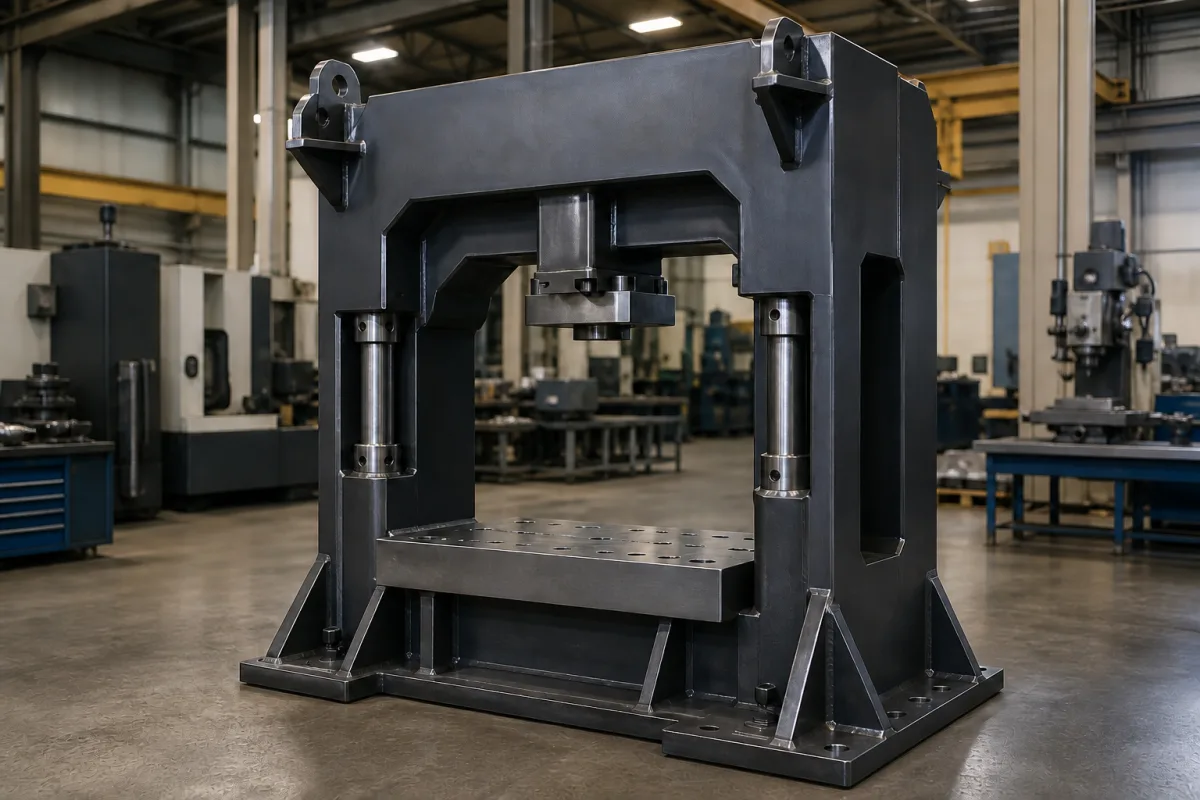
Representative product image. Confirm appearance and specifications with the manufacturer.

Product Specifications

Technical details and manufacturing context for Press Frame

Definition
The Press Frame is the foundational structural component of a Precision Pressing Station, designed to withstand the significant forces generated during pressing operations. It serves as the rigid mounting platform for the press cylinder, platens, guides, and other critical components, ensuring precise alignment and minimal deflection under load to maintain pressing accuracy. The frame is typically constructed from structural steel (e.g., A36) for standard applications, or alloy steel for high-load applications, as specified in the product data. Its design must account for the maximum working width, defined as the distance between the inner faces of the two main vertical columns, which determines the maximum workpiece or tooling size that can be accommodated. This dimension is a key selection parameter and must be verified against the specific model requirements. The frame's rigidity directly influences the accuracy of the pressing operation, as any elastic deformation under load can cause misalignment between the moving and fixed platens. Therefore, the frame is engineered to minimize deflection, ensuring that the moving platen travels in a linear path relative to the fixed platen. The frame also transfers reaction forces from the pressing action into the station's foundation, requiring proper installation and anchoring. When selecting a Press Frame, it is essential to confirm the required working width, load capacity, and material grade with the legal manufacturer or supplier, as these factors determine the frame's suitability for the intended application. Regular inspection for signs of fatigue, such as cracks or permanent deformation, is necessary to maintain operational safety and accuracy.
Working Principle
The frame functions as a load-bearing structure, transferring the reaction forces from the pressing action (generated by the cylinder) through its rigid members (columns, beams, base) into the station's foundation. Its design minimizes elastic deformation to ensure the moving platen travels in a perfectly linear path relative to the fixed platen. The frame's stiffness is critical; any deflection under load would compromise the alignment of the platens, leading to inaccurate pressing results. The material and cross-sectional geometry of the frame members are selected to provide the necessary rigidity for the expected load range.
Common Materials
Structural Steel (e.g., A36), Alloy Steel (for high-load applications)
Technical Parameters

What to specify in your RFQ

  • The distance between the inner faces of the two main vertical columns, defining the maximum width of the workpiece or tooling that can be accommodated. in mm

These are the quantities to specify to the manufacturer when sizing or requesting a quote. The manufacturer's own documentation governs the exact figures and applicable standard.

Components / BOM
  • Crown / Top Beam Part
    Connects the top of the vertical columns and supports the press cylinder.
    Material: steel
  • Columns / Uprights
    Vertical structural members that connect the crown to the base, guiding the moving platen and resisting side loads.
    Material: steel
  • Base / Bed Part
    The bottom horizontal member that provides a stable foundation, often incorporating the fixed platen or bolster plate.
    Material: steel
  • Tie Rods (if applicable) Optional Part
    Pre-stressed rods that connect the crown to the base, increasing frame rigidity by placing the structure under tension.
    Material: alloy steel

Applied To / Applications

This component is essential for the following industrial systems and equipment:

Industrial Ecosystem & Supply Chain Structure

Complementary Systems
Downstream Applications
Specialized Tooling

Application Fit & Sizing Matrix

Operational Limits
pressure: Up to 500 MPa
other spec: Frame deflection limit: ≤0.1 mm under max load
temperature: -20°C to 150°C
Media Compatibility
✓ Metal forming operations ✓ Ceramic powder compaction ✓ Composite material pressing
Unsuitable: Continuous high-frequency cyclic loading (>10 Hz)
Sizing Data Required
  • Maximum pressing force required (kN)
  • Workpiece dimensions and press stroke length (mm)
  • Required frame stiffness/deflection tolerance (mm/kN)

Reliability & Engineering Risk Analysis

Failure Mode & Root Cause
Fatigue cracking
Cause: Cyclic loading from repeated press operations leading to stress concentration at weld joints or sharp corners, exacerbated by material imperfections or improper design.
Structural deformation
Cause: Overloading beyond rated capacity, uneven load distribution, or foundation settlement causing misalignment and permanent bending or twisting of frame members.
Maintenance Indicators
  • Visible cracks or deformation in critical weld areas or structural members
  • Unusual noises (creaking, popping) during press operation indicating stress or movement
Engineering Tips
  • Implement regular non-destructive testing (ultrasonic or magnetic particle) on high-stress areas to detect subsurface defects before catastrophic failure
  • Install strain gauges and alignment monitoring systems with automated alerts for real-time structural health monitoring and load distribution optimization

Indicative industry ranges for design and RFQ preparation. Confirm the exact figures and applicable standard with the manufacturer before specifying.

Compliance & Manufacturing Standards

Applicable Standards
ANSI B11.0 Safety of Machinery DIN 8580 Manufacturing Processes

Quoted from the published standard.

Manufacturing Precision
  • Parallelism of platens: +/-0.05mm
  • Frame alignment: 0.1mm per meter
Quality Inspection
  • Dimensional Verification with CMM
  • Load Testing to 150% rated capacity

Manufacturers of Press Frame

Manufacturer profiles associated with Press Frame.

Sourcing Press Frame from China?
Tell us your specification and target quantity — we will match it against manufacturer records and come back with the factories that fit.
Request manufacturers We manufacture this

Manufacturer listings support early research and capability understanding. They are not certification, ranking, or transaction guarantees.

Technical documentation
Request current drawings, revision history, and a signed specification sheet.
Manufacturing capability
Verify equipment lists, process limits, capacity, and representative production evidence.
Inspection readiness
Confirm test methods, calibrated equipment, sampling plans, and traceable reports.
Supplier transparency
Check the legal entity, factory address, ownership, certifications, and direct contacts.

CNFX does not score or rank suppliers. Buyers must verify all claims and documents with the legal manufacturer before ordering.

Supply Chain Compatible Machinery & Devices

Hydraulic Press

Industrial machine using hydraulic pressure to compress, form, or assemble materials

Explore Specs →
Heavy-Duty CNC Plasma Cutting Machine

The Heavy-Duty CNC Plasma Cutting Machine is a standalone industrial device designed for cutting conductive metals such as steel, stainless steel, aluminum, and copper alloys.

Explore Specs →
Automated Powder Coating System

Integrated industrial system for applying dry powder coatings to metal substrates.

Explore Specs →
Centrifugal Pump Impeller

The centrifugal pump impeller is a critical rotating component that converts mechanical energy from the motor into kinetic energy in fluid systems.

Explore Specs →

Frequently Asked Questions

What is the primary function of a Press Frame?

The Press Frame provides the rigid structural support for the pressing mechanism, ensuring precise alignment of the platens and transferring reaction forces to the foundation.

What materials are commonly used for Press Frames?

According to the product data, structural steel (e.g., A36) is used for standard applications, and alloy steel for high-load applications. The specific grade must be confirmed with the manufacturer.

How is the size of a Press Frame specified?

A key specification is the distance between the inner faces of the two main vertical columns, which defines the maximum width of the workpiece or tooling that can be accommodated. This value must be verified for the specific model.

Why is frame rigidity important?

Rigidity minimizes elastic deformation under load, ensuring the moving platen travels in a linear path relative to the fixed platen, which is essential for maintaining pressing accuracy.

Data Basis

Editorial classification, named public sources where available, and source-reviewed manufacturer records.

Preliminary Technical Classification
This page supports structured research, RFQ preparation, and supplier evaluation. It does not replace buyer-led supplier qualification, standards review, or technical approval.
Buyer enquiry

Request manufacturing insight for Press Frame

Ask for use case, specification boundaries, supplier type, and RFQ preparation information for this product.

Where it goes
Straight to the CNFX editorial desk, and to the manufacturer if this product is linked to a claimed profile. Nothing is broadcast to a supplier list.
Your details stay here
We do not sell or rent enquiry data, and we do not add you to a mailing list. Used only to answer this request.
No commission, no middleman
CNFX is a directory. We take no cut of any order and never negotiate on a supplier's behalf.
What we don't claim
A listing is not an endorsement. Qualify every supplier and verify every figure yourself before ordering.

Your business information is used only to process this request.

Thank you! Your message has been sent. We'll respond within 1–3 business days.
Sorry, we couldn't send your message. Please try again, or email us at contact@cnfx.com.

Need to Manufacture Press Frame?

Compare manufacturer profiles with relevant product and process capability.

Previous Product
Z-axis Ram/Spindle
Last Product
Get QuotesChat