Editorial Technical Reference

Primary Forming Press

This page explains how Primary Forming Press is classified within Fabricated Metal Product Manufacturing. Technical values and manufacturer relationships are research references; confirm the current specification and supplier evidence for each order.

Technical Definition & Core Assembly

A hydraulic or mechanical press that applies high pressure to shape metal blanks into initial forms within an integrated production system.
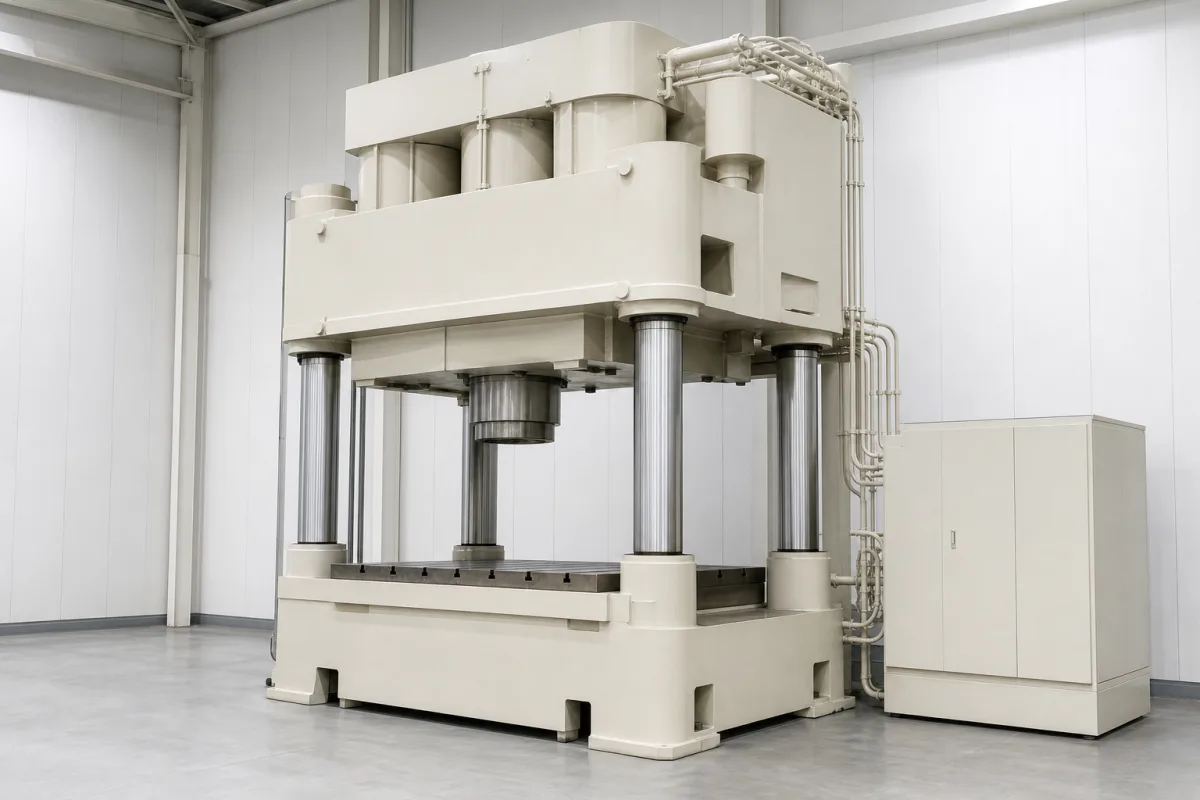
Representative product image. Confirm appearance and specifications with the manufacturer.

Product Specifications

Technical details and manufacturing context for Primary Forming Press

Definition
The Primary Forming Press is a core component of the Integrated Metal Forming and Finishing Production System, responsible for the initial deformation of metal workpieces through compressive force. It transforms flat metal sheets or blanks into basic three-dimensional shapes that serve as precursors for subsequent finishing operations, establishing the fundamental geometry and structural integrity of the final metal product. This press is typically used in the fabricated metal product manufacturing industry, where it performs the first shaping step in a production line. The press operates by converting electrical energy into mechanical force through a hydraulic system or mechanical linkage. A ram or platen descends with controlled pressure onto a metal blank positioned over a die, forcing the material to conform to the die cavity shape. Pressure is maintained for a specified duration to ensure proper material flow and shape retention before the ram retracts. The press is available with a nominal force ranging from 1000 to 6000 kN, a stroke length of 200 to 800 mm, and a production rate of 10 to 60 strokes per minute. It accommodates a die height of 300 to 800 mm and a bolster area of 800×800 to 2000×2000 mm. Slide adjustment ranges from 50 to 200 mm, and positioning accuracy is ±0.05 to ±0.1 mm. The motor power is 15 to 90 kW, and the supply voltage is 380 to 480 V AC (three-phase, 50/60 Hz) per IEC 60038. The operating temperature range is 5 to 40 °C, and the protection class is IP54 to IP65 per IEC 60529. The machine weight is 10 to 80 t. Materials typically used for the press structure include high-strength alloy steel and tool steel. The nominal force parameter is referenced to ISO 16092. These values are directory reference ranges and must be confirmed for the actual model and application with the legal manufacturer or supplier.
Working Principle
The press operates by converting electrical energy into mechanical force through a hydraulic system or mechanical linkage. A ram or platen descends with controlled pressure onto a metal blank positioned over a die, forcing the material to conform to the die cavity shape. Pressure is maintained for a specified duration to ensure proper material flow and shape retention before the ram retracts. The process is controlled by parameters such as nominal force, stroke length, and strokes per minute, which are set according to the material and desired shape. The press is integrated into a production system, with interfaces for material handling and control signals. Verification of performance involves checking positioning accuracy and monitoring for deviations. Maintenance signals include unusual noise, hydraulic leaks, or inconsistent part quality. Failure boundaries are defined by the maximum force and stroke limits, beyond which the press may be damaged.
Common Materials
High-strength alloy steel, Tool steel
Technical Parameters
ParameterTypical rangeNotes & selection driver
Nominal Force1000–6000 kNDetermines maximum forming capacityISO 16092
Stroke Length200–800 mmAffects part depth and tooling clearance
Strokes per Minute10–60 min⁻¹Production rate for continuous operation
Die Height300–800 mmMaximum tool height accommodated
Bolster Area800×800–2000×2000 mmDefines maximum die footprint
Slide Adjustment50–200 mmEnables die height fine-tuning
Positioning Accuracy±0.05–±0.1 mmCritical for consistent part quality
Motor Power15–90 kWDrives hydraulic pump or flywheel
Supply Voltage380–480 V ACThree-phase, 50/60 HzIEC 60038
Operating Temperature5–40 °COutside range may affect hydraulic fluid viscosity
Protection ClassIP54–IP65Protects against dust and water ingressIEC 60529
Machine Weight10–80 tInfluences foundation and installation requirements

Ranges are indicative industry figures for RFQ preparation, not a supplier commitment. Confirm every value and standard with the legal manufacturer before ordering.

Components / BOM
  • Hydraulic Cylinder
    Generates and transmits compressive force through hydraulic pressure
    Material: High-strength alloy steel
  • Press Frame
    Provides structural support and absorbs forming forces
    Material: Cast steel
  • Control System
    Manages pressure, stroke, and timing parameters
    Material: Electronic components
  • Ram / Platen
    The moving member that carries the force down onto the blank.
  • Forming Die
    Defines the shape the blank is forced to take.

Industrial Ecosystem & Supply Chain Structure

Complementary Systems
Downstream Applications
Specialized Tooling

Application Fit & Sizing Matrix

Operational Limits
pressure: Up to 1000 MPa (hydraulic) or 5000 kN (mechanical)
flow rate: 10-100 L/min (hydraulic system)
temperature: Ambient to 150°C (typical metal forming range)
slurry concentration: Not applicable (dry forming process)
Media Compatibility
✓ Steel blanks ✓ Aluminum alloys ✓ Copper-based materials
Unsuitable: Corrosive chemical environments (acidic/alkaline)
Sizing Data Required
  • Maximum forming force required (kN or tons)
  • Blank material thickness and yield strength
  • Production cycle time (strokes per minute)

Reliability & Engineering Risk Analysis

Failure Mode & Root Cause
Hydraulic cylinder seal failure
Cause: Contamination of hydraulic fluid leading to abrasive wear, or excessive pressure causing extrusion and degradation of seals over time.
Ram misalignment and bearing wear
Cause: Uneven loading, poor lubrication, or foundation settling causing excessive side loads and accelerated wear on guide bearings and ways.
Maintenance Indicators
  • Unusual knocking or grinding sounds during ram movement indicating bearing or guide wear
  • Hydraulic fluid leaks around cylinder seals or connections, especially under pressure
Engineering Tips
  • Implement regular hydraulic fluid analysis and filtration maintenance to prevent contamination-related failures
  • Establish laser alignment checks and thermal growth compensation procedures for the ram and platen to maintain proper alignment

Indicative industry ranges for design and RFQ preparation. Confirm the exact figures and applicable standard with the manufacturer before specifying.

Compliance & Manufacturing Standards

Applicable Standards
ISO 12100:2010 - Safety of machinery ANSI B11.1 - Mechanical Power Presses CE Marking - Machinery Directive 2006/42/EC

Quoted from the published standard.

Manufacturing Precision
  • Ram parallelism: +/-0.02mm per 300mm
  • Bed flatness: 0.1mm over entire surface
Quality Inspection
  • Load testing with strain gauges
  • Non-destructive testing (NDT) of critical welds

Manufacturers of Primary Forming Press

Manufacturer profiles associated with Primary Forming Press.

Sourcing Primary Forming Press from China?
Tell us your specification and target quantity — we will match it against manufacturer records and come back with the factories that fit.
Request manufacturers We manufacture this

Manufacturer listings support early research and capability understanding. They are not certification, ranking, or transaction guarantees.

Technical documentation
Request current drawings, revision history, and a signed specification sheet.
Manufacturing capability
Verify equipment lists, process limits, capacity, and representative production evidence.
Inspection readiness
Confirm test methods, calibrated equipment, sampling plans, and traceable reports.
Supplier transparency
Check the legal entity, factory address, ownership, certifications, and direct contacts.

CNFX does not score or rank suppliers. Buyers must verify all claims and documents with the legal manufacturer before ordering.

Supply Chain Compatible Machinery & Devices

Metal Plate Rolling Machine

A metal plate rolling machine is a standalone industrial device used in fabricated metal product manufacturing to form flat metal plates into curved sections, cylinders, or cones.

Explore Specs →
Hydraulic Cylinder Piston Rod

A hydraulic cylinder piston rod is a precision-machined, load-bearing component that converts hydraulic pressure into linear mechanical force.

Explore Specs →
Industrial Tube Bending Machine

An industrial tube bending machine is a CNC-controlled device designed to precisely bend metal tubes and pipes to specific angles and radii.

Explore Specs →
Precision Linear Motion Guide Rail

Precision linear guide component for smooth, accurate motion in industrial machinery

Explore Specs →

Frequently Asked Questions

What is the primary function of the Primary Forming Press?

The press applies high pressure to shape metal blanks into initial three-dimensional forms, serving as the first step in an integrated metal forming and finishing production system.

What are the typical force and stroke ranges?

The nominal force ranges from 1000 to 6000 kN, and the stroke length ranges from 200 to 800 mm, as per directory reference values. Confirm exact values for your model.

Which standards are referenced for this press?

The nominal force is referenced to ISO 16092, supply voltage to IEC 60038, and protection class to IEC 60529. These are verification references, not certifications.

How should I verify the press specifications?

Always confirm model-specific values and standards with the legal manufacturer or supplier, as directory values are reference ranges only.

Data Basis

Editorial classification, named public sources where available, and source-reviewed manufacturer records.

Preliminary Technical Classification
This page supports structured research, RFQ preparation, and supplier evaluation. It does not replace buyer-led supplier qualification, standards review, or technical approval.
Buyer enquiry

Request manufacturing insight for Primary Forming Press

Ask for use case, specification boundaries, supplier type, and RFQ preparation information for this product.

Where it goes
Straight to the CNFX editorial desk, and to the manufacturer if this product is linked to a claimed profile. Nothing is broadcast to a supplier list.
Your details stay here
We do not sell or rent enquiry data, and we do not add you to a mailing list. Used only to answer this request.
No commission, no middleman
CNFX is a directory. We take no cut of any order and never negotiate on a supplier's behalf.
What we don't claim
A listing is not an endorsement. Qualify every supplier and verify every figure yourself before ordering.

Your business information is used only to process this request.

Thank you! Your message has been sent. We'll respond within 1–3 business days.
Sorry, we couldn't send your message. Please try again, or email us at contact@cnfx.com.

Need to Manufacture Primary Forming Press?

Compare manufacturer profiles with relevant product and process capability.

Previous Product
Welding Positioner
Last Product
Get QuotesChat