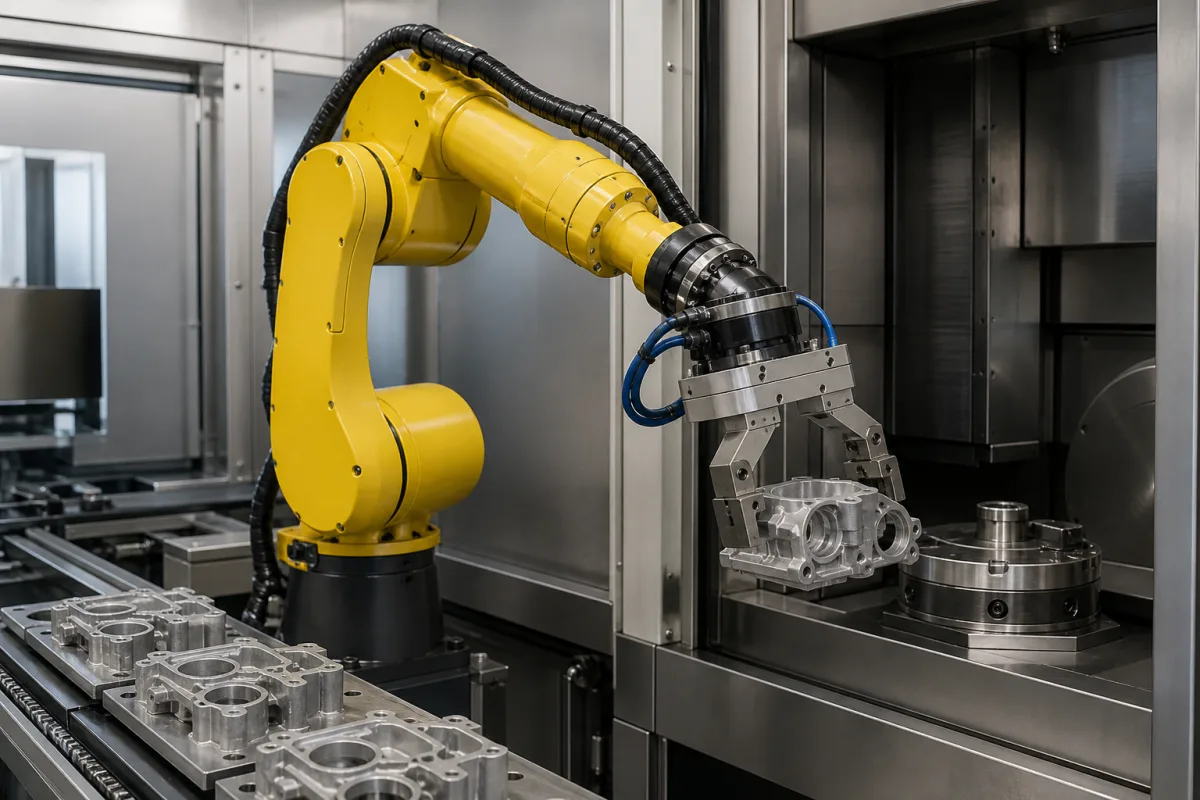
The illustrated cell is a machine-tending arrangement: a six-axis arm with a pneumatic gripper takes cast aluminium housings from a pallet conveyor and puts them into a machine through its open door. The arm's reach and payload decide whether it can do the job; the sequence decides how much machining time it costs. Two things dominate that sequence: how the finished part and the next blank are exchanged, and how the cell proves that the door, chuck, part and robot are where they should be before anything moves.
Covers robot arms with grippers used to load and unload machine tools: the part-exchange sequence, single versus dual grippers and their effect on cycle time and spindle idle time, and the hand-off states and interlocks between robot and machine. Gripper repeatability and compensation units are on End-Effector/Gripper (4392); clamping force and jaw length on Robot Gripper (4660); vacuum end effectors for machine tending on Specialized End Effector (1017); sizing an articulated arm by wrist load and envelope on Robotic Manipulator (1010).
CNFX editorial research · Sources checked October 13, 2026 · 3 sources
What the spindle waits for: the exchange sequence step by step
EVS's lathe-tending note lists the tending sequence as access request, door movement, unload, approved cleaning, blank pickup, load, seating proof, chuck action, robot withdrawal, door close and cycle start, and advises keeping cutting time separate from tending time so the real constraint is visible.
The waiting and non-waiting columns are an editorial reading of the EVS sequence: with one gripper the robot cannot hold the next blank while it unloads, so the trip to put the finished part down and fetch the blank happens with the door open. UNISIG describes the same effect from the machine side: its dual-gripper head reduces the time spindles are not drilling, because the robot makes fewer trips and exchanges parts while the other spindle drills.
Measured on the real cell, the useful figure is machine idle time per part, not robot cycle time; EVS recommends comparing alternatives with measured machine timing, part presentation, inspection and recovery.
Step
Single gripper: machine waiting?
Dual gripper: machine waiting?
Pick blank
Yes, gripper must be empty to unload first (Editorial reading)
No, blank picked while machine cuts (Editorial reading)
Door open, unload finished part
Yes
Yes
Set finished part down
Yes, robot leaves the machine
No, part held in second jaw set
Pick blank and return
Yes
No
Load blank, seating proof, chuck closes
Yes
Yes
Robot withdraws, door closes, cycle start
Yes
Yes
The step list is EVS's for a lathe; a machining centre with a pallet or vice has its own clamp and seating checks.
02
Dual gripper in one case: 27 s to 15 s, and what the second jaw set costs
OnRobot's case study at the Danish gear maker Osvald Jensen gives the one public before-and-after figure: an existing collaborative machine-tending cell fitted with a dual RG2 gripper, handling two parts in one movement.
OnRobot also reports return on investment in under three months and unattended running once operators load raw material into the magazines. These are the vendor's figures for one cell; the machine itself was not changed.
EVS lists the price of the second jaw set: more tool mass and inertia, more cable and hose routing, a larger collision volume and more part-present states to prove, and possibly changeover or collision constraints. The added mass counts against the arm's payload and wrist moments, and the larger tool still has to pass the machine door in both orientations (editorial reading). UNISIG notes that its dual-gripper head handles workpieces up to 300 mm long without gripper changeover.
Item
Single gripper
Dual gripper
Cycle time (OnRobot)
27 s
15 s
Reduction (OnRobot)
—
44%
Cycles per hour (Editorial calculation)
133
240
Cycles per 8 h shift (Editorial calculation)
1,067
1,920
Cycle-time gains depend on how much of the original cycle was exchange time; on a long machining cycle the same saving is a smaller share.
03
Proving each hand-off: door, spindle, chuck, seating and robot clear
EVS treats a lathe-tending cell as ready for production trials only when it can prove the door, spindle, chuck, part seating, robot-clear and program states at every hand-off; a door-open command or a completed robot move is not physical evidence that the machine may accept the next action.
For the illustrated cell this means two part definitions, the cast blank from the pallet and the machined housing going back, and separate checks that the housing is seated before the chuck or clamp closes and that the gripper has let go before the robot leaves.
Adds machined surfaces to protect, temperature, coolant, chips, dimensional or process disposition, destination
Gripping faces
A jaw pattern that grips rough stock may damage a finished diameter; a vacuum surface on the blank may disappear after machining
Release
A gripper-open signal alone may not show that the part is no longer caught in a finger
Chips and coolant
Chips can block the locating face, alter grip, damage a surface or obscure sensing; coolant changes friction and can contaminate sensors; record both during trials
Air blow
If permitted, define pressure, direction, duration and containment
Standards named
ISO 10218-2:2025 for robot cell integration and commissioning boundaries
EVS frames its note as a commissioning ledger, not a cycle-time promise; site safety validation remains machine-specific.
04
What to give an integrator for a machine-tending arm and gripper
Paste it into your enquiry below or into an email to a maker, then replace every bracket.
Give the part family with blank and finished masses and dimensions, gripping faces before and after machining, presentation method, machine type and door opening, cutting time per part, required parts per shift, chip and coolant conditions, and whether the cell must run unattended. Ask for the measured or simulated exchange time with single and dual grippers, tool mass and payload margin, the list of interlock signals between robot and machine, and how a failed seating or release is detected and recovered.
1 company lists this product among what they make. Company figures are quoted from each
company's own website; every card states where the relationship came from.
Shanghai YoungYou Intelligence Co.,Ltd.
TBC
Shanghai Youngyou lists collaborative and industrial robot arms, including ABB, KUKA, Yaskawa and FANUC models, with a Robotic Arm Gripper category and dress packs for loading and unloading. Exchange times and interlock packages are not stated; TBC. Location TBC.
Explore company information and manufacturing capabilities, then discuss the scope of your project with a relevant supplier.
Share this page
Compiled and source-reviewed by the CNFX editorial team.
Each manufacturer above links to the page on that company's own website where the product is listed, with the date we checked it. How we source and review
· Page last updated 13 October 2026
Buyer questions
How much does a dual gripper save?
In OnRobot's Osvald Jensen case, handling two parts per movement with a dual RG2 cut the cycle from 27 s to 15 s, a 44% reduction, without changing the machine. [1]
Why does a dual gripper cut spindle idle time?
UNISIG says its dual-gripper head reduces the time spindles are not drilling because the robot makes fewer trips and exchanges parts while the other spindle drills. [3]
What does a dual gripper cost besides the gripper?
EVS lists more tool mass and inertia, more cable and hose routing, a larger collision volume and more part-present states to prove. [2]
What must a tending cell prove at each hand-off?
EVS names door, spindle, chuck, part seating, robot-clear and program states, and warns that a gripper-open signal alone may not show that the part has been released. [2]
Sources and what still needs a direct check
Sources checked 2026-10-13. A gripper maker's case study, a robot maker's lathe-tending integration note, and a machine builder's description of its dual-gripper automation.