Industry-Verified Manufacturing Data (2026)

Infeed Conveyor

Based on aggregated insights from multiple verified factory profiles within the CNFX directory, the standard Infeed Conveyor used in the Machinery and Equipment Manufacturing sector typically supports operational capacities ranging from standard industrial configurations to heavy-duty production requirements.

Technical Definition & Core Assembly

A canonical Infeed Conveyor is characterized by the integration of Drive Motor and Conveyor Belt/Roller Bed. In industrial production environments, manufacturers listed on CNFX commonly emphasize Stainless Steel construction to support stable, high-cycle operation across diverse manufacturing scenarios.

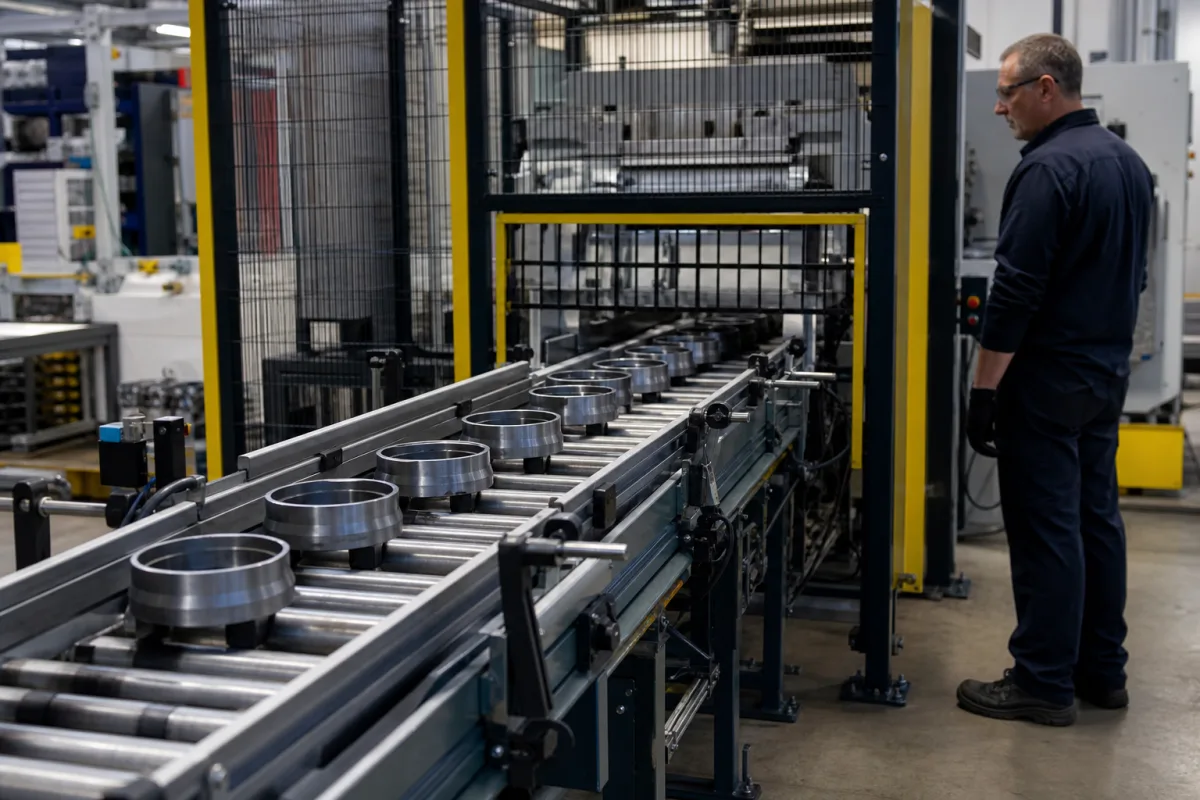
A conveyor system component designed to receive and transport raw materials or workpieces into an industrial processing system.
Product Specifications

Technical details and manufacturing context for Infeed Conveyor

Definition
The Infeed Conveyor is a critical initial-stage component within an Industrial System, responsible for the controlled intake, alignment, and presentation of materials to subsequent processing, assembly, or packaging stations. It ensures a consistent and reliable supply flow, directly impacting overall system throughput and efficiency.
Working Principle
The Infeed Conveyor operates by utilizing a driven mechanism (such as belts, chains, or rollers) to create continuous or indexed linear motion. Material is placed onto the conveyor surface at the intake point. The moving surface then transports the material along a defined path at a controlled speed and orientation, delivering it precisely to the designated entry point of the next system stage.
Common Materials
Stainless Steel, Industrial-Grade Polymer
Technical Parameters
  • The operational speed at which the conveyor belt or surface moves, determining material throughput rate. (meters per minute (m/min)) Standard Spec
Components / BOM
  • Drive Motor
    Provides the mechanical power to move the conveyor belt or rollers.
    Material: Cast Iron Housing, Copper Windings
  • Conveyor Belt/Roller Bed
    The moving surface that directly contacts and transports the material.
    Material: Reinforced Rubber Belt or Steel Rollers
  • Frame & Support Structure
    Provides structural rigidity, alignment, and mounting points for all other components.
    Material: Powder-Coated Steel
  • Infeed Guide Rails Optional
    Aligns and centers material as it enters the conveyor to prevent misalignment or jamming.
    Material: Stainless Steel or Aluminum
Engineering Reasoning
0.5-2.0 m/s belt speed, 50-5000 kg/m linear load capacity
Belt tensile stress exceeding 25 MPa (EP400 belt material yield point), bearing temperature exceeding 120°C (grease breakdown threshold)
Design Rationale: Material fatigue from cyclic loading at belt splice joints (stress concentration factor Kt=3.2), lubricant film breakdown at bearing Hertzian contact pressure >1.5 GPa
Risk Mitigation (FMEA)
Trigger Material accumulation exceeding 15% of roller diameter
Mode: Roller bearing seizure due to radial load exceeding C0 static load rating
Strategy: Install self-cleaning spiral rollers with 30° helix angle and automated purge system
Trigger Belt misalignment exceeding 3% of belt width
Mode: Edge damage propagation at 0.5 mm/hour wear rate leading to tensile failure
Strategy: Implement laser alignment sensors with PID-controlled steering rollers (response time <100 ms)

Industry Taxonomies & Aliases

Commonly used trade names and technical identifiers for Infeed Conveyor.

Applied To / Applications

This component is essential for the following industrial systems and equipment:

Industrial Ecosystem & Supply Chain DNA

Complementary Systems
Downstream Applications
Specialized Tooling

Application Fit & Sizing Matrix

Operational Limits
pressure: Not applicable (atmospheric)
other spec: Max load capacity: 500 kg/m, Belt speed: 0.1-2.0 m/s, Material size: Up to 300 mm
temperature: -20°C to 80°C
Media Compatibility
✓ Bulk granular materials (grains, pellets) ✓ Packaged goods (boxes, bags) ✓ Metal parts/components
Unsuitable: Highly corrosive chemicals or abrasive slurries without specialized belt/coating
Sizing Data Required
  • Material flow rate (tons/hour)
  • Conveyor length and incline angle
  • Material characteristics (size, density, abrasiveness)

Reliability & Engineering Risk Analysis

Failure Mode & Root Cause
Belt misalignment and tracking failure
Cause: Improper tensioning, worn or damaged idlers/pulleys, material buildup on components, or structural misalignment of conveyor frame.
Bearing failure in drive/motor or idler rollers
Cause: Inadequate lubrication, contamination from dust/debris, excessive loading, misalignment, or seal degradation leading to ingress.
Maintenance Indicators
  • Audible grinding, squealing, or knocking noises from drive components or idlers indicating bearing wear or misalignment.
  • Visible belt edge damage, fraying, or material spillage along the conveyor path, signaling tracking issues or component wear.
Engineering Tips
  • Implement a routine infrared thermography program to monitor motor, bearing, and gearbox temperatures, identifying overheating issues before catastrophic failure.
  • Establish a strict belt tracking and tensioning protocol with laser alignment tools, and use wear-resistant, sealed bearings in idlers with automated lubrication systems where feasible.

Compliance & Manufacturing Standards

Reference Standards
ISO 340:2013 - Conveyor belts - Laboratory scale flammability characteristics ANSI/CEMA 402-2003 - Belt Conveyors DIN 22101:2011 - Continuous conveyors - Belt conveyors for bulk materials
Manufacturing Precision
  • Belt tracking alignment: +/- 3 mm over 10 m length
  • Roller concentricity: +/- 0.05 mm
Quality Inspection
  • Non-destructive testing (NDT) of welds using Magnetic Particle Inspection
  • Load testing with calibrated weights to verify rated capacity

Factories Producing Infeed Conveyor

Verified manufacturers with capability to produce this product in China

✓ 95% Supplier Capability Match Found

S Sourcing Manager from Brazil Feb 13, 2026
★★★★★
"Great transparency on the Infeed Conveyor components. Essential for our Machinery and Equipment Manufacturing supply chain."
Technical Specifications Verified
P Procurement Specialist from Canada Feb 10, 2026
★★★★☆
"The Infeed Conveyor we sourced perfectly fits our Machinery and Equipment Manufacturing production line requirements. (Delivery took slightly longer than expected, but technical support was excellent.)"
Technical Specifications Verified
T Technical Director from United States Feb 07, 2026
★★★★★
"Found 16+ suppliers for Infeed Conveyor on CNFX, but this spec remains the most cost-effective."
Technical Specifications Verified
Verification Protocol

“Feedback is collected from verified sourcing managers during RFQ (Request for Quote) and factory evaluation processes on CNFX. These reports represent historical performance data and technical audit summaries from our B2B manufacturing network.”

9 sourcing managers are analyzing this specification now. Last inquiry for Infeed Conveyor from Vietnam (27m ago).

Supply Chain Commonly Integrated Components

Drive Motor

Electric motor that provides rotational power to drive the blending mechanism in pharmaceutical powder blending equipment

Explore Specs →
Vision System

An optical inspection subsystem that uses cameras, lighting, and image processing to detect defects in pharmaceutical vials.

Explore Specs →
Coating Pan

A rotating vessel used to apply uniform coating layers to pharmaceutical tablets through controlled spraying and drying processes.

Explore Specs →
Spray System

A precision fluid delivery subsystem that atomizes and applies coating solutions onto pharmaceutical tablets within an automated coating system.

Explore Specs →

Frequently Asked Questions

What materials are used in your infeed conveyors?

Our infeed conveyors are constructed with corrosion-resistant stainless steel frames and industrial-grade polymer components for durability and smooth material flow.

How does the infeed conveyor integrate with existing processing systems?

The infeed conveyor features adjustable guide rails and customizable drive systems to seamlessly connect with various industrial processing equipment and production lines.

What maintenance is required for the infeed conveyor system?

Regular inspection of the conveyor belt/roller bed, lubrication of moving parts, and monitoring of the drive motor ensure optimal performance and longevity.

Can I contact factories directly on CNFX?

CNFX is an open directory, not a transaction platform. Each factory profile provides direct contact information and production details to help you initiate direct inquiries with Chinese suppliers.

Get Quote for Infeed Conveyor

Request technical pricing, lead times, or customized specifications for Infeed Conveyor directly from verified manufacturing units.

Your business information is encrypted and only shared with verified Infeed Conveyor suppliers.

Thank you! Your message has been sent. We'll respond within 1–3 business days.

Need to Manufacture Infeed Conveyor?

Connect with verified factories specializing in this product category

Add Your Factory Contact Us
Previous Product
Inert Gas Supply Manifold
Next Product
Infeed Conveyor Belt