Industry-Verified Manufacturing Data (2026)

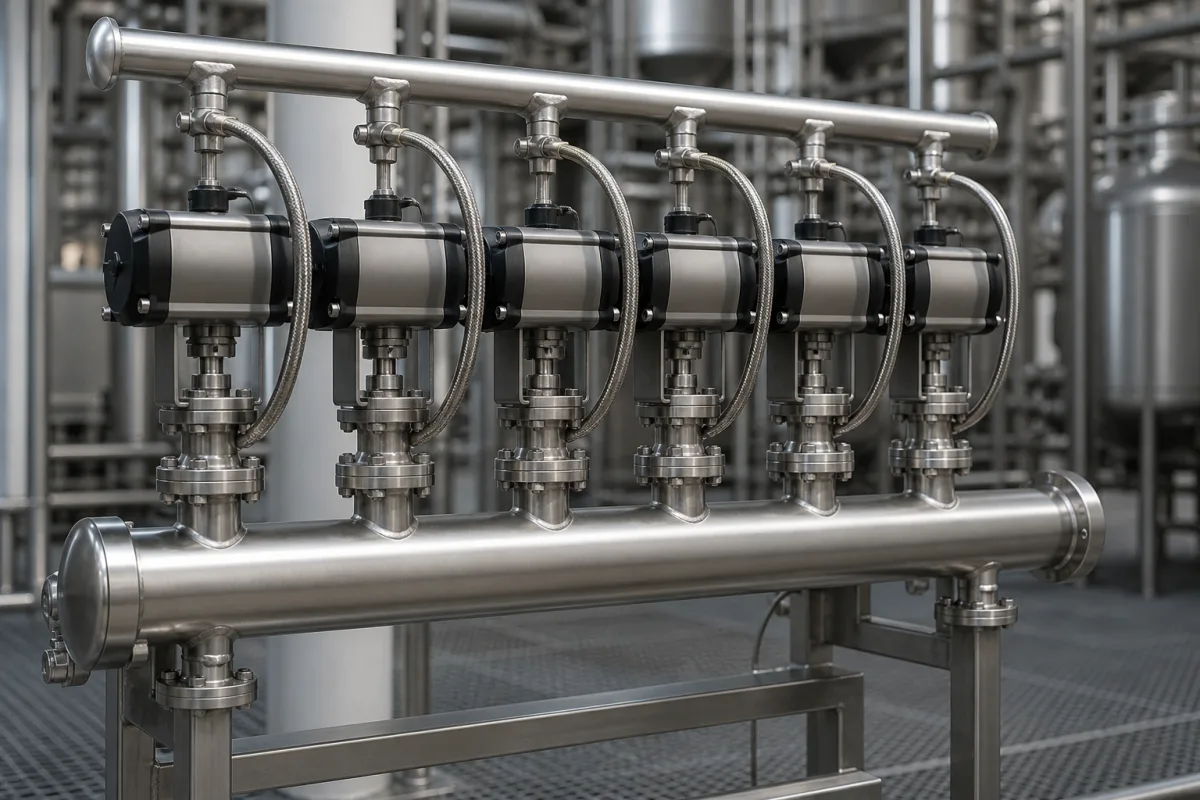
Rapid-Activation Valve Bank

Based on aggregated insights from multiple verified factory profiles within the CNFX directory, the standard Rapid-Activation Valve Bank used in the Machinery and Equipment Manufacturing sector typically supports operational capacities ranging from standard industrial configurations to heavy-duty production requirements.

Technical Definition & Core Assembly

A canonical Rapid-Activation Valve Bank is characterized by the integration of Solenoid/Pneumatic Actuator and Valve Body. In industrial production environments, manufacturers listed on CNFX commonly emphasize Stainless Steel (body/actuator) construction to support stable, high-cycle operation across diverse manufacturing scenarios.

A multi-valve assembly designed for immediate, coordinated fluid release in emergency quenching applications.

Product Specifications

Technical details and manufacturing context for Rapid-Activation Valve Bank

Definition
A critical safety component within the Emergency Quench System, the Rapid-Activation Valve Bank consists of multiple valves configured to operate simultaneously upon receiving an emergency signal. Its primary function is to ensure the rapid and controlled discharge of quenching agents (such as water, inert gases, or chemical suppressants) to extinguish fires, cool overheated equipment, or halt runaway chemical reactions in industrial processes.
Working Principle
The valve bank is connected to a pressurized quenching agent supply line and the system's emergency control logic. Upon activation by a safety sensor or manual override, a pneumatic, hydraulic, or solenoid actuator triggers all valves in the bank to open simultaneously. This bypasses normal sequential valve operation, allowing a high-volume, instantaneous flow of the quenching medium into the protected zone or equipment.
Common Materials
Stainless Steel (body/actuator), PTFE/Viton (seals/gaskets), Brass/Copper (internal fittings)
Technical Parameters
  • Nominal port diameter (e.g., DN25, DN40) defining the flow capacity of each valve in the bank. (mm) Per Request
Components / BOM
  • Solenoid/Pneumatic Actuator
    Receives the emergency signal and provides the mechanical force to open the valve.
    Material: Aluminum Alloy / Stainless Steel
  • Valve Body
    Houses the internal mechanism and provides the fluid flow path and connection ports.
    Material: Stainless Steel / Brass
  • Poppet/Seal Assembly
    The moving part that seals against the valve seat to stop flow and retracts to allow flow upon activation.
    Material: Stainless Steel with PTFE/Viton Seal
  • Manifold Block
    The central structure that physically connects and aligns all individual valves, often incorporating common inlet/outlet ports.
    Material: Stainless Steel / Aluminum
Engineering Reasoning
0.5-25.0 bar
28.5 bar differential pressure across any valve seat
Design Rationale: Plastic deformation of 316L stainless steel valve seats exceeding yield strength of 290 MPa at 28.5 bar differential pressure with 10.2 mm seat diameter
Risk Mitigation (FMEA)
Trigger Hydraulic fluid contamination with 15 μm+ particulate matter
Mode: Valve seat erosion leading to 0.3 L/min leakage at 20 bar
Strategy: Install 10 μm absolute filtration with differential pressure monitoring at 0.5 bar threshold
Trigger Thermal cycling between 20°C and 180°C at 5 cycles/hour
Mode: Thermal fatigue cracking in brazed joints between valve bodies and manifold
Strategy: Replace brazed joints with electron beam welded connections using Inconel 625 filler material

Industry Taxonomies & Aliases

Commonly used trade names and technical identifiers for Rapid-Activation Valve Bank.

Applied To / Applications

This component is essential for the following industrial systems and equipment:

Industrial Ecosystem & Supply Chain DNA

Complementary Systems
Downstream Applications
Specialized Tooling

Application Fit & Sizing Matrix

Operational Limits
pressure: 0 to 25 bar (max operating)
flow rate: Up to 500 L/min per valve
temperature: -20°C to 150°C
slurry concentration: Max 15% solids by weight
Media Compatibility
✓ Water-based quenching fluids ✓ Glycol-water mixtures ✓ Fire suppression foams
Unsuitable: Highly corrosive acids or oxidizing agents
Sizing Data Required
  • Required total flow rate (L/min)
  • System operating pressure (bar)
  • Number of simultaneous release points needed

Reliability & Engineering Risk Analysis

Failure Mode & Root Cause
Seal degradation
Cause: Incompatible fluid media causing chemical attack, thermal cycling, or particulate contamination leading to seal hardening, cracking, or extrusion
Solenoid coil burnout
Cause: Voltage spikes, excessive duty cycling, inadequate cooling, or moisture ingress causing insulation breakdown and overheating
Maintenance Indicators
  • Audible hissing or chattering during operation indicating internal leakage or unstable valve response
  • Visible fluid weeping at valve body joints or solenoid connections suggesting seal failure or fitting degradation
Engineering Tips
  • Implement proactive filtration of fluid media to ISO 4406 18/16/13 or better, with regular particle count analysis to prevent abrasive wear and contamination-induced failures
  • Install surge protection devices on electrical supply lines and monitor coil temperature with infrared thermography during operation to prevent electrical and thermal degradation

Compliance & Manufacturing Standards

Reference Standards
ISO 5599-1: Pneumatic fluid power - Five-port directional control valves - Part 1: Mounting interface surfaces ANSI/NFPA T3.21.1: Fluid Power Systems and Components - Pressure Rating and Test Methods DIN EN 175301: Connectors, electrical, circular, with bayonet coupling for industrial applications
Manufacturing Precision
  • Bore diameter tolerance: +/-0.02mm
  • Surface flatness of mounting interface: 0.05mm
Quality Inspection
  • Pressure decay leak test (per ISO 19973-1)
  • Functional cycle test with pneumatic actuation verification

Factories Producing Rapid-Activation Valve Bank

Verified manufacturers with capability to produce this product in China

✓ 94% Supplier Capability Match Found

P Procurement Specialist from United Arab Emirates Jan 31, 2026
★★★★★
"Found 59+ suppliers for Rapid-Activation Valve Bank on CNFX, but this spec remains the most cost-effective."
Technical Specifications Verified
T Technical Director from Australia Jan 28, 2026
★★★★★
"The technical documentation for this Rapid-Activation Valve Bank is very thorough, especially regarding technical reliability."
Technical Specifications Verified
P Project Engineer from Singapore Jan 25, 2026
★★★★★
"Reliable performance in harsh Machinery and Equipment Manufacturing environments. No issues with the Rapid-Activation Valve Bank so far."
Technical Specifications Verified
Verification Protocol

“Feedback is collected from verified sourcing managers during RFQ (Request for Quote) and factory evaluation processes on CNFX. These reports represent historical performance data and technical audit summaries from our B2B manufacturing network.”

7 sourcing managers are analyzing this specification now. Last inquiry for Rapid-Activation Valve Bank from Thailand (1h ago).

Supply Chain Compatible Machinery & Devices

Automated Assembly Line System

Integrated production system for sequential component assembly operations

Explore Specs →
Automated Powder Coating System

Integrated industrial system for applying dry powder coatings to metal substrates.

Explore Specs →
Centrifugal Pump Impeller

Rotating component that transfers energy to fluid in centrifugal pumps.

Explore Specs →
High-Precision CNC Laser Cutting Machine

Computer-controlled industrial machine using focused laser beams to cut sheet metal with micron-level accuracy.

Explore Specs →

Frequently Asked Questions

What makes the Rapid-Activation Valve Bank suitable for emergency quenching applications?

Its multi-valve design enables immediate, coordinated fluid release, while stainless steel construction and PTFE/Viton seals ensure durability and leak resistance under high-pressure emergency conditions.

What materials are used in the valve bank's construction?

The body and actuator are stainless steel for corrosion resistance, seals and gaskets are PTFE/Viton for chemical compatibility, and internal fittings are brass/copper for optimal fluid flow and durability.

How does the valve bank achieve coordinated fluid release?

Through its manifold block design that synchronizes multiple poppet/seal assemblies and solenoid/pneumatic actuators, allowing simultaneous operation of all valves for uniform quenching coverage.

Can I contact factories directly on CNFX?

CNFX is an open directory, not a transaction platform. Each factory profile provides direct contact information and production details to help you initiate direct inquiries with Chinese suppliers.

Get Quote for Rapid-Activation Valve Bank

Request technical pricing, lead times, or customized specifications for Rapid-Activation Valve Bank directly from verified manufacturing units.

Your business information is encrypted and only shared with verified Rapid-Activation Valve Bank suppliers.

Thank you! Your message has been sent. We'll respond within 1–3 business days.

Need to Manufacture Rapid-Activation Valve Bank?

Connect with verified factories specializing in this product category

Add Your Factory Contact Us
Previous Product
RAP Storage Bin
Next Product
Re-heater