Industry-Verified Manufacturing Data (2026)

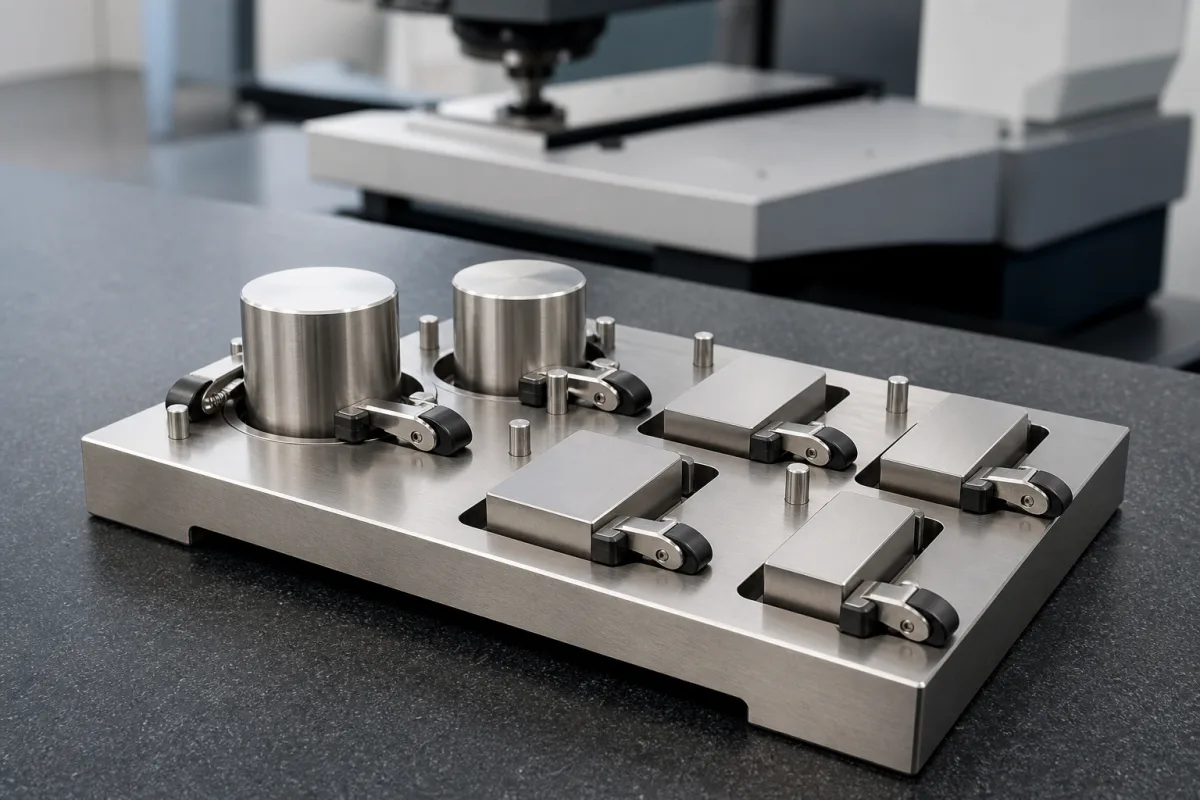
Reference Standard Holder

Based on aggregated insights from multiple verified factory profiles within the CNFX directory, the standard Reference Standard Holder used in the Machinery and Equipment Manufacturing sector typically supports operational capacities ranging from standard industrial configurations to heavy-duty production requirements.

Technical Definition & Core Assembly

A canonical Reference Standard Holder is characterized by the integration of Base Plate and Clamping Mechanism. In industrial production environments, manufacturers listed on CNFX commonly emphasize Stainless Steel construction to support stable, high-cycle operation across diverse manufacturing scenarios.

A specialized fixture designed to securely position and maintain reference standards during calibration or measurement processes.
Product Specifications

Technical details and manufacturing context for Reference Standard Holder

Definition
The Reference Standard Holder is a critical component within a Reference Standard Station that provides precise, stable mounting for reference standards. It ensures proper alignment and repeatable positioning of calibration artifacts, preventing movement or vibration that could compromise measurement accuracy. The holder typically interfaces with the station's positioning system and may include features for thermal stability, electrical isolation, or environmental protection depending on the application.
Working Principle
The holder mechanically secures the reference standard using clamping mechanisms, vacuum chucks, or kinematic mounts. It maintains precise geometric relationships between the standard and measurement probes/sensors. Some designs incorporate temperature control elements or vibration damping materials to minimize environmental influences on the reference standard during calibration procedures.
Common Materials
Stainless Steel, Aluminum Alloy, Ceramic Composite
Technical Parameters
  • Maximum reference standard dimensions accommodated (mm) Standard Spec
Components / BOM
  • Base Plate
    Provides structural foundation and mounting interface to station
    Material: Stainless Steel
  • Clamping Mechanism
    Securely holds reference standard without causing deformation
    Material: Aluminum Alloy
  • Alignment Pins
    Ensures precise positioning and repeatable placement of reference standard
    Material: Hardened Steel
Engineering Reasoning
0-50 N clamping force, 0.001-0.1 mm positional tolerance, -20°C to 80°C temperature range
Clamping force exceeds 60 N causing plastic deformation, positional deviation exceeds 0.15 mm, temperature exceeds 100°C causing thermal expansion beyond 0.2 mm
Design Rationale: Yield strength of 6061-T6 aluminum (276 MPa) exceeded at 60 N clamping force, thermal expansion coefficient of 23.6×10⁻⁶/°C for aluminum causing dimensional instability, surface wear coefficient exceeding 5×10⁻⁶ mm³/N·m
Risk Mitigation (FMEA)
Trigger Thermal cycling between -20°C and 80°C at 10 cycles/hour
Mode: Reference standard positional drift exceeding 0.15 mm due to differential thermal expansion
Strategy: Implement invar alloy (1.2×10⁻⁶/°C expansion coefficient) inserts at clamping interfaces
Trigger Vibration at 100-500 Hz frequency with 0.5 g acceleration
Mode: Clamping force reduction to 30 N due to resonant loosening
Strategy: Integrate piezoelectric force sensors with 0.1 N resolution and active damping at 250 Hz natural frequency

Industry Taxonomies & Aliases

Commonly used trade names and technical identifiers for Reference Standard Holder.

Applied To / Applications

This component is essential for the following industrial systems and equipment:

Industrial Ecosystem & Supply Chain DNA

Complementary Systems
Downstream Applications
Specialized Tooling

Application Fit & Sizing Matrix

Operational Limits
pressure: Atmospheric to 2 bar
other spec: Vibration tolerance: <0.5g RMS, Humidity: 10-90% non-condensing
temperature: -20°C to 80°C
Media Compatibility
✓ Calibration gases (e.g., nitrogen, argon) ✓ Liquid standards (e.g., water, calibration oils) ✓ Solid reference artifacts (e.g., gauge blocks, optical flats)
Unsuitable: Corrosive chemical environments (e.g., acids, strong oxidizers)
Sizing Data Required
  • Reference standard dimensions (length, diameter, geometry)
  • Required positional accuracy and repeatability
  • Mounting interface compatibility (e.g., bench, instrument-specific)

Reliability & Engineering Risk Analysis

Failure Mode & Root Cause
Misalignment-induced bearing failure
Cause: Improper installation, thermal expansion, or foundation settling causing shaft misalignment beyond tolerance, leading to excessive vibration and premature bearing wear.
Corrosion and material degradation
Cause: Exposure to harsh environmental conditions (moisture, chemicals, salt) without adequate protective coatings or material selection, resulting in pitting, rust, or stress corrosion cracking.
Maintenance Indicators
  • Unusual vibration or audible knocking during operation
  • Visible misalignment or excessive play in the reference surface or mounting points
Engineering Tips
  • Implement precision laser alignment during installation and periodic realignment checks to maintain tolerances within manufacturer specifications.
  • Apply appropriate corrosion-resistant coatings and establish regular inspection schedules for early detection of material degradation.

Compliance & Manufacturing Standards

Reference Standards
ISO 9001:2015 - Quality Management Systems ASTM A36/A36M - Standard Specification for Carbon Structural Steel CE Marking - Conformity with EU Directives for Machinery Safety
Manufacturing Precision
  • Bore Diameter: +/-0.02mm
  • Surface Flatness: 0.1mm per 100mm length
Quality Inspection
  • Dye Penetrant Test for Surface Defects
  • Coordinate Measuring Machine (CMM) Dimensional Verification

Factories Producing Reference Standard Holder

Verified manufacturers with capability to produce this product in China

✓ 93% Supplier Capability Match Found

S Sourcing Manager from Germany Feb 25, 2026
★★★★★
"Impressive build quality. Especially the technical reliability is very stable during long-term operation."
Technical Specifications Verified
P Procurement Specialist from Brazil Feb 22, 2026
★★★★☆
"As a professional in the Machinery and Equipment Manufacturing sector, I confirm this Reference Standard Holder meets all ISO standards. (Delivery took slightly longer than expected, but technical support was excellent.)"
Technical Specifications Verified
T Technical Director from Canada Feb 19, 2026
★★★★★
"Standard OEM quality for Machinery and Equipment Manufacturing applications. The Reference Standard Holder arrived with full certification."
Technical Specifications Verified
Verification Protocol

“Feedback is collected from verified sourcing managers during RFQ (Request for Quote) and factory evaluation processes on CNFX. These reports represent historical performance data and technical audit summaries from our B2B manufacturing network.”

15 sourcing managers are analyzing this specification now. Last inquiry for Reference Standard Holder from India (1h ago).

Supply Chain Compatible Machinery & Devices

Heavy-Duty CNC Plasma Cutting Machine

Industrial machine for precision metal cutting using plasma arc technology

Explore Specs →
Automated Assembly Line System

Integrated production system for sequential component assembly operations

Explore Specs →
Automated Powder Coating System

Integrated industrial system for applying dry powder coatings to metal substrates.

Explore Specs →
Centrifugal Pump Impeller

Rotating component that transfers energy to fluid in centrifugal pumps.

Explore Specs →

Frequently Asked Questions

What materials are used in the Reference Standard Holder and why?

The holder uses stainless steel for durability and corrosion resistance, aluminum alloy for lightweight stability, and ceramic composite for thermal stability and minimal expansion during precise measurements.

How does the clamping mechanism ensure secure positioning during calibration?

The clamping mechanism provides adjustable, vibration-resistant pressure to hold reference standards firmly in place without deformation, ensuring repeatable accuracy during calibration processes.

What industries benefit most from using this Reference Standard Holder?

Machinery and equipment manufacturing, precision engineering, metrology labs, and quality control departments benefit from its ability to maintain measurement traceability and calibration accuracy.

Can I contact factories directly on CNFX?

CNFX is an open directory, not a transaction platform. Each factory profile provides direct contact information and production details to help you initiate direct inquiries with Chinese suppliers.

Get Quote for Reference Standard Holder

Request technical pricing, lead times, or customized specifications for Reference Standard Holder directly from verified manufacturing units.

Your business information is encrypted and only shared with verified Reference Standard Holder suppliers.

Thank you! Your message has been sent. We'll respond within 1–3 business days.

Need to Manufacture Reference Standard Holder?

Connect with verified factories specializing in this product category

Add Your Factory Contact Us
Previous Product
Reference Standard
Next Product
Reference Standard Station