Industry-Verified Manufacturing Data (2026)

Reject Mechanism

Based on aggregated insights from multiple verified factory profiles within the CNFX directory, the standard Reject Mechanism used in the Machinery and Equipment Manufacturing sector typically supports operational capacities ranging from standard industrial configurations to heavy-duty production requirements.

Technical Definition & Core Assembly

A canonical Reject Mechanism is characterized by the integration of Actuator and Mounting Bracket. In industrial production environments, manufacturers listed on CNFX commonly emphasize Stainless Steel construction to support stable, high-cycle operation across diverse manufacturing scenarios.

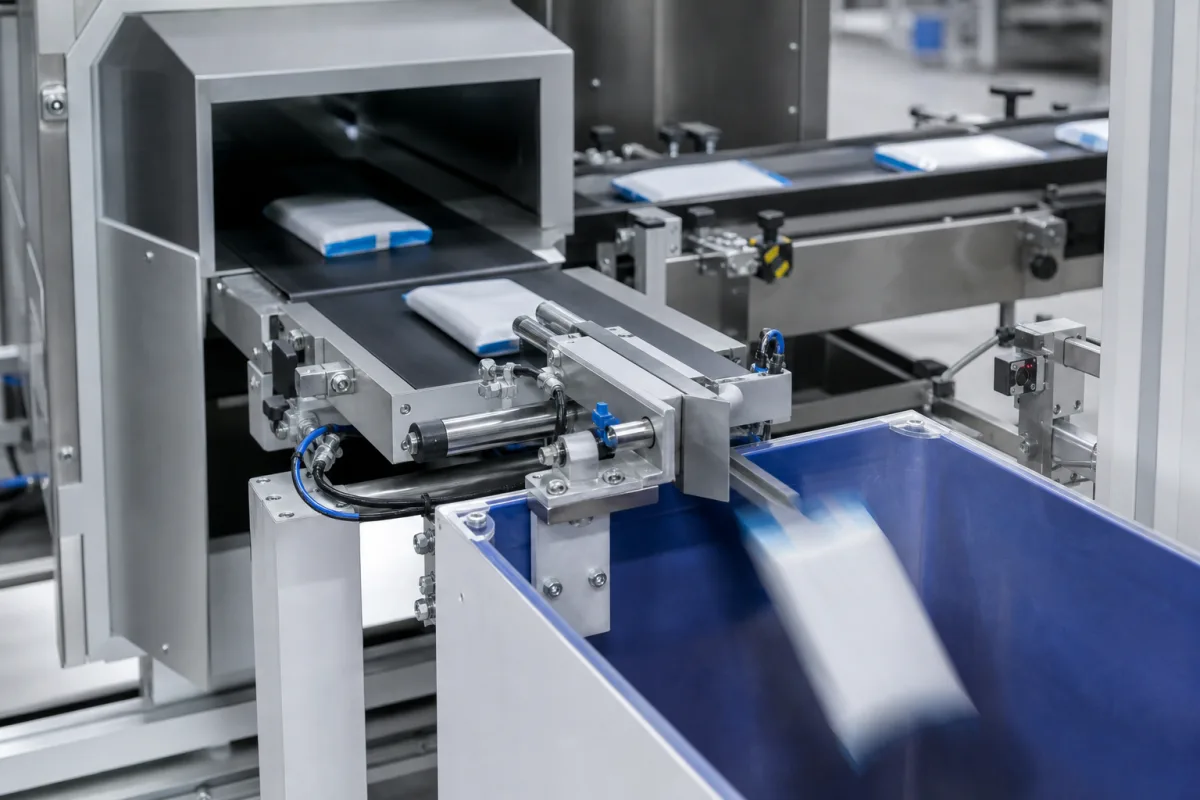
A mechanical component within an industrial system designed to identify and remove defective or non-conforming items from the production line.
Product Specifications

Technical details and manufacturing context for Reject Mechanism

Definition
The Reject Mechanism is a critical quality control component integrated into industrial systems that automatically detects products failing to meet specified standards and physically ejects them from the main processing or packaging flow. It operates in conjunction with inspection sensors to maintain product quality and prevent defective items from reaching downstream processes or final packaging.
Working Principle
The Reject Mechanism typically functions by receiving a signal from an upstream inspection system (e.g., vision system, weight checker, metal detector). Upon receiving a reject command, it activates a mechanical actuator—such as a pneumatic pusher, a diverter arm, a retractable flap, or a blow-off nozzle—to physically displace the identified defective item from the conveyor line into a designated reject bin or chute.
Common Materials
Stainless Steel, Aluminum Alloy
Technical Parameters
  • Maximum reject rate or cycle speed (items/minute) Per Request
Components / BOM
  • Actuator
    Provides the physical motion to push, divert, or blow the rejected product off the line. Common types include pneumatic cylinders, electric solenoids, or servo motors.
    Material: Stainless Steel body, internal seals (e.g., Nitrile, Polyurethane)
  • Mounting Bracket
    Secures the reject mechanism to the frame of the industrial system at the correct position along the conveyor.
    Material: Stainless Steel or Powder-Coated Steel
  • Control Solenoid Valve Optional
    For pneumatically actuated mechanisms, this valve controls the flow of compressed air to the actuator based on the electrical signal from the inspection system.
    Material: Brass or Aluminum body, internal plastic components
Engineering Reasoning
0.5-2.5 m/s linear actuator velocity, 20-100 N actuation force, 0.1-1.0 mm positional accuracy
Actuation force exceeding 120 N causes permanent deformation of linkage pins, positional accuracy degradation beyond 1.5 mm triggers false rejects
Design Rationale: Fatigue failure of 4140 steel linkage pins at 10^6 cycles under 100 N loading, wear-induced clearance accumulation in linear guides exceeding 0.2 mm
Risk Mitigation (FMEA)
Trigger Electromagnetic interference from adjacent 480V AC motors inducing 50 mV noise in proximity sensor circuits
Mode: False positive rejection of conforming items at 15% rate
Strategy: Shielded twisted-pair sensor wiring with ferrite cores, sensor circuit isolation using optocouplers
Trigger Accumulation of 0.05 mm abrasive particles in pneumatic cylinder seals over 5000 cycles
Mode: Actuation time delay increasing from 150 ms to 450 ms
Strategy: F7 grade filtration at 5 μm particle retention, stainless steel cylinder rods with hard chrome plating

Industry Taxonomies & Aliases

Commonly used trade names and technical identifiers for Reject Mechanism.

Applied To / Applications

This component is essential for the following industrial systems and equipment:

Industrial Ecosystem & Supply Chain DNA

Complementary Systems
Downstream Applications
Specialized Tooling

Application Fit & Sizing Matrix

Operational Limits
pressure: 0-10 bar
flow rate: Up to 100 m³/h
temperature: -20°C to 120°C
slurry concentration: Max 40% solids by weight
Media Compatibility
✓ Plastic pellets ✓ Food products ✓ Pharmaceutical tablets
Unsuitable: Highly corrosive chemical slurries
Sizing Data Required
  • Production line speed (items/min)
  • Defect size threshold (mm)
  • Maximum acceptable reject rate (%)

Reliability & Engineering Risk Analysis

Failure Mode & Root Cause
Seal degradation
Cause: Chemical incompatibility with process media leading to swelling, hardening, or cracking of elastomeric components
Mechanical binding
Cause: Accumulation of particulate contamination or corrosion products within the reject mechanism's moving components
Maintenance Indicators
  • Audible grinding or scraping noises during operation indicating mechanical interference
  • Visible leakage around the reject mechanism housing or discharge points
Engineering Tips
  • Implement regular flushing cycles with compatible cleaning agents to remove accumulated contaminants
  • Establish a preventive maintenance schedule for seal inspection and replacement based on operating hours and media compatibility data

Compliance & Manufacturing Standards

Reference Standards
ISO 9001:2015 Quality Management Systems ANSI B18.3 Hexagon Socket Head Cap Screws DIN 471 Retaining Rings
Manufacturing Precision
  • Bore Diameter: +/-0.02mm
  • Surface Flatness: 0.1mm
Quality Inspection
  • Dimensional Verification with CMM
  • Hardness Testing (Rockwell C Scale)

Factories Producing Reject Mechanism

Verified manufacturers with capability to produce this product in China

✓ 94% Supplier Capability Match Found

P Procurement Specialist from United Arab Emirates Jan 31, 2026
★★★★★
"Found 29+ suppliers for Reject Mechanism on CNFX, but this spec remains the most cost-effective."
Technical Specifications Verified
T Technical Director from Australia Jan 28, 2026
★★★★★
"The technical documentation for this Reject Mechanism is very thorough, especially regarding technical reliability."
Technical Specifications Verified
P Project Engineer from Singapore Jan 25, 2026
★★★★★
"Reliable performance in harsh Machinery and Equipment Manufacturing environments. No issues with the Reject Mechanism so far."
Technical Specifications Verified
Verification Protocol

“Feedback is collected from verified sourcing managers during RFQ (Request for Quote) and factory evaluation processes on CNFX. These reports represent historical performance data and technical audit summaries from our B2B manufacturing network.”

10 sourcing managers are analyzing this specification now. Last inquiry for Reject Mechanism from Thailand (1h ago).

Supply Chain Commonly Integrated Components

Vision System

An optical inspection subsystem that uses cameras, lighting, and image processing to detect defects in pharmaceutical vials.

Explore Specs →
Coating Pan

A rotating vessel used to apply uniform coating layers to pharmaceutical tablets through controlled spraying and drying processes.

Explore Specs →
Spray System

A precision fluid delivery subsystem that atomizes and applies coating solutions onto pharmaceutical tablets within an automated coating system.

Explore Specs →
Air Handling Unit

A device that conditions and circulates air as part of a heating, ventilation, and air conditioning (HVAC) system

Explore Specs →

Frequently Asked Questions

What materials are used in this reject mechanism?

This reject mechanism is constructed from durable stainless steel and lightweight aluminum alloy components for optimal performance in industrial environments.

How does the reject mechanism identify defective items?

The mechanism uses integrated sensors and control systems to detect non-conforming items based on predefined quality parameters, then activates the actuator to remove them from the production line.

What maintenance is required for the reject mechanism?

Regular inspection of the actuator, control solenoid valve, and mounting bracket is recommended, along with periodic lubrication and cleaning to ensure reliable operation.

Can I contact factories directly on CNFX?

CNFX is an open directory, not a transaction platform. Each factory profile provides direct contact information and production details to help you initiate direct inquiries with Chinese suppliers.

Get Quote for Reject Mechanism

Request technical pricing, lead times, or customized specifications for Reject Mechanism directly from verified manufacturing units.

Your business information is encrypted and only shared with verified Reject Mechanism suppliers.

Thank you! Your message has been sent. We'll respond within 1–3 business days.

Need to Manufacture Reject Mechanism?

Connect with verified factories specializing in this product category

Add Your Factory Contact Us
Previous Product
Regulation Valve/Gate
Next Product
Rejection Gate/Mechanism