Industry-Verified Manufacturing Data (2026)

Reservoir/Sump

Based on aggregated insights from multiple verified factory profiles within the CNFX directory, the standard Reservoir/Sump used in the Machinery and Equipment Manufacturing sector typically supports operational capacities ranging from standard industrial configurations to heavy-duty production requirements.

Technical Definition & Core Assembly

A canonical Reservoir/Sump is characterized by the integration of Drain Plug and Filler Cap/Breather. In industrial production environments, manufacturers listed on CNFX commonly emphasize Carbon steel construction to support stable, high-cycle operation across diverse manufacturing scenarios.

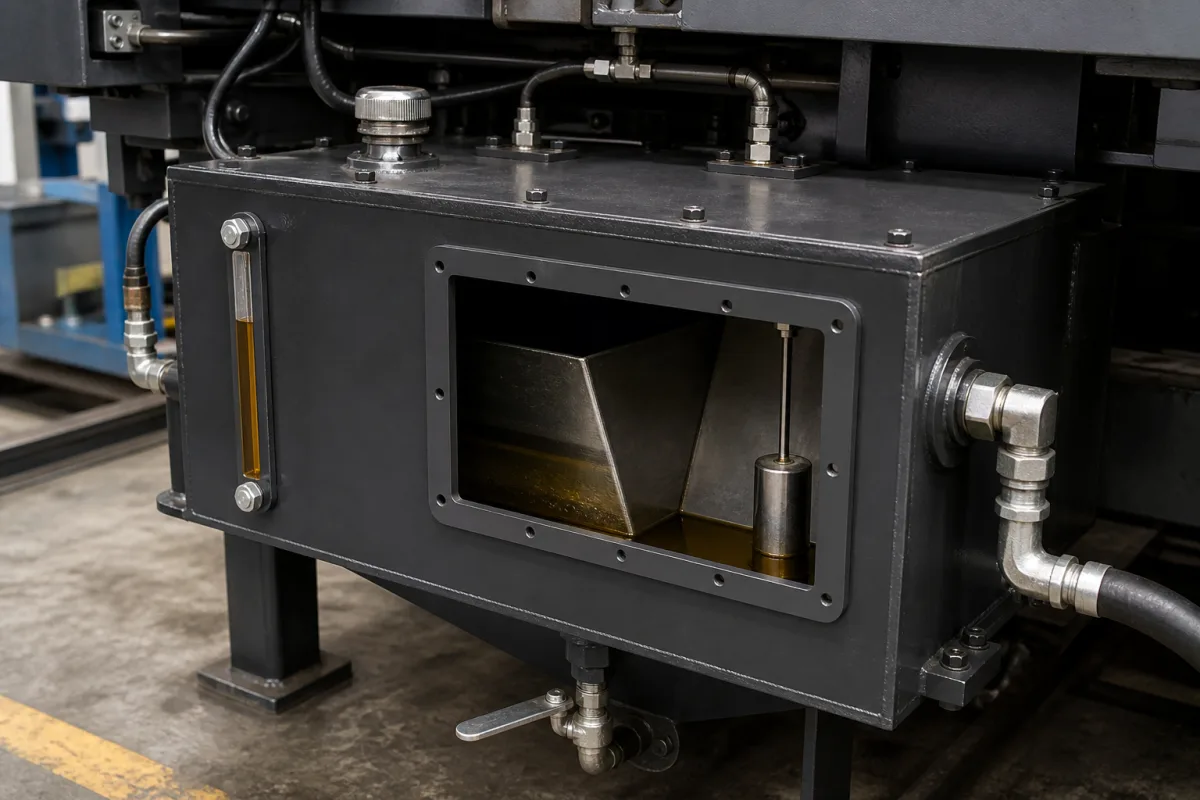
A container that stores lubricating oil within a lubrication system, providing a reservoir for oil supply and collection.
Product Specifications

Technical details and manufacturing context for Reservoir/Sump

Definition
The reservoir or sump is an essential component of lubrication systems that serves as the primary storage and collection point for lubricating oil. It holds the oil supply for the system, allows for oil cooling and settling of contaminants, and provides a base for oil pumps to draw from. In many systems, it also serves as the collection point for oil returning from lubricated components.
Working Principle
The reservoir/sump operates by providing a contained volume for lubricating oil storage. Oil is drawn from the reservoir by pumps to lubricate system components, then returns to the reservoir through gravity or return lines. The reservoir allows for oil temperature stabilization, contaminant settling, and maintains the necessary oil volume for continuous system operation.
Common Materials
Carbon steel, Stainless steel, Aluminum alloy
Technical Parameters
  • Capacity of the reservoir/sump (L) Customizable
Components / BOM
  • Drain Plug
    Allows for complete drainage of oil during maintenance or oil changes
    Material: Steel or brass
  • Filler Cap/Breather
    Provides access for oil filling and allows for pressure equalization while preventing contamination
    Material: Plastic or metal
  • Oil Level Indicator
    Visual or electronic device to monitor oil level within the reservoir
    Material: Glass, plastic, or metal with sensor components
  • Baffle Plates
    Internal plates that prevent oil sloshing and promote contaminant settling
    Material: Steel
Engineering Reasoning
0.1-2.0 bar (gauge pressure), 5-80°C temperature, 0.5-10 m³ capacity
Pressure >2.5 bar causes seal failure, temperature >90°C initiates oil degradation, capacity <0.3 m³ triggers pump cavitation
Design Rationale: Exceeding 2.5 bar pressure differential across seals exceeds elastomer yield strength (3.5 MPa), temperatures >90°C accelerate oxidation rate (Arrhenius equation k=Ae^(-Ea/RT) with Ea=75 kJ/mol for mineral oil)
Risk Mitigation (FMEA)
Trigger Particulate contamination exceeding ISO 4406 18/16/13 cleanliness level
Mode: Abrasive wear on pump components increasing clearance beyond 50 μm tolerance
Strategy: Install 10 μm absolute beta₃≥200 filter with differential pressure monitoring at 0.7 bar
Trigger Water ingress exceeding 500 ppm saturation limit (ASTM D6304)
Mode: Hydrolysis of ester-based additives forming acidic compounds dropping pH below 5.0
Strategy: Integrate coalescing separator with 99.9% efficiency at 0.1 μm droplet size and continuous moisture monitoring

Industry Taxonomies & Aliases

Commonly used trade names and technical identifiers for Reservoir/Sump.

Applied To / Applications

This component is essential for the following industrial systems and equipment:

Industrial Ecosystem & Supply Chain DNA

Complementary Systems
Downstream Applications
Specialized Tooling

Application Fit & Sizing Matrix

Operational Limits
pressure: Atmospheric to 1.5 bar
flow rate: Dependent on pump capacity, typically 0-100 L/min
temperature: -20°C to 120°C
slurry concentration: Not applicable for lubricating oil reservoirs
Media Compatibility
✓ Mineral-based lubricating oils ✓ Synthetic lubricants ✓ Hydraulic fluids
Unsuitable: Corrosive chemicals or acids
Sizing Data Required
  • Required oil volume (L)
  • System flow rate (L/min)
  • Required residence time for settling/deaeration (minutes)

Reliability & Engineering Risk Analysis

Failure Mode & Root Cause
Corrosion
Cause: Chemical attack from stored fluids, galvanic corrosion due to dissimilar metals, or exposure to corrosive environments without proper protective coatings.
Structural fatigue cracking
Cause: Cyclic loading from fluid level changes, thermal expansion/contraction stresses, vibration from connected equipment, or inadequate structural design for operational loads.
Maintenance Indicators
  • Visible fluid leakage at seams, welds, or connections indicating loss of containment integrity
  • Unusual audible vibrations, rattling, or resonance during filling/draining cycles suggesting structural issues or loose internal components
Engineering Tips
  • Implement regular ultrasonic thickness testing at critical locations to monitor wall thinning from corrosion/erosion before failure occurs
  • Install proper venting/breather systems with desiccant filters to control internal moisture and prevent condensation-related corrosion

Compliance & Manufacturing Standards

Reference Standards
ISO 9001:2015 Quality Management Systems ANSI/ASME B31.3 Process Piping DIN 28018-1 Pressure Vessels - Design and Construction
Manufacturing Precision
  • Wall Thickness: +/-5% of nominal
  • Flatness of Mounting Surfaces: 0.5mm per meter
Quality Inspection
  • Hydrostatic Pressure Test
  • Visual and Dimensional Inspection

Factories Producing Reservoir/Sump

Verified manufacturers with capability to produce this product in China

✓ 92% Supplier Capability Match Found

P Procurement Specialist from United States Jan 03, 2026
★★★★★
"The Reservoir/Sump we sourced perfectly fits our Machinery and Equipment Manufacturing production line requirements."
Technical Specifications Verified
T Technical Director from United Arab Emirates Dec 31, 2025
★★★★★
"Found 27+ suppliers for Reservoir/Sump on CNFX, but this spec remains the most cost-effective."
Technical Specifications Verified
P Project Engineer from Australia Dec 28, 2025
★★★★★
"The technical documentation for this Reservoir/Sump is very thorough, especially regarding technical reliability."
Technical Specifications Verified
Verification Protocol

“Feedback is collected from verified sourcing managers during RFQ (Request for Quote) and factory evaluation processes on CNFX. These reports represent historical performance data and technical audit summaries from our B2B manufacturing network.”

10 sourcing managers are analyzing this specification now. Last inquiry for Reservoir/Sump from Turkey (24m ago).

Supply Chain Compatible Machinery & Devices

Hydraulic Press

Industrial machine using hydraulic pressure to compress, form, or assemble materials

Explore Specs →
Heavy-Duty CNC Plasma Cutting Machine

Industrial machine for precision metal cutting using plasma arc technology

Explore Specs →
Automated Assembly Line System

Integrated production system for sequential component assembly operations

Explore Specs →
Automated Powder Coating System

Integrated industrial system for applying dry powder coatings to metal substrates.

Explore Specs →

Frequently Asked Questions

What are the key components of a reservoir/sump for lubrication systems?

Key components include baffle plates to prevent oil sloshing, a drain plug for easy maintenance, a filler cap/breather for oil addition and ventilation, and an oil level indicator for monitoring.

Which material is best for a corrosive environment?

Stainless steel offers the best corrosion resistance for harsh or corrosive environments, while aluminum alloy provides good corrosion resistance with lighter weight.

How do baffle plates improve reservoir performance?

Baffle plates stabilize oil flow, prevent vortex formation and air entrainment during pump operation, ensure consistent oil supply, and help separate contaminants.

Can I contact factories directly on CNFX?

CNFX is an open directory, not a transaction platform. Each factory profile provides direct contact information and production details to help you initiate direct inquiries with Chinese suppliers.

Get Quote for Reservoir/Sump

Request technical pricing, lead times, or customized specifications for Reservoir/Sump directly from verified manufacturing units.

Your business information is encrypted and only shared with verified Reservoir/Sump suppliers.

Thank you! Your message has been sent. We'll respond within 1–3 business days.

Need to Manufacture Reservoir/Sump?

Connect with verified factories specializing in this product category

Add Your Factory Contact Us
Previous Product
Reservoir Tank
Next Product
Resin Underdrain / Collector System