Dry blending · Inner and outer ribbons and counter-flow, fill level and minimum batch, tip speed and scale-up, ribbon-to-trough clearance, removable agitators
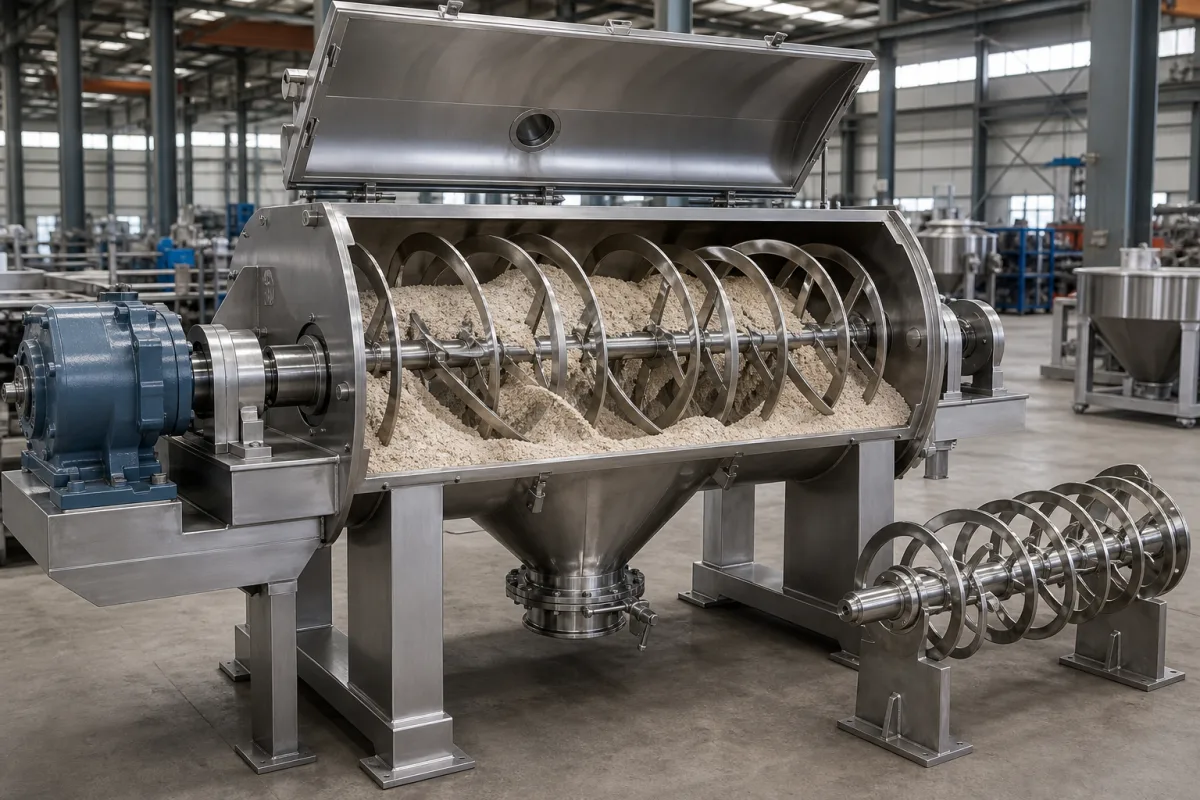
A ribbon blender agitator is the horizontal shaft in a U-shaped trough carrying an outer and an inner helical ribbon on support arms; turning it moves dry powders, granules or pastes back and forth along the trough and across it until the batch is uniform. Ask three things first: how the ribbons are pitched and how close the outer ribbon runs to the trough, what batch range and bulk density the agitator and drive are sized for, and how the agitator is sealed, driven and removed for cleaning.
Ribbon agitators and the batch ribbon blenders they run in, for dry powders, granules and light pastes. Paddle and plough mixers, vertical liquid agitators and continuous mixers are outside this page except where compared.
CNFX editorial research · Sources checked October 12, 2026 · 4 sources
Charles Ross & Son states that optimal mixing needs a batch of at least 30–40% of the rated volumetric capacity, because smaller batches do not give enough contact between agitator and product; full working capacity corresponds to a batch level at about the height of the top ribbon, material at rest should not be above the agitator, and overfilling can lead to long cycles or poor mixes. [3] It notes the batch volume sets blender size while bulk density sets horsepower, noting that "most standard blenders can typically handle bulk densities around 35 lbs/cu.ft.", with heavier-duty models for denser products. [2]
Ross states that “Tip speeds in the range of 300 feet/min are typical”, recommends keeping the same tip speed when scaling up from successful pilot trials, and notes the agitator need not run at full speed with friable ingredients and that longer mixing times should be expected as power per unit volume falls. Ross says the ribbon blender "normally achieves complete mixing within a short time - in many cases, 15 minutes or less", especially for ingredients of similar particle size and bulk density. [1][2]
Editorial calculation: holding 300 ft/min (about 91 m/min) at the ribbon tip means about 48 rpm for a 0.6 m agitator diameter, 24 rpm at 1.2 m and 15 rpm at 2.0 m, from rpm = tip speed / (π × diameter). A 1,000 L blender at 30–40% minimum fill needs at least 300–400 L in the batch. [1][3]
Give the supplier the materials and their bulk densities (lowest and highest), batch volume range, mixing time target, any liquid additions or heating, friability, required blend uniformity, sanitary or explosion-protection requirements, cleaning method, discharge valve type, drive and control preferences, and testing needs.
02
Specify ribbons, clearance, drive and cleaning access
Ross describes the agitator as inner and outer helical ribbons pitched to move material axially in opposing directions and radially, and says a well-designed blender holds 1/8 to 3/16 in. between outer ribbon and trough to avoid dead zones, with well-polished stainless surfaces and radiused welds to prevent build-up. [3][1]
Ross recommends a one-piece gearmotor direct drive over belt or chain drives, with a variable frequency drive for soft starting under full load and speed control; lantern rings on the packing gland for fine or abrasive powders and slight positive air pressure to keep particles out of the stuffing box; a clamped gasketed cover and dust-tight knife-gate or ball valve; and an interchangeable paddle agitator for gentler blending of fragile products. [1][3]
If the agitator must be removed, Ross advises telling the maker before purchase: match marks on shaft flanges for occasional removal, or a flat-flange clamshell coupling to lift the agitator out without moving end shafts, bearings or seals when it must come out after every batch. It notes the blender may be cleaned with brush, steam, air or water spray and that "in most applications, there is no need to remove the agitator when cleaning". [3]
03
Ribbon blenders in powder lines and ribbon agitators among industrial agitators
Listings include ribbon blenders in powder mixing and filling lines and ribbon agitators among industrial agitators; ask each for ribbon-to-trough clearance, tip speed, drive and seal design, and a mixing test with your materials.
04
Compare working capacity, speed range and jacket rating across makers
Lee Industries' fact sheet lists horizontal ribbon blenders from 25 to 5,000 gallons, with single or double ribbon, paddle or bar agitators, all available with scraped surface. Its notes define working capacity as approximately 75% of the ribbon height and approximately 68% of total volume, and state that horsepower is designed for 20 RPM motors on an AC inverter set to give 3–30 RPM mixing speeds. [4]
Blenders above 500 gallons have either a non-removable shaft or removable end pieces. The Uniflow jacket is used for operating pressures up to 250 PSI; jacketed units come with 1 1/2 in of insulation and a 304 stainless sheath, product-contact parts are 304 or 316 stainless, and finishes run from the standard #4 to a #7 mirror finish of less than 6 Ra. [4]
Editorial calculation: at Lee's 68% working-to-total ratio, a 1,000 gal working batch implies a vessel of about 1,470 gal total volume (1,000 / 0.68). Ask each supplier whether a quoted capacity is working or total volume. The table gives Lee's working capacities with litre conversions (1 US gal = 3.785 L).
Working capacity (US gal)
Working capacity (cu ft)
Editorial conversion (L)
100
13.4
about 379
500
66.8
about 1,893
1,000
133.7
about 3,785
1,500
200.5
about 5,678
05
Drive shaft, outer and inner ribbons, support arms, shaft seals and drive
The two ribbons work as a pair: Ross pitches the outer and inner ribbons to move material axially in opposite directions and radially, and holds the outer one 1/8 to 3/16 in. from the trough to avoid dead zones. [3]
Part
Role
Fix in the order
Central drive shaft
Carries ribbons; takes torque.
Diameter, material.
Outer helical ribbon
Moves material one way; sets trough clearance. [3]
Working volume, agitator speed, motor power, uniformity and wetted materials for an agitator order
State whether a capacity is working or total volume: Lee Industries puts working capacity at about 68% of total volume, so 1,000 gal working means a vessel of about 1,470 gal (editorial calculation). [4]
2 companies list this product among what they make. Company figures are quoted from each
company's own website; every card states where the relationship came from.
Shanghai Dahe Packaging Machinery Co., Ltd.
Manufacturing site to be confirmed for the order
Lists ribbon blenders within powder mixing and filling lines.
Explore company information and manufacturing capabilities, then discuss the scope of your project with a relevant supplier.
Share this page
Compiled and source-reviewed by the CNFX editorial team.
Each manufacturer above links to the page on that company's own website where the product is listed, with the date we checked it. How we source and review
· Page last updated 13 October 2026
Buyer questions
How full should a ribbon blender be?
Ross says the batch should be at least 30–40% of rated capacity and no higher than about the top of the ribbon, not above the agitator at rest. [3]
What tip speed does a ribbon agitator run at?
Ross states that “Tip speeds in the range of 300 feet/min are typical” and advises keeping pilot-scale tip speed on scale-up. [1][2]
What clearance should the ribbon have to the trough?
Ross cites 1/8 to 3/16 in. between outer ribbon and trough to prevent dead zones. [3]
What share of a ribbon blender's volume is working capacity?
Lee Industries' fact sheet gives working capacity as approximately 75% of the ribbon height and approximately 68% of total volume. [4]
Sources and what still needs a direct check
Sources checked 2026-10-12. Charles Ross & Son is a mixer maker; its technology briefs and the article by its application engineer describe practice for its blenders. Lee Industries' fact sheet gives its own capacity and jacket data.