Industry-Verified Manufacturing Data (2026)

Rinsing Tanks

Based on aggregated insights from multiple verified factory profiles within the CNFX directory, the standard Rinsing Tanks used in the Machinery and Equipment Manufacturing sector typically supports operational capacities ranging from standard industrial configurations to heavy-duty production requirements.

Technical Definition & Core Assembly

A canonical Rinsing Tanks is characterized by the integration of Tank Body and Drain Valve. In industrial production environments, manufacturers listed on CNFX commonly emphasize Stainless Steel 304/316 construction to support stable, high-cycle operation across diverse manufacturing scenarios.

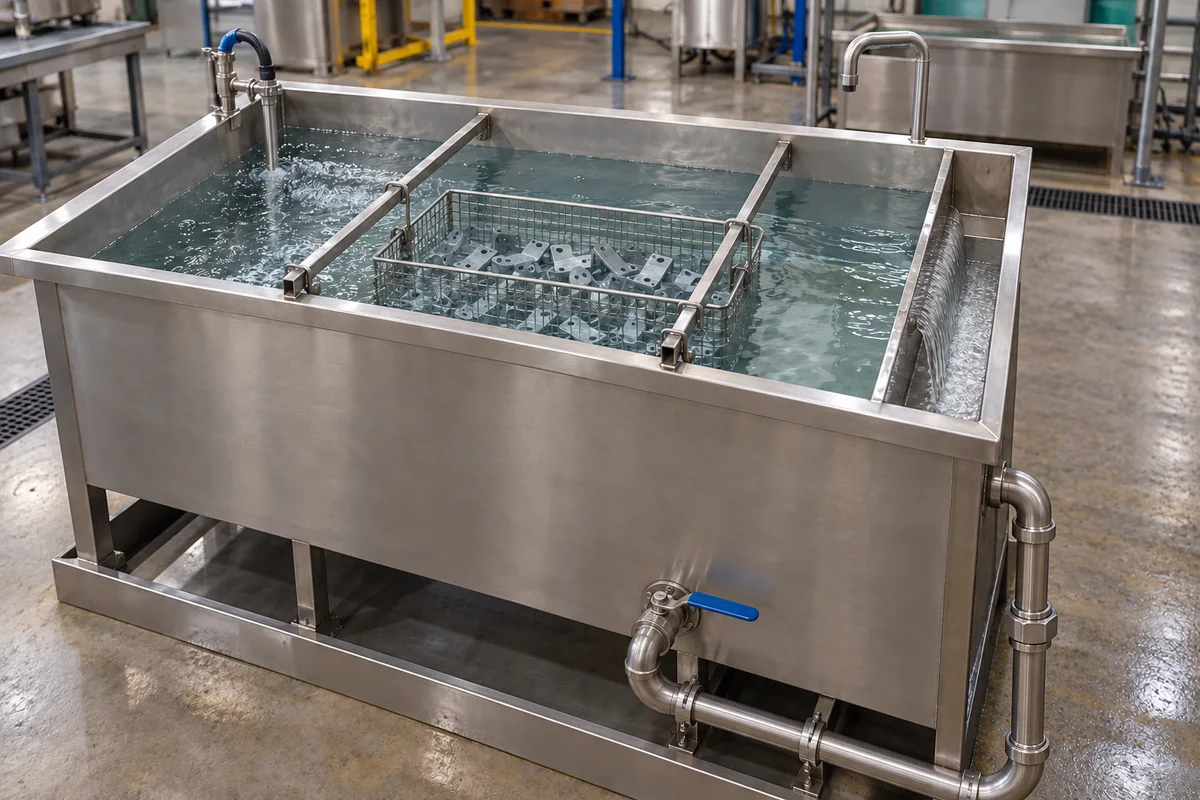
Tanks used for rinsing and cleaning parts or materials in industrial pretreatment processes
Product Specifications

Technical details and manufacturing context for Rinsing Tanks

Definition
Rinsing tanks are essential components within pretreatment systems designed to remove contaminants, residues, or processing chemicals from surfaces through immersion and agitation in water or cleaning solutions. They typically follow cleaning or etching stages to ensure thorough removal of all substances before subsequent processing.
Working Principle
Parts or materials are immersed in the tank containing water or rinsing solution. The cleaning action occurs through mechanical agitation, spray systems, or ultrasonic waves that dislodge and remove contaminants from surfaces. Fresh water may be continuously supplied or the solution may be recirculated through filtration systems.
Common Materials
Stainless Steel 304/316, Polypropylene, Fiberglass Reinforced Plastic
Technical Parameters
  • Tank dimensions (length × width × depth) and wall thickness (mm) Customizable
Components / BOM
  • Tank Body
    Main container holding rinsing solution
    Material: stainless steel
  • Drain Valve
    Controls drainage of used rinsing solution
    Material: PVC or stainless steel
  • Overflow Weir
    Maintains constant liquid level and removes surface contaminants
    Material: stainless steel
  • Agitation System
    Creates movement in solution to enhance cleaning
    Material: stainless steel

Industry Taxonomies & Aliases

Commonly used trade names and technical identifiers for Rinsing Tanks.

Applied To / Applications

This component is essential for the following industrial systems and equipment:

Industrial Ecosystem & Supply Chain DNA

Complementary Systems
Downstream Applications
Specialized Tooling

Application Fit & Sizing Matrix

Operational Limits
pressure: Atmospheric to 0.5 bar (7.25 psi) gauge
flow rate: Up to 50 m³/h (220 GPM)
temperature: Ambient to 90°C (194°F)
slurry concentration: Up to 10% solids by weight
Media Compatibility
✓ Aqueous cleaning solutions ✓ Mild alkaline detergents ✓ Deionized water rinses
Unsuitable: Hydrofluoric acid or strong oxidizing agents
Sizing Data Required
  • Maximum part dimensions and batch volume
  • Required rinse cycle time and throughput
  • Available floor space and utility connections

Reliability & Engineering Risk Analysis

Failure Mode & Root Cause
Corrosion-induced perforation
Cause: Chemical attack from aggressive cleaning agents or process fluids, exacerbated by improper material selection or inadequate protective coatings.
Structural weld fatigue cracking
Cause: Cyclic thermal stresses from repeated heating/cooling cycles or mechanical vibrations from adjacent equipment, leading to crack initiation at weld joints.
Maintenance Indicators
  • Visible pitting, discoloration, or weeping at tank seams/welds indicating active corrosion
  • Unusual audible vibrations or resonance during operation suggesting loose internal components or structural issues
Engineering Tips
  • Implement routine ultrasonic thickness testing at high-corrosion zones to monitor material loss before failure occurs
  • Install sacrificial anodes or impressed current cathodic protection systems to actively combat electrochemical corrosion

Compliance & Manufacturing Standards

Reference Standards
ISO 14001:2015 - Environmental management systems ANSI Z358.1-2014 - Emergency eyewash and shower equipment DIN 50930-6:2018 - Corrosion of metallic materials in water systems
Manufacturing Precision
  • Tank flatness: +/- 0.5 mm per meter
  • Weld seam alignment: +/- 1.0 mm
Quality Inspection
  • Leak test (hydrostatic or pneumatic)
  • Surface finish verification (Ra value measurement)

Factories Producing Rinsing Tanks

Verified manufacturers with capability to produce this product in China

✓ 95% Supplier Capability Match Found

P Procurement Specialist from Brazil Jan 30, 2026
★★★★★
"As a professional in the Machinery and Equipment Manufacturing sector, I confirm this Rinsing Tanks meets all ISO standards."
Technical Specifications Verified
T Technical Director from Canada Jan 27, 2026
★★★★★
"Standard OEM quality for Machinery and Equipment Manufacturing applications. The Rinsing Tanks arrived with full certification."
Technical Specifications Verified
P Project Engineer from United States Jan 24, 2026
★★★★★
"Great transparency on the Rinsing Tanks components. Essential for our Machinery and Equipment Manufacturing supply chain."
Technical Specifications Verified
Verification Protocol

“Feedback is collected from verified sourcing managers during RFQ (Request for Quote) and factory evaluation processes on CNFX. These reports represent historical performance data and technical audit summaries from our B2B manufacturing network.”

7 sourcing managers are analyzing this specification now. Last inquiry for Rinsing Tanks from Vietnam (55m ago).

Supply Chain Compatible Machinery & Devices

Hydraulic Press

Industrial machine using hydraulic pressure to compress, form, or assemble materials

Explore Specs →
Heavy-Duty CNC Plasma Cutting Machine

Industrial machine for precision metal cutting using plasma arc technology

Explore Specs →
Automated Assembly Line System

Integrated production system for sequential component assembly operations

Explore Specs →
Automated Powder Coating System

Integrated industrial system for applying dry powder coatings to metal substrates.

Explore Specs →

Frequently Asked Questions

What materials are best for corrosive chemical rinsing applications?

For highly corrosive environments, Stainless Steel 316 offers superior chemical resistance compared to 304. Polypropylene and Fiberglass Reinforced Plastic (FRP) are also excellent choices for specific chemical compatibility.

How does the agitation system improve rinsing efficiency?

The agitation system creates turbulent flow within the tank, ensuring thorough contact between cleaning solutions and parts. This reduces rinsing time, improves cleaning consistency, and prevents sediment buildup.

What maintenance is required for industrial rinsing tanks?

Regular maintenance includes inspecting drain valves for leaks, cleaning overflow weirs to prevent clogging, checking agitation system components, and monitoring tank walls for corrosion or damage based on material type.

Can I contact factories directly on CNFX?

CNFX is an open directory, not a transaction platform. Each factory profile provides direct contact information and production details to help you initiate direct inquiries with Chinese suppliers.

Get Quote for Rinsing Tanks

Request technical pricing, lead times, or customized specifications for Rinsing Tanks directly from verified manufacturing units.

Your business information is encrypted and only shared with verified Rinsing Tanks suppliers.

Thank you! Your message has been sent. We'll respond within 1–3 business days.

Need to Manufacture Rinsing Tanks?

Connect with verified factories specializing in this product category

Add Your Factory Contact Us
Previous Product
Ribbon Blender Agitator
Next Product
Ripper