Editorial Technical Reference

Chemical Dosing System

This page explains how Chemical Dosing System is classified within Beverage Manufacturing. Technical values and manufacturer relationships are research references; confirm the current specification and supplier evidence for each order.

Technical Definition & Core Assembly

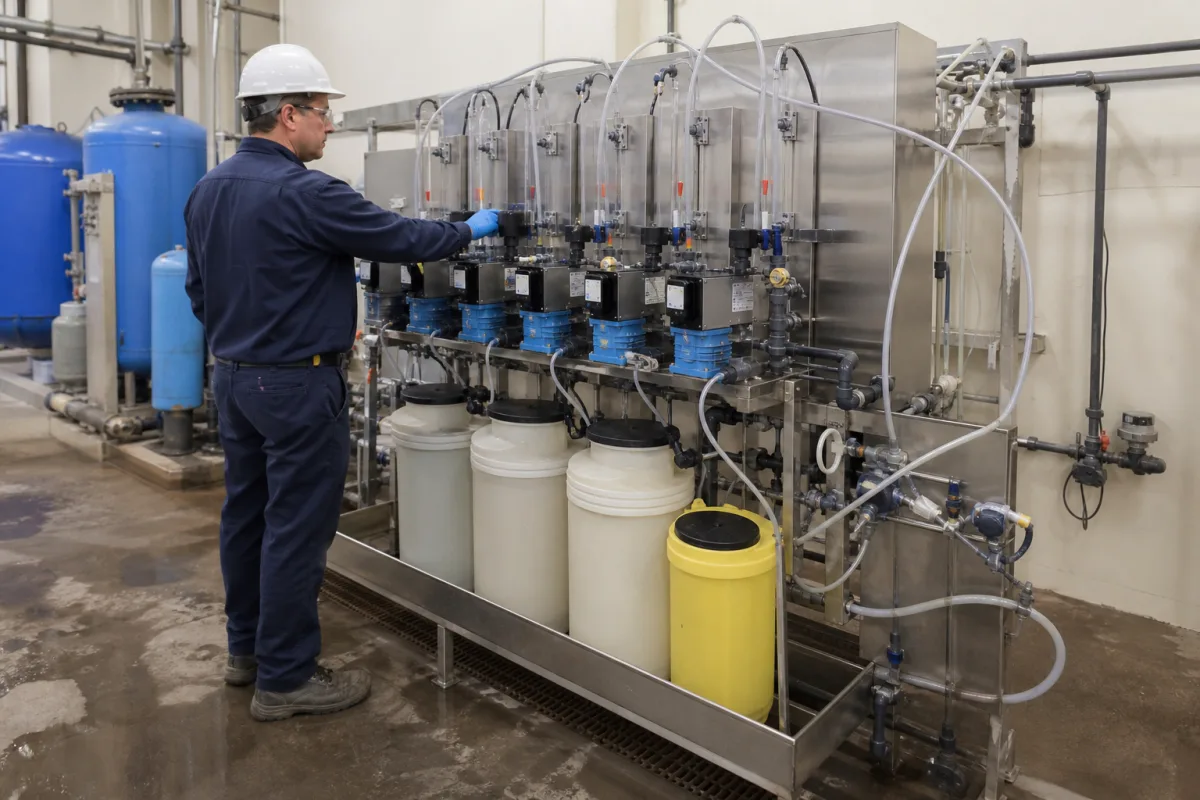
A precision-controlled system that accurately meters and injects sterilizing chemicals into beverage containers during the sterilization process.

Representative product image. Confirm appearance and specifications with the manufacturer.

Product Specifications

Technical details and manufacturing context for Chemical Dosing System

Definition
The Chemical Dosing System is a critical component of the Automated Beverage Container Sterilization System responsible for the precise measurement, mixing, and injection of liquid sterilizing agents (such as hydrogen peroxide, peracetic acid, or chlorine-based solutions) into beverage containers. It ensures consistent chemical concentration and dosage to achieve effective microbial decontamination while minimizing chemical waste and preventing over-treatment that could affect product quality. The system typically uses positive displacement pumps (such as diaphragm or peristaltic pumps) controlled by programmable logic controllers (PLCs) to draw sterilant from storage tanks. Flow meters and sensors monitor the volume and concentration, with feedback loops adjusting pump speed to maintain precise dosing rates as containers move through the sterilization line. The chemicals are then injected via spray nozzles or vaporizers into the containers. Key parameters include a chemical concentration range of 0.5–5.0%, dosing accuracy of ±0.5% of set point, maximum flow rate of 50–500 L/h, operating pressure of 2–6 bar, and operating temperature range of 10–40 °C. Materials of construction include 316L stainless steel, PTFE, silicone, and chemical-resistant plastics. The system is designed for continuous duty in beverage plants, with a service life of 10–15 years under proper maintenance. It integrates with existing line control systems via PLC with HMI, 4–20 mA, and Modbus RTU/TCP. Standards referenced include ISO 9001, IEC 61131-3, IEC 60038, ISO 7005, FDA 21 CFR 177, and EU 1935/2004. Verify model-specific values and standards with the legal manufacturer or supplier.
Working Principle
The system uses positive displacement pumps (diaphragm or peristaltic) controlled by PLCs to draw sterilant from storage tanks. Flow meters and sensors monitor volume and concentration, with feedback loops adjusting pump speed to maintain precise dosing rates. Chemicals are injected via spray nozzles or vaporizers into containers as they move through the sterilization line. The PLC adjusts pump speed based on real-time feedback to ensure consistent dosing accuracy of ±0.5% of set point. Operating pressure ranges from 2–6 bar, and flow rates from 50–500 L/h. The system is designed for continuous operation in beverage plants, with materials compatible with sterilants like peracetic acid and hydrogen peroxide.
Common Materials
Stainless Steel 316L, PTFE (Polytetrafluoroethylene), Silicone, Chemical-resistant plastics
Technical Parameters
ParameterTypical rangeNotes & selection driver
Chemical Concentration Range0.5–5.0 %0.5–5.0 — Typical sterilant concentration for beverage container sterilization; adjustable via PLC. Typical sterilant concentration for beverage container sterilization; adjustable via PLC.
Dosing AccuracyRequired±0.5 % of set point±0.5 — Maintained across flow range and viscosity changes. Maintained across flow range and viscosity changes.
Maximum Flow RateRequired50–500 L/hMaximum chemical delivery capacity Depends on line speed and container size; higher rates for larger production lines.
Operating PressureRequired2–6 bar2–6 — At pump discharge; higher pressure may require reinforced tubing and fittings. At pump discharge; higher pressure may require reinforced tubing and fittings.
Pump TypeDiaphragm or peristalticDiaphragm or peristaltic — Positive displacement pumps; peristaltic for low shear, diaphragm for higher pressure. Positive displacement pumps; peristaltic for low shear, diaphragm for higher pressure.
Materials of Construction316L stainless steel, PTFE, silicone, chemical-resistant plastics316L stainless steel, PTFE, silicone, chemical-resistant plastics — Wetted parts must be compatible with sterilant (e.g., peracetic acid, hydrogen peroxide). Wetted parts must be compatible with sterilant (e.g., peracetic acid, hydrogen peroxide).
Operating Temperature Range10–40 °C10–40 — Ambient and fluid temperature; outside range may affect viscosity and dosing accuracy. Ambient and fluid temperature; outside range may affect viscosity and dosing accuracy.
Power Supply230/400 V, 50/60 Hz, 3-phase230/400 V, 50/60 Hz, 3-phase — Typical industrial supply; specify voltage and frequency for site. Typical industrial supply; specify voltage and frequency for site.IEC 60038
Control InterfacePLC with HMI, 4–20 mA, Modbus RTU/TCPPLC with HMI, 4–20 mA, Modbus RTU/TCP — For integration with existing line control systems. For integration with existing line control systems.IEC 61131-3
Connection SizeDN15–DN50DN15–DN50 — Inlet/outlet connections; depends on flow rate and pipe size. Inlet/outlet connections; depends on flow rate and pipe size.ISO 7005
Duty CycleContinuousContinuous — Designed for 24/7 operation in beverage plants. Designed for 24/7 operation in beverage plants.
Service Life10–15 years10–15 — With proper maintenance; wear parts (e.g., pump tubes, diaphragms) may need replacement. With proper maintenance; wear parts (e.g., pump tubes, diaphragms) may need replacement.
Ambient temperature10–40 °C10–40 °C — Outside this window: Below 10 °C may cause chemical crystallization; above 40 °C may degrade chemicals and affect pump seals. Outside this window: Below 10 °C may cause chemical crystallization; above 40 °C may degrade chemicals and affect pump seals.
Fluid viscosity1–100 cP1–100 cP — Outside this window: Higher viscosity reduces flow rate and accuracy; may require larger pump or heating. Outside this window: Higher viscosity reduces flow rate and accuracy; may require larger pump or heating.
Supply voltage±10% of nominal±10% of nominal — Outside this window: Voltage fluctuations can cause pump speed variation, affecting dosing accuracy. Outside this window: Voltage fluctuations can cause pump speed variation, affecting dosing accuracy.
Back pressure0.5–6 bar0.5–6 bar — Outside this window: Excessive back pressure may cause pump overload or leakage; low pressure may cause siphoning. Outside this window: Excessive back pressure may cause pump overload or leakage; low pressure may cause siphoning.

Ranges are indicative industry figures for RFQ preparation, not a supplier commitment. Confirm every value and standard with the legal manufacturer before ordering.

Components / BOM
  • Dosing Pump
    Precisely meters and delivers sterilizing chemicals
    Material: Stainless Steel 316L with PTFE diaphragms
  • Chemical Storage Tank
    Holds sterilizing solution with level monitoring
    Material: Stainless Steel 316L or HDPE
  • Flow Meter/Sensor
    Measures actual chemical flow for feedback control
    Material: Stainless Steel with ceramic measuring chamber
  • Control Panel
    Interface for setting dosing parameters and monitoring operation
    Material: Stainless Steel enclosure with touchscreen
  • Injection Nozzles
    Distributes chemicals into beverage containers
    Material: Stainless Steel or ceramic

Industry Taxonomies & Aliases

Commonly used trade names and technical identifiers for Chemical Dosing System.

Applied To / Applications

This component is essential for the following industrial systems and equipment:

Industrial Ecosystem & Supply Chain Structure

Complementary Systems
Downstream Applications
Specialized Tooling

Application Fit & Sizing Matrix

What Decides the Award
  • What is the required dosing accuracy and repeatability for your specific sterilant and container type?
  • What is the maximum flow rate needed to match your line speed and container size?
  • What materials of construction are compatible with the sterilant you use (e.g., peracetic acid, hydrogen peroxide)?
  • What control interface and communication protocols are required for integration with your existing PLC/SCADA?
  • What is the total cost of ownership, including maintenance and spare parts availability?
  • Does the supplier provide validation documentation and compliance with food safety standards (e.g., FDA, EU 1935/2004)?
  • What is the lead time and after-sales support for installation and commissioning?
Failure Modes & Inspection
  • Dosing inaccuracy
    Check: Perform a timed volume test using a graduated cylinder; compare actual vs. set point. Check for air bubbles in sight glass.
  • Chemical leakage
    Check: Visual inspection for drips or residue; pressure test the system at 1.5x operating pressure.
  • Pump failure
    Check: Monitor pump pressure and flow; listen for abnormal noise. Disassemble and inspect diaphragm for tears.
  • Contamination
    Check: Swab test wetted parts for chemical residue; verify material certificates for 316L and PTFE.
  • Control system malfunction
    Check: Check alarm logs, verify sensor calibration, and test communication with a loopback test.

Reliability & Engineering Risk Analysis

Failure Mode & Root Cause
Chemical corrosion of wetted components
Cause: Incompatibility between dosing chemicals and pump materials (e.g., diaphragm, valves, seals) leading to material degradation and leaks
Diaphragm/check valve failure
Cause: Fatigue from cyclic operation, chemical attack, or particulate contamination causing loss of dosing accuracy and flow
Maintenance Indicators
  • Visible chemical leakage around pump head or injection points
  • Audible knocking or irregular clicking sounds during operation indicating valve or diaphragm issues
Engineering Tips
  • Implement material compatibility verification for all wetted parts based on chemical concentration, temperature, and exposure duration
  • Install dual redundant filtration upstream of dosing pumps and establish strict particulate monitoring protocols

Indicative industry ranges for design and RFQ preparation. Confirm the exact figures and applicable standard with the manufacturer before specifying.

Compliance & Manufacturing Standards

Applicable Standards
ANSI/ISA 84.00.01 - Functional safety of electrical/electronic/programmable electronic safety-related systems CE Marking - EU Directive 2014/68/EU (Pressure Equipment Directive)

Quoted from the published standard.

Manufacturing Precision
  • Flow rate accuracy: +/- 1% of setpoint
  • Dosing valve seat flatness: 0.05mm maximum deviation
Quality Inspection
  • Pressure test at 1.5x maximum operating pressure for 30 minutes
  • Material composition verification via X-ray fluorescence (XRF) analysis

Manufacturers of Chemical Dosing System

2 companies list this product among what they make. Company figures are quoted from each company's own website; every card states where the relationship came from.

Hebei Kingwell Machinery Co., Ltd.
Hebei, CN
API ISO GOST
Listed on the company's own website · profile compiled by CNFX from public sources
Globaluf
Guangdong, CN
Listed on the company's own website · profile compiled by CNFX from public sources

Manufacturer listings support early research and capability understanding. They are not certification, ranking, or transaction guarantees.

Technical documentation
Request current drawings, revision history, and a signed specification sheet.
Manufacturing capability
Verify equipment lists, process limits, capacity, and representative production evidence.
Inspection readiness
Confirm test methods, calibrated equipment, sampling plans, and traceable reports.
Supplier transparency
Check the legal entity, factory address, ownership, certifications, and direct contacts.

CNFX does not score or rank suppliers. Buyers must verify all claims and documents with the legal manufacturer before ordering.

Supply Chain Compatible Machinery & Devices

Automated Beverage Container Integrity Testing System

Automated system for non-destructive testing of beverage container seals and structural integrity.

Explore Specs →
Automated Beverage Container Pressure Testing System

Automated system for testing beverage container pressure resistance and seal integrity.

Explore Specs →
Automated Beverage Container Leak Detection System

The Automated Beverage Container Leak Detection System is an industrial device designed for integration into bottling or canning lines.

Explore Specs →
Automated Beverage Container Depalletizing Machine

Industrial machine that automatically removes beverage containers from pallets for production line feeding

Explore Specs →

Frequently Asked Questions

What sterilants can be used with this system?

The system is designed for liquid sterilizing agents such as hydrogen peroxide, peracetic acid, or chlorine-based solutions. Wetted parts are made of 316L stainless steel, PTFE, silicone, and chemical-resistant plastics to ensure compatibility. Always verify chemical compatibility with the manufacturer for your specific sterilant.

How is dosing accuracy maintained?

Dosing accuracy is maintained through PLC-controlled positive displacement pumps and feedback loops from flow meters and sensors. The system adjusts pump speed in real time to keep concentration within ±0.5% of the set point, even with changes in flow rate or viscosity.

What are the operating limits for temperature and pressure?

The operating temperature range is 10–40 °C, and the operating pressure is 2–6 bar. Outside these ranges, chemical viscosity may change, affecting dosing accuracy, or pump seals may degrade. Ensure the system is operated within these limits and consult the manufacturer for extreme conditions.

What standards apply to this system?

Referenced standards include ISO 9001 for quality management, IEC 61131-3 for PLC programming, IEC 60038 for voltage, ISO 7005 for flanges, and FDA 21 CFR 177 and EU 1935/2004 for food contact materials. These are procurement references; verify actual compliance with the supplier.

Data Basis

Editorial classification, named public sources where available, and source-reviewed manufacturer records.

Preliminary Technical Classification
This page supports structured research, RFQ preparation, and supplier evaluation. It does not replace buyer-led supplier qualification, standards review, or technical approval.
Buyer enquiry

Request manufacturing insight for Chemical Dosing System

Ask for use case, specification boundaries, supplier type, and RFQ preparation information for this product.

Where it goes
Straight to the CNFX editorial desk, and to the manufacturer if this product is linked to a claimed profile. Nothing is broadcast to a supplier list.
Your details stay here
We do not sell or rent enquiry data, and we do not add you to a mailing list. Used only to answer this request.
No commission, no middleman
CNFX is a directory. We take no cut of any order and never negotiate on a supplier's behalf.
What we don't claim
A listing is not an endorsement. Qualify every supplier and verify every figure yourself before ordering.

Your business information is used only to process this request.

Thank you! Your message has been sent. We'll respond within 1–3 business days.
Sorry, we couldn't send your message. Please try again, or email us at contact@cnfx.com.

Need to Manufacture Chemical Dosing System?

Compare manufacturer profiles with relevant product and process capability.

Previous Product
Carbonator
Next Product
Container Infeed Starwheel
Get QuotesChat