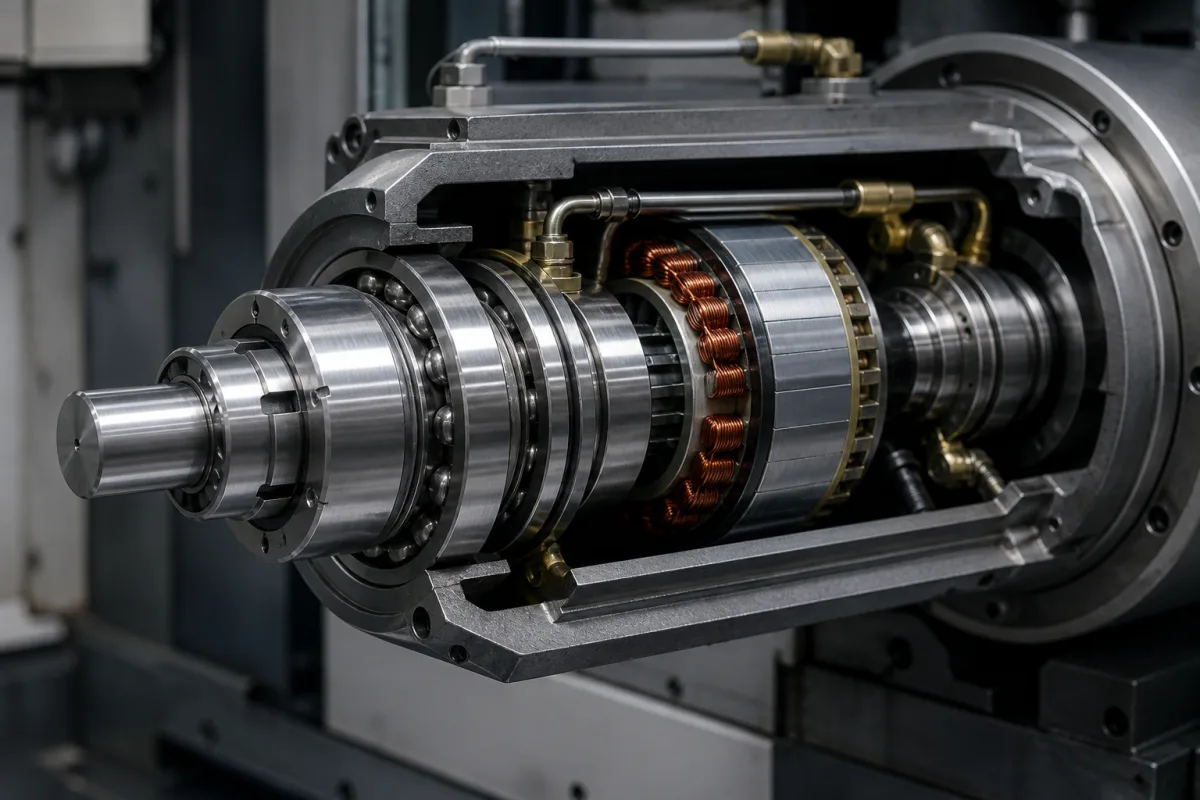
Built-in motor rotary spindle for CNC lathes (workpiece spindle carrying the chuck)
Workpiece spindle of a CNC lathe with the motor's stator and rotor built around the shaft · A2-5, A2-6 or A2-8 nose against through-hole for bar stock, S1 and short-time torque, cooling of the built-in motor
A built-in motor rotary spindle for a lathe is the workpiece spindle itself: a hollow shaft running in precision bearings, with a chuck or collet mounted on its nose, and a motor whose rotor is fitted on the shaft and whose stator is fixed in the housing, so there is no belt or gearbox. Bar stock passes through the bore. Three choices set the rest of the machine: the spindle nose and through-hole for the chucks and bar diameters to be run, the continuous and short-time torque at low speed, and how the motor heat is carried away.
Workpiece (main and sub) spindles with built-in motors for CNC lathes and turning centres, supplied as cartridges with shaft, bearings, built-in stator and rotor, encoder, brake disk and A2-type spindle nose. Externally driven main spindles with belt or gear drives are covered on the Main spindle unit with external belt or gear drive page, and spindle units with an attached or separate motor on the Spindle assembly page. High-speed tool spindles for machining centres and grinding are covered on the High-speed spindle page, and router and engraving spindle motors on the Spindle motor page. Swivelling or tilting spindle heads and rotary tables are outside this page.
CNFX editorial research · Sources checked October 12, 2026 · 4 sources
A2-5, A2-6 or A2-8 nose: 56, 75 or 88 mm through-hole for bar stock
Setco's motorized lathe spindles with FANUC built-in motors show how the spindle nose, the through-hole that limits bar diameter and the bearing size grow together. All three units are for horizontal mounting with grease-lubricated bearings, a 1/20 spindle taper, an aiBz sensor, oil cooling and a standard brake disk. [2][1][3]
Editorial calculation: moving from the A2-5 to the A2-8 unit adds 32 mm of through-hole (56 to 88 mm) and lowers the maximum speed by 2,500 rpm (6,000 to 3,500 rpm). [2][3]
Editorial note: the through-hole is a limit on the spindle, not the bar capacity of the lathe; the draw tube, the chuck or collet and the bar feeder each take up part of it, so ask the supplier for the usable bar diameter with the chuck you will fit.
Give the supplier the largest bar diameter and chuck or collet size, the spindle nose you want, the maximum speed needed for the smallest parts, and whether the spindle is a main or sub-spindle.
02
Continuous S1 against short-time S3 torque, and the speed where full power starts
The same three Setco spindles list their FANUC BiI motors with continuous (S1) and short-time ratings: 140 Nm S1 and 208 Nm S3 at 40% for the A2-5 unit (BiI-160S/13000, 11 kW S1, 15 kW S2 for 30 min); 233 Nm S1 and 477 Nm S3 at 25% for the A2-6 unit (BiI-180M/6000, 11 kW S1, 15 kW S2 for 20 min); and 398 Nm S1 and 700 Nm S3 at 25% for the A2-8 unit (BiI-200L/6000, 15 kW S1, 22 kW S2 for 30 min). [2][1][3]
Editorial calculation: the speed at which the S1 power is reached with S1 torque is n = P × 60 ÷ (2π × T): 11,000 × 60 ÷ (2π × 140) ≈ 750 rpm for the A2-5 unit, 11,000 × 60 ÷ (2π × 233) ≈ 451 rpm for the A2-6 unit and 15,000 × 60 ÷ (2π × 398) ≈ 360 rpm for the A2-8 unit. Below these speeds the spindle is limited by torque, above them by power. [2][1][3]
Editorial calculation: the short-time torque of the A2-6 unit is 477 ÷ 233 ≈ 2.0 times its S1 torque, and 700 ÷ 398 ≈ 1.8 times for the A2-8 unit, available only for the 25% duty stated. [1][3]
FANUC describes its BiI-B built-in spindle motors as giving large torque at low speed and high power at high speed by speed range control, and its BiS-B series as having an IPM (interior magnet) type suited to turning with large torque at low speed and an SPM (surface magnet) type for high-speed milling. [4]
State the largest workpiece diameter and the cutting force or depth of cut at that diameter, the cycle (continuous or short bursts), and the speeds needed for finishing.
03
Taking heat out of the built-in stator: oil or water cooling and resin-moulded windings
In a built-in spindle the motor losses arise inside the spindle housing. FANUC's brochure for its BiI-B and BiS-B built-in spindle motors gives two examples of what cooling changes: a resin-moulded stator raising continuous rated output by 34%, or lowering temperature rise at the same output by 34%; and water cooling instead of oil cooling raising continuous rated output by 20%, or lowering temperature rise at the same output by 25%. Both require more chiller capacity. [4]
FANUC lists the stator resin mould as an option on the BiI-B series and standard on the BiS-B series, a stator with or without cooling jacket, a copper-bar rotor on some BiI-B models for larger torque, and S6 short-time ratings equal to S3 through its spindle control. [4]
Each Setco unit reviewed is specified with oil cooling of the motor and grease-lubricated bearings. [1] Editorial note: the chiller for a built-in spindle has to be sized for the motor losses at the rated duty; ask for the heat load, coolant type, flow and inlet temperature with the spindle quotation, and whether the rating assumes oil or water cooling.
04
Send the chuck, bar, torque and cooling data together
Paste it into your enquiry below or into an email to a maker, then replace every bracket.
Workpiece: [largest bar diameter; chuck or collet size; largest turned diameter]
Spindle: [main or sub; nose A2-5/A2-6/A2-8; through-hole; mounting]
Speed: [maximum rpm; finishing speed range]
Torque: [S1 at low speed; short-time S3 and duty]
Motor: [built-in motor make and model; drive]
Bearings: [lubrication grease or oil-air]
Cooling: [oil or water; chiller capacity]
Options: [brake disk; C-axis encoder]
Explore company information and manufacturing capabilities, then discuss the scope of your project with a relevant supplier.
Share this page
Compiled and source-reviewed by the CNFX editorial team.
Each manufacturer above links to the page on that company's own website where the product is listed, with the date we checked it. How we source and review
· Page last updated 13 October 2026
Buyer questions
What through-hole comes with an A2-6 lathe spindle?
Setco's A2-6 built-in motor unit 307A030 has a Ø75 mm through-hole; its A2-5 unit has Ø56 mm and its A2-8 unit Ø88 mm. [1][2][3]
How much torque does a built-in lathe spindle give?
In the Setco units reviewed, 140 to 398 Nm continuous (S1) and 208 to 700 Nm short-time (S3). [2][3]
Does water cooling help a built-in spindle motor?
FANUC's example shows 20% more continuous output, or 25% lower temperature rise at the same output, with water cooling instead of oil. [4]
Which built-in motor type suits turning?
FANUC describes the IPM type of its BiS-B series as suited to turning with large torque at low speed. [4]
Sources and what still needs a direct check
Sources checked 2026-10-12. Setco's three spec sheets describe single standard units fitted with FANUC motors; FANUC's brochure describes its built-in spindle motor series with illustrative examples, not ratings for a specific spindle.