Industry-Verified Manufacturing Data (2026)

Safety Door Interlock

Based on aggregated insights from multiple verified factory profiles within the CNFX directory, the standard Safety Door Interlock used in the Machinery and Equipment Manufacturing sector typically supports operational capacities ranging from standard industrial configurations to heavy-duty production requirements.

Technical Definition & Core Assembly

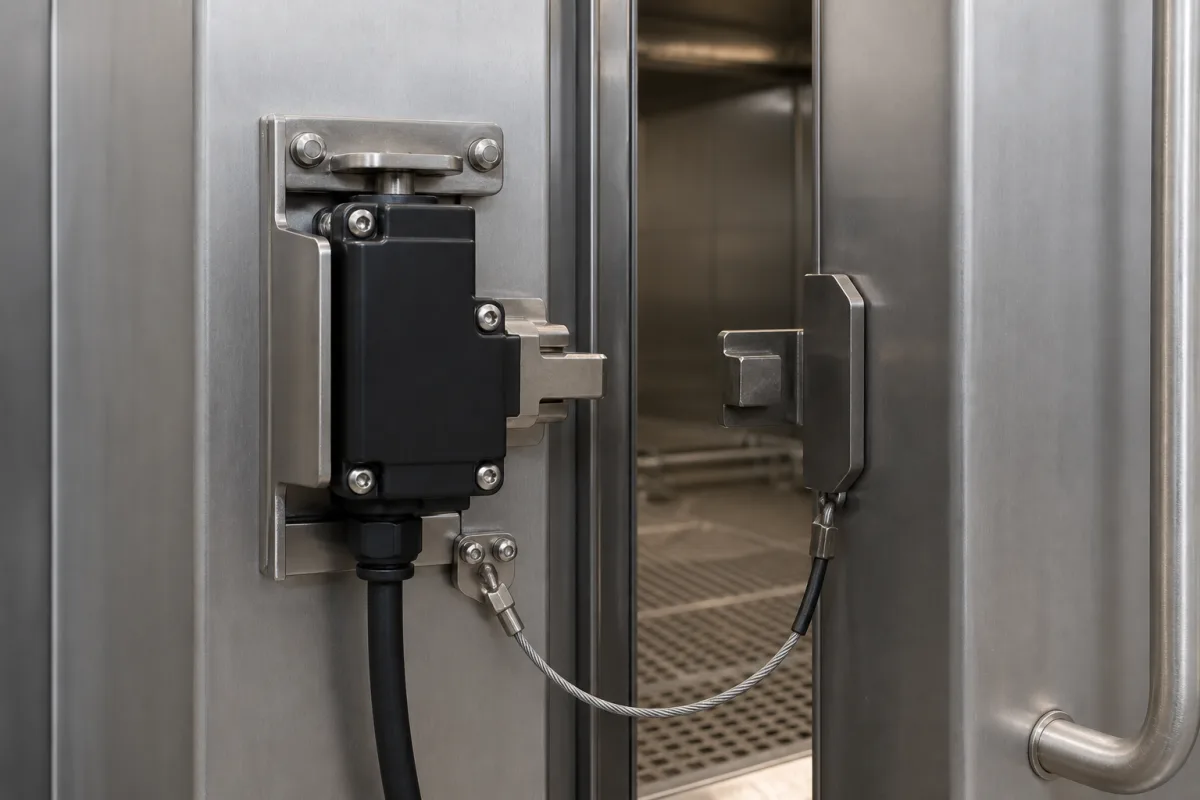
A canonical Safety Door Interlock is characterized by the integration of Actuator and Sensor. In industrial production environments, manufacturers listed on CNFX commonly emphasize Stainless Steel construction to support stable, high-cycle operation across diverse manufacturing scenarios.

A safety device that prevents operation of the high-temperature rinse chamber when the door is open
Product Specifications

Technical details and manufacturing context for Safety Door Interlock

Definition
A critical safety component in high-temperature rinse chambers that ensures the door is securely closed and locked before the chamber can operate, preventing exposure to high-temperature water, steam, and chemicals during the rinsing process. It typically consists of mechanical and/or electrical locking mechanisms that interface with the chamber's control system.
Working Principle
The interlock uses mechanical switches, magnetic sensors, or proximity sensors to detect door position. When the door is open, the interlock sends a signal to the control system that prevents activation of pumps, heaters, and spray systems. Only when the door is fully closed and latched does the interlock allow the chamber to operate, ensuring operator safety.
Common Materials
Stainless Steel, Engineering Plastics, Copper Alloys
Technical Parameters
  • Mounting dimensions and clearance requirements (mm) Standard Spec
Components / BOM
  • Actuator
    Mechanical interface that engages with door latch
    Material: Stainless Steel
  • Sensor
    Detects door position and sends signal to control system
    Material: Engineering Plastic with Copper Contacts
  • Mounting Bracket
    Secures interlock to chamber frame
    Material: Stainless Steel
  • Wiring Harness
    Electrical connection to control system
    Material: Copper with Silicone Insulation
Engineering Reasoning
0.5-2.0 mm gap tolerance, 24 VDC ±10% supply voltage, -20°C to +85°C ambient temperature
Contact gap >2.5 mm prevents electrical continuity, supply voltage <21.6 VDC causes relay dropout, ambient temperature >90°C degrades polymer components
Design Rationale: Excessive mechanical wear increases contact gap beyond Hall effect sensor detection range, voltage sag below holding coil minimum causes magnetic field collapse, polymer creep at elevated temperatures deforms actuator mechanism
Risk Mitigation (FMEA)
Trigger Mechanical abrasion from door misalignment
Mode: Contact gap exceeds 2.5 mm threshold
Strategy: Hardened tungsten carbide contact surfaces with 0.1 mm wear allowance
Trigger Voltage transient from adjacent motor starts
Mode: Relay coil demagnetization at <21.6 VDC
Strategy: Dedicated 24 VDC power supply with 100 ms ride-through capacitor bank

Industry Taxonomies & Aliases

Commonly used trade names and technical identifiers for Safety Door Interlock.

Applied To / Applications

This component is essential for the following industrial systems and equipment:

Industrial Ecosystem & Supply Chain DNA

Complementary Systems
Downstream Applications
Specialized Tooling

Application Fit & Sizing Matrix

Operational Limits
pressure: 0 to 1 bar (atmospheric to slight positive pressure)
other spec: Door gap tolerance: ±2mm, Response time: <100ms, IP rating: IP67/IP69K, Mechanical life: >1 million cycles
temperature: -40°C to +150°C (operating), up to +200°C (peak)
Media Compatibility
✓ High-temperature rinse water (up to 95°C) ✓ Industrial cleaning chemicals (alkaline/acidic solutions) ✓ Food-grade sanitizing agents
Unsuitable: High-pressure steam environments (>2 bar steam pressure)
Sizing Data Required
  • Door thickness and material (for actuator mounting)
  • Required safety integrity level (SIL 2/SIL 3/PL d/PL e)
  • Available electrical interface (24VDC, 110VAC, safety relay integration)

Reliability & Engineering Risk Analysis

Failure Mode & Root Cause
Mechanical wear and misalignment
Cause: Repeated cycling causing physical degradation of latch mechanisms, hinges, or striker plates; improper installation leading to misalignment that prevents proper engagement
Electrical contact failure
Cause: Corrosion or contamination of electrical contacts from environmental factors (moisture, dust, chemicals); wear from repeated switching cycles leading to poor conductivity or open circuits
Maintenance Indicators
  • Audible grinding or scraping sounds during door operation indicating mechanical wear
  • Intermittent or complete failure of safety system to recognize door closure (machine continues to operate with door open)
Engineering Tips
  • Implement regular alignment checks and adjustments using precision tools to ensure proper mechanical engagement between door and interlock components
  • Establish preventive maintenance schedule for contact cleaning and lubrication using manufacturer-recommended materials, and install protective covers or seals in harsh environments

Compliance & Manufacturing Standards

Reference Standards
ISO 14119:2013 Safety of machinery - Interlocking devices associated with guards ANSI B11.19-2019 Performance Requirements for Risk Reduction and Safeguarding EN 1088:1995 Safety of machinery - Interlocking devices associated with guards - Principles for design and selection
Manufacturing Precision
  • Actuator alignment tolerance: +/-0.5mm
  • Switch actuation force: 10-30N
Quality Inspection
  • Functional safety test (EN ISO 13849-1 PL d)
  • Environmental sealing test (IP65/IP67 rating verification)

Factories Producing Safety Door Interlock

Verified manufacturers with capability to produce this product in China

✓ 93% Supplier Capability Match Found

T Technical Director from Germany Jan 14, 2026
★★★★★
"Great transparency on the Safety Door Interlock components. Essential for our Machinery and Equipment Manufacturing supply chain."
Technical Specifications Verified
P Project Engineer from Brazil Jan 11, 2026
★★★★☆
"The Safety Door Interlock we sourced perfectly fits our Machinery and Equipment Manufacturing production line requirements. (Delivery took slightly longer than expected, but technical support was excellent.)"
Technical Specifications Verified
S Sourcing Manager from Canada Jan 08, 2026
★★★★★
"Found 46+ suppliers for Safety Door Interlock on CNFX, but this spec remains the most cost-effective."
Technical Specifications Verified
Verification Protocol

“Feedback is collected from verified sourcing managers during RFQ (Request for Quote) and factory evaluation processes on CNFX. These reports represent historical performance data and technical audit summaries from our B2B manufacturing network.”

11 sourcing managers are analyzing this specification now. Last inquiry for Safety Door Interlock from Vietnam (47m ago).

Supply Chain Compatible Machinery & Devices

Heavy-Duty CNC Plasma Cutting Machine

Industrial machine for precision metal cutting using plasma arc technology

Explore Specs →
Automated Assembly Line System

Integrated production system for sequential component assembly operations

Explore Specs →
Automated Powder Coating System

Integrated industrial system for applying dry powder coatings to metal substrates.

Explore Specs →
Centrifugal Pump Impeller

Rotating component that transfers energy to fluid in centrifugal pumps.

Explore Specs →

Frequently Asked Questions

What is the primary function of this safety door interlock?

It prevents the operation of high-temperature rinse chambers when the door is open, ensuring operator safety by eliminating exposure to hazardous conditions.

What materials are used in this safety interlock and why?

Stainless steel for corrosion resistance, engineering plastics for durability and insulation, and copper alloys for reliable electrical conductivity in the wiring components.

How does this interlock integrate with existing machinery?

It connects via the included wiring harness and mounts using the bracket, with the sensor detecting door position and the actuator engaging/disengaging the safety mechanism automatically.

Can I contact factories directly on CNFX?

CNFX is an open directory, not a transaction platform. Each factory profile provides direct contact information and production details to help you initiate direct inquiries with Chinese suppliers.

Get Quote for Safety Door Interlock

Request technical pricing, lead times, or customized specifications for Safety Door Interlock directly from verified manufacturing units.

Your business information is encrypted and only shared with verified Safety Door Interlock suppliers.

Thank you! Your message has been sent. We'll respond within 1–3 business days.

Need to Manufacture Safety Door Interlock?

Connect with verified factories specializing in this product category

Add Your Factory Contact Us
Previous Product
Safety Devices
Next Product
Safety Enclosure