Industry-Verified Manufacturing Data (2026)

Safety Enclosures

Based on aggregated insights from multiple verified factory profiles within the CNFX directory, the standard Safety Enclosures used in the Machinery and Equipment Manufacturing sector typically supports operational capacities ranging from standard industrial configurations to heavy-duty production requirements.

Technical Definition & Core Assembly

A canonical Safety Enclosures is characterized by the integration of Frame Structure and Safety Interlock System. In industrial production environments, manufacturers listed on CNFX commonly emphasize Powder-coated steel construction to support stable, high-cycle operation across diverse manufacturing scenarios.

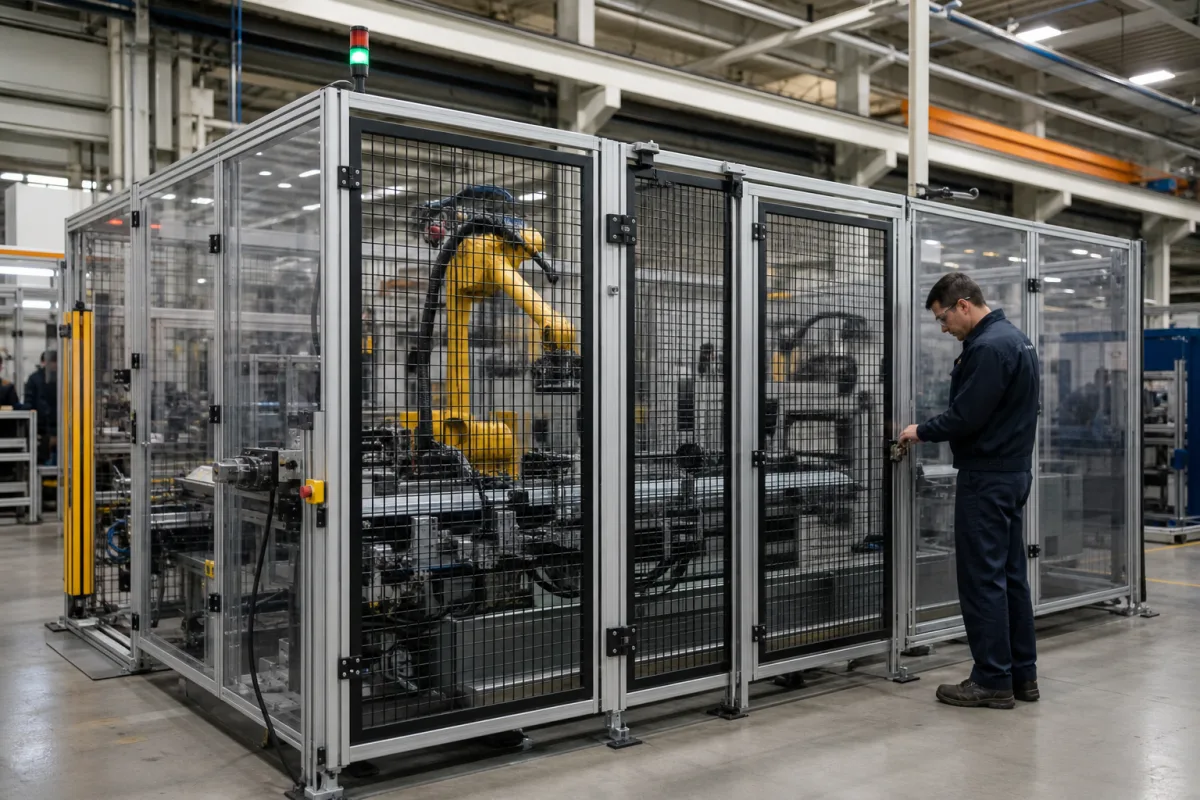
Protective barriers designed to shield operators and equipment from hazards in automated assembly environments.

Product Specifications

Technical details and manufacturing context for Safety Enclosures

Definition
Safety enclosures are protective structures integrated into automated assembly line systems that create physical barriers between moving machinery components and human operators. They prevent accidental contact with hazardous areas such as robotic arms, conveyor mechanisms, and processing zones, while allowing visibility and access for maintenance when properly secured. These enclosures are essential for compliance with industrial safety standards and risk mitigation in high-speed manufacturing operations.
Working Principle
Safety enclosures operate by creating a physical separation between hazardous machinery and personnel. They typically incorporate interlock systems that automatically halt machine operation when access doors are opened, and may include safety-rated sensors, transparent viewing panels, and emergency stop mechanisms. The enclosures are designed to withstand impact forces while maintaining structural integrity during normal operation.
Common Materials
Powder-coated steel, Polycarbonate panels, Aluminum framing
Technical Parameters
  • Dimensions of enclosure openings and panel thickness (mm) Per Request
Components / BOM
  • Frame Structure
    Provides structural support and mounting points for panels and doors
    Material: Powder-coated steel
  • Safety Interlock System
    Detects door openings and triggers machine shutdown for operator safety
    Material: Stainless steel with electronic components
  • Viewing Panels
    Allows visual monitoring of enclosed processes while maintaining protection
    Material: Polycarbonate or safety glass
  • Access Doors
    Provides controlled entry points for maintenance and loading/unloading
    Material: Steel with safety hinges and latches
Engineering Reasoning
0-120 dB(A) noise attenuation, 0-1500 N impact resistance, -20°C to 80°C temperature range
Structural failure at >1500 N impact force, acoustic failure at >120 dB(A) transmitted noise, thermal failure at >80°C material temperature
Design Rationale: Material yield strength exceeded (AISI 304 stainless steel: 215 MPa yield), acoustic transmission coefficient >0.1 at 120 dB, polymer degradation at >80°C (polycarbonate Tg: 147°C)
Risk Mitigation (FMEA)
Trigger Resonant vibration at 85-125 Hz matching enclosure natural frequency
Mode: Fatigue cracking at welded joints due to cyclic stress exceeding 107 MPa
Strategy: Damping material application (butyl rubber, 0.3 loss factor) and structural stiffeners to shift natural frequency to 180+ Hz
Trigger Electrostatic discharge (ESD) accumulation to >15 kV on polycarbonate surfaces
Mode: Arc flash through ventilation gaps exceeding 30 kV/mm dielectric strength of air
Strategy: Conductive surface coating (carbon-filled polymer, 106 Ω/sq surface resistivity) and ionization system maintaining <5 kV potential

Industry Taxonomies & Aliases

Commonly used trade names and technical identifiers for Safety Enclosures.

Applied To / Applications

This component is essential for the following industrial systems and equipment:

Industrial Ecosystem & Supply Chain DNA

Complementary Systems
Downstream Applications
Specialized Tooling

Application Fit & Sizing Matrix

Operational Limits
pressure: 0 to 0.5 bar (typical), 1 bar max differential pressure
other spec: IP54/IP65 ingress protection, 85 dB max noise attenuation, 0.5-2.0 m/s airflow velocity
temperature: -20°C to +80°C (operational), -40°C to +100°C (storage)
Media Compatibility
✓ Automated robotic assembly cells ✓ CNC machining centers with coolant systems ✓ Packaging machinery with moving parts
Unsuitable: High-pressure hydraulic testing environments (>10 bar)
Sizing Data Required
  • Maximum equipment footprint dimensions (LxWxH)
  • Required access points and door configurations
  • Hazard zone classification and required safety distance

Reliability & Engineering Risk Analysis

Failure Mode & Root Cause
Structural Integrity Compromise
Cause: Fatigue from cyclic loading or impact, corrosion from environmental exposure, or improper installation leading to stress concentrations
Interlock System Failure
Cause: Wear or misalignment of mechanical components, electrical faults in sensors or wiring, or software/controller malfunctions preventing proper safety function
Maintenance Indicators
  • Visible deformation, cracks, or corrosion on enclosure panels or structural members
  • Audible grinding, sticking, or failure of interlock mechanisms during operation, or warning lights/alarms indicating safety system faults
Engineering Tips
  • Implement regular non-destructive testing (e.g., ultrasonic thickness testing, visual inspections with borescopes) to detect early signs of material degradation before catastrophic failure
  • Establish a preventive maintenance schedule for interlock systems including cleaning, lubrication, alignment checks, and functional testing with calibrated equipment to ensure reliability

Compliance & Manufacturing Standards

Reference Standards
ISO 14120:2015 - Safety of machinery - Guards - General requirements for the design and construction of fixed and movable guards ANSI B11.19-2019 - Performance Criteria for Safeguarding CE Marking - Machinery Directive 2006/42/EC - Essential health and safety requirements for machinery
Manufacturing Precision
  • Gap between moving parts and guard: ≤ 6 mm (finger protection)
  • Guard mesh opening size: ≤ 20 mm (limb protection)
Quality Inspection
  • Non-Destructive Testing (NDT) - Visual and dimensional inspection for structural integrity and proper installation
  • Functional Safety Test - Verification of interlock systems and emergency stop functionality

Factories Producing Safety Enclosures

Verified manufacturers with capability to produce this product in China

✓ 96% Supplier Capability Match Found

S Sourcing Manager from Australia Jan 16, 2026
★★★★★
"Standard OEM quality for Machinery and Equipment Manufacturing applications. The Safety Enclosures arrived with full certification."
Technical Specifications Verified
P Procurement Specialist from Singapore Jan 13, 2026
★★★★☆
"Great transparency on the Safety Enclosures components. Essential for our Machinery and Equipment Manufacturing supply chain. (Delivery took slightly longer than expected, but technical support was excellent.)"
Technical Specifications Verified
T Technical Director from Germany Jan 10, 2026
★★★★★
"The Safety Enclosures we sourced perfectly fits our Machinery and Equipment Manufacturing production line requirements."
Technical Specifications Verified
Verification Protocol

“Feedback is collected from verified sourcing managers during RFQ (Request for Quote) and factory evaluation processes on CNFX. These reports represent historical performance data and technical audit summaries from our B2B manufacturing network.”

7 sourcing managers are analyzing this specification now. Last inquiry for Safety Enclosures from India (1h ago).

Supply Chain Compatible Machinery & Devices

Automated Assembly Line System

Integrated production system for sequential component assembly operations

Explore Specs →
Automated Powder Coating System

Integrated industrial system for applying dry powder coatings to metal substrates.

Explore Specs →
Centrifugal Pump Impeller

Rotating component that transfers energy to fluid in centrifugal pumps.

Explore Specs →
High-Precision CNC Laser Cutting Machine

Computer-controlled industrial machine using focused laser beams to cut sheet metal with micron-level accuracy.

Explore Specs →

Frequently Asked Questions

What materials are used in these safety enclosures for durability?

Our safety enclosures are constructed with powder-coated steel for structural strength, polycarbonate panels for impact-resistant viewing, and aluminum framing for lightweight yet robust support in industrial environments.

How do the safety interlock systems work in these enclosures?

The safety interlock systems automatically shut down machinery when enclosure doors are opened, preventing access to hazardous areas during operation and ensuring compliance with industrial safety standards.

Can these protective barriers be customized for specific machinery?

Yes, our safety enclosures feature modular designs with customizable frame structures, access doors, and viewing panels to fit various automated assembly equipment and specific operational requirements.

Can I contact factories directly on CNFX?

CNFX is an open directory, not a transaction platform. Each factory profile provides direct contact information and production details to help you initiate direct inquiries with Chinese suppliers.

Get Quote for Safety Enclosures

Request technical pricing, lead times, or customized specifications for Safety Enclosures directly from verified manufacturing units.

Your business information is encrypted and only shared with verified Safety Enclosures suppliers.

Thank you! Your message has been sent. We'll respond within 1–3 business days.

Need to Manufacture Safety Enclosures?

Connect with verified factories specializing in this product category

Add Your Factory Contact Us
Previous Product
Safety Enclosure
Next Product
Safety Frame