Industry-Verified Manufacturing Data (2026)

Safety Monitoring Subsystem

Based on aggregated insights from multiple verified factory profiles within the CNFX directory, the standard Safety Monitoring Subsystem used in the Machinery and Equipment Manufacturing sector typically supports operational capacities ranging from standard industrial configurations to heavy-duty production requirements.

Technical Definition & Core Assembly

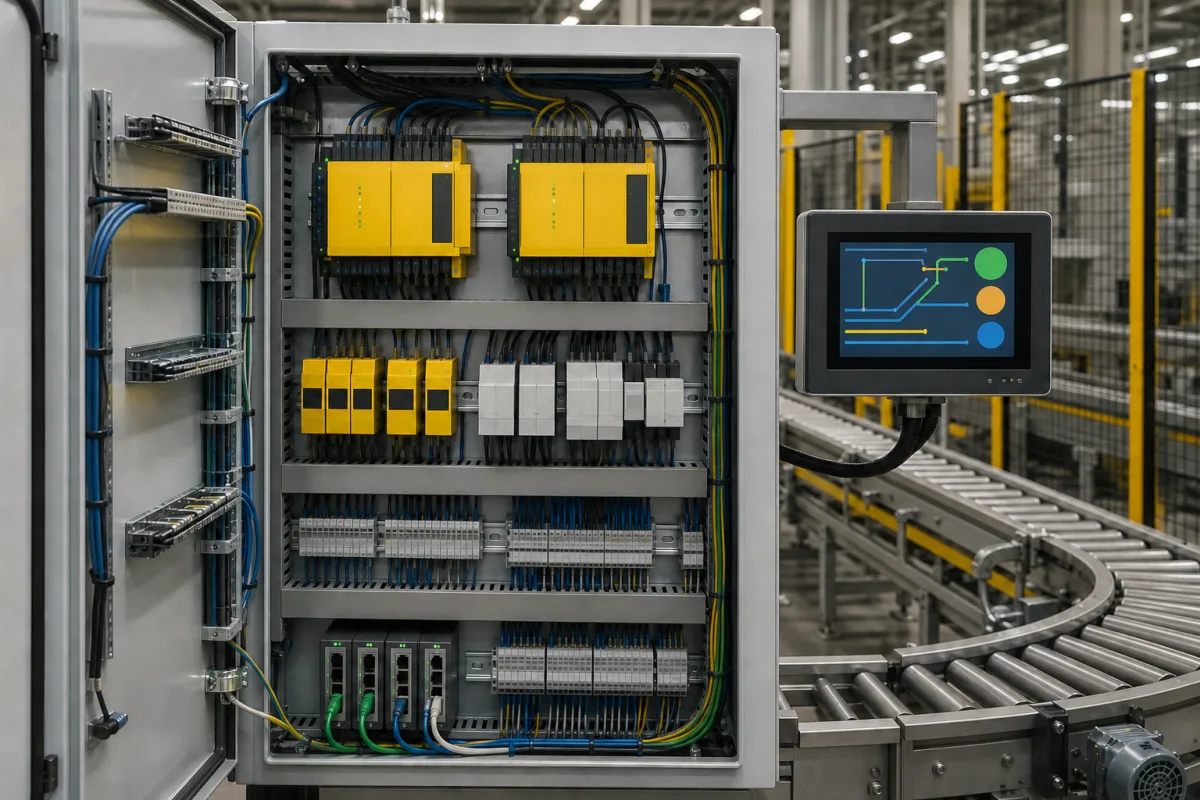
A canonical Safety Monitoring Subsystem is characterized by the integration of Signal Processing Unit and Logic Controller. In industrial production environments, manufacturers listed on CNFX commonly emphasize Electronic components (PCBs, ICs) construction to support stable, high-cycle operation across diverse manufacturing scenarios.

A specialized component within the Central Control System (WMS) responsible for continuously monitoring and ensuring operational safety parameters.
Product Specifications

Technical details and manufacturing context for Safety Monitoring Subsystem

Definition
The Safety Monitoring Subsystem is an integral part of the Warehouse Management System's Central Control System. It functions as the primary safety oversight mechanism, continuously collecting data from sensors and equipment throughout the facility. Its role is to detect potential hazards, abnormal conditions, or deviations from safe operating parameters in real-time, triggering alerts, warnings, or automatic safety interventions to prevent accidents, equipment damage, or operational disruptions.
Working Principle
The subsystem operates by receiving continuous input streams from various safety sensors (e.g., temperature, pressure, motion, presence, emergency stop status). It processes this data against predefined safety thresholds and logic rules. Upon detecting a parameter outside the safe range or a hazardous condition, it executes predefined responses. These can include sending visual/audible alarms to the control interface, logging the event, communicating with other control subsystems to initiate corrective actions (like slowing or stopping machinery), and, if integrated, activating emergency protocols or shutdown sequences.
Common Materials
Electronic components (PCBs, ICs), Enclosure (steel or aluminum alloy), Wiring and connectors
Technical Parameters
  • System response time from hazard detection to alarm/action initiation. (ms) Standard Spec
Components / BOM
  • Signal Processing Unit
    Receives raw analog/digital signals from safety sensors, filters noise, and converts them into standardized data for analysis.
    Material: PCB with integrated circuits
  • Logic Controller
    Executes the programmed safety logic, comparing incoming data against safety thresholds and rules to determine if an alarm or action is required.
    Material: Microprocessor or PLC module
  • Communication Interface
    Manages data transmission of status, alerts, and logs to the central WMS controller and may receive commands from it.
    Material: Network interface card or chipset
  • Alarm Output Relay
    Provides physical dry-contact or voltage outputs to directly trigger external alarms, warning lights, or initiate equipment shutdown sequences.
    Material: Electromechanical relay or solid-state relay
Engineering Reasoning
0.1-1.5 MPa (1-15 bar)
2.0 MPa (20 bar) pressure differential across sensor diaphragm
Design Rationale: Diaphragm plastic deformation exceeding yield strength of 316L stainless steel (205 MPa) due to overpressure events
Risk Mitigation (FMEA)
Trigger Electromagnetic interference from adjacent 480V AC motor drives exceeding 100 V/m field strength
Mode: Signal conditioning circuit saturation causing false safety trip at 4-20 mA output
Strategy: Shielded twisted-pair cabling with ferrite chokes and 0.1 μF bypass capacitors at sensor terminals
Trigger Condensation ingress through IP67-rated housing at sustained 95% relative humidity above 40°C
Mode: Corrosion-induced resistance drift in Wheatstone bridge exceeding ±0.5% full-scale accuracy
Strategy: Conformal coating of PCB with silicone-based material (ASTM D5537) and desiccant cartridge in housing

Industry Taxonomies & Aliases

Commonly used trade names and technical identifiers for Safety Monitoring Subsystem.

Applied To / Applications

This component is essential for the following industrial systems and equipment:

Industrial Ecosystem & Supply Chain DNA

Complementary Systems
Downstream Applications
Specialized Tooling

Application Fit & Sizing Matrix

Operational Limits
pressure: 0 to 10 bar
flow rate: 0.1 to 100 L/min
temperature: -20°C to +85°C
slurry concentration: 0 to 40% solids by weight
Media Compatibility
✓ Water-based fluids ✓ Hydraulic oils ✓ Non-corrosive gases
Unsuitable: Highly corrosive acids or bases
Sizing Data Required
  • Maximum expected flow rate
  • Required pressure drop tolerance
  • Specific gravity/viscosity of media

Reliability & Engineering Risk Analysis

Failure Mode & Root Cause
Sensor Drift/Calibration Loss
Cause: Environmental factors (temperature fluctuations, humidity, vibration) causing gradual sensor inaccuracy, or electronic component aging leading to signal degradation.
Communication Failure
Cause: Corrosion or physical damage to wiring/connectors, electromagnetic interference disrupting signals, or software/firmware glitches in data transmission protocols.
Maintenance Indicators
  • Inconsistent or erratic readings on monitoring displays/alarms without corresponding process changes
  • Audible alarm malfunctions (e.g., alarm sounds continuously, doesn't sound when triggered, or has distorted audio)
Engineering Tips
  • Implement regular calibration schedules using traceable standards and environmental compensation in sensor design to maintain accuracy.
  • Use shielded, properly routed cabling with sealed connectors, and install surge protection/EMI filters on power and signal lines to prevent electrical interference.

Compliance & Manufacturing Standards

Reference Standards
ISO 13849-1: Safety of machinery - Safety-related parts of control systems ANSI/UL 61010-1: Safety Requirements for Electrical Equipment for Measurement, Control, and Laboratory Use CE Marking: Compliance with EU Machinery Directive 2006/42/EC
Manufacturing Precision
  • Sensor Alignment: +/-0.5° angular deviation
  • Enclosure Seam Gap: ≤0.1mm for IP65 rating
Quality Inspection
  • Functional Safety Test (PL/SIL verification per ISO 13849)
  • Environmental Stress Screening (Temperature/Humidity Cycling)

Factories Producing Safety Monitoring Subsystem

Verified manufacturers with capability to produce this product in China

✓ 97% Supplier Capability Match Found

P Project Engineer from Canada Feb 22, 2026
★★★★★
"Great transparency on the Safety Monitoring Subsystem components. Essential for our Machinery and Equipment Manufacturing supply chain."
Technical Specifications Verified
S Sourcing Manager from United States Feb 19, 2026
★★★★★
"The Safety Monitoring Subsystem we sourced perfectly fits our Machinery and Equipment Manufacturing production line requirements."
Technical Specifications Verified
P Procurement Specialist from United Arab Emirates Feb 16, 2026
★★★★★
"Found 27+ suppliers for Safety Monitoring Subsystem on CNFX, but this spec remains the most cost-effective."
Technical Specifications Verified
Verification Protocol

“Feedback is collected from verified sourcing managers during RFQ (Request for Quote) and factory evaluation processes on CNFX. These reports represent historical performance data and technical audit summaries from our B2B manufacturing network.”

15 sourcing managers are analyzing this specification now. Last inquiry for Safety Monitoring Subsystem from Turkey (35m ago).

Supply Chain Compatible Machinery & Devices

Heavy-Duty CNC Plasma Cutting Machine

Industrial machine for precision metal cutting using plasma arc technology

Explore Specs →
Automated Assembly Line System

Integrated production system for sequential component assembly operations

Explore Specs →
Automated Powder Coating System

Integrated industrial system for applying dry powder coatings to metal substrates.

Explore Specs →
Centrifugal Pump Impeller

Rotating component that transfers energy to fluid in centrifugal pumps.

Explore Specs →

Frequently Asked Questions

What is the primary function of the Safety Monitoring Subsystem?

The Safety Monitoring Subsystem continuously monitors operational safety parameters within machinery control systems, ensuring compliance with safety standards and triggering alarms when parameters exceed safe limits.

How does this subsystem integrate with existing Central Control Systems (WMS)?

It connects via standardized communication interfaces and wiring connectors, designed to seamlessly integrate with WMS architectures while maintaining independent safety monitoring functionality.

What maintenance is required for the Safety Monitoring Subsystem?

Regular calibration checks of signal processing units, inspection of alarm output relays, and verification of communication interface functionality are recommended as part of preventive maintenance schedules.

Can I contact factories directly on CNFX?

CNFX is an open directory, not a transaction platform. Each factory profile provides direct contact information and production details to help you initiate direct inquiries with Chinese suppliers.

Get Quote for Safety Monitoring Subsystem

Request technical pricing, lead times, or customized specifications for Safety Monitoring Subsystem directly from verified manufacturing units.

Your business information is encrypted and only shared with verified Safety Monitoring Subsystem suppliers.

Thank you! Your message has been sent. We'll respond within 1–3 business days.

Need to Manufacture Safety Monitoring Subsystem?

Connect with verified factories specializing in this product category

Add Your Factory Contact Us
Previous Product
Safety Light Curtain
Next Product
Safety Output Relays