Editorial Technical Reference

Sealing Head / Welding Head

This page explains how Sealing Head / Welding Head is classified within Machinery and Equipment Manufacturing. Technical values and manufacturer relationships are research references; confirm the current specification and supplier evidence for each order.

Technical Definition & Core Assembly

A critical component of the Final Sealing Station that applies heat and pressure to create hermetic seals on packaging materials.
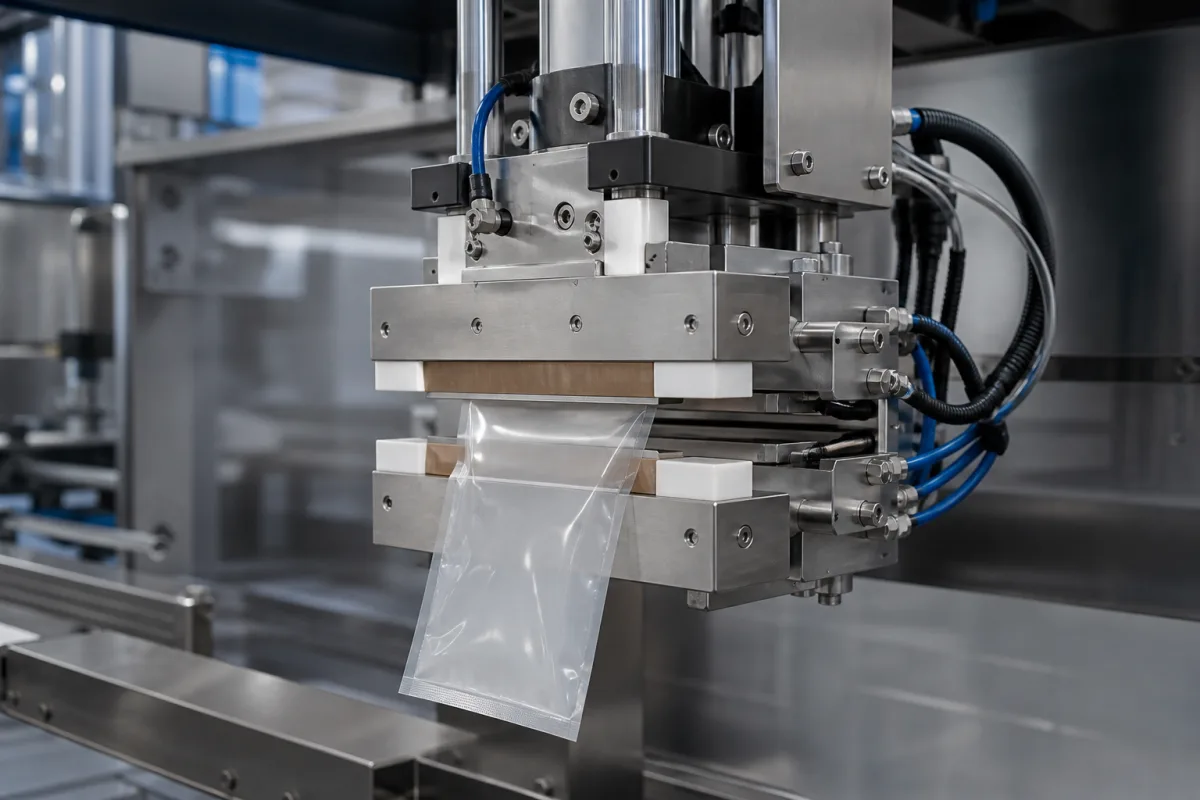
Sealing Head / Welding Head in a manufacturing environment
Representative product image. Confirm appearance and specifications with the manufacturer.

Product Specifications

Technical details and manufacturing context for Sealing Head / Welding Head

Definition
The Sealing Head/Welding Head is the primary working element of the Final Sealing Station responsible for creating permanent, airtight seals on various packaging materials. It precisely applies controlled heat and pressure to fuse packaging layers together, ensuring product integrity and protection against contamination, moisture, and tampering. This component is designed for integration into automated packaging lines, where it interfaces with the machine's control system to regulate sealing parameters. The head typically consists of a heating element, pressure mechanism, and temperature sensors, all housed in a robust frame. Materials commonly used include stainless steel for structural parts, heat-resistant alloys for high-temperature zones, ceramic insulators for electrical isolation, and copper heating elements for efficient thermal transfer. The sealing head operates within specified ranges for pressure, temperature, time, and width, which must be adjusted based on the packaging material and application. For instance, operating pressure typically ranges from 1.0 to 1.6 MPa, sealing temperature from 120 to 200 °C, sealing time from 0.5 to 2.0 seconds, and sealing width from 5 to 20 mm. Heating power can vary between 500 and 2000 W, with temperature accuracy of ±2 °C and pressure accuracy of ±0.05 MPa. The supply voltage is 220–240 V AC (single phase, 50/60 Hz), and total power consumption is 1.5–3.0 kW. The component is designed for an operating temperature range of 5–40 °C and offers ingress protection rated IP54–IP65. The standard material grade is SUS304 stainless steel, and the weight ranges from 15 to 60 kg depending on configuration. These values are reference ranges; actual specifications must be confirmed with the manufacturer for the specific model and application. The sealing head is a critical part that requires regular maintenance, including cleaning of the sealing surface and checking for wear. Failure to maintain proper temperature or pressure can result in weak seals, to product contamination or leakage. Always verify model-specific parameters and standards with the legal manufacturer or supplier before procurement.
Working Principle
The sealing head operates by applying controlled thermal energy and mechanical pressure to the packaging interface. Heating elements within the head raise the temperature to melt or soften the packaging material's sealing layer, while pressure mechanisms ensure proper contact and bonding as the material cools, creating a uniform, reliable seal. The process is precisely controlled to achieve consistent results, with temperature and pressure accuracy maintained within tight tolerances. The head's design allows for adjustment of sealing time and width to accommodate different material thicknesses and seal strength requirements. Proper operation requires correct setting of parameters based on the material being sealed, as insufficient pressure or temperature can lead to weak seals, while excessive heat may damage the material.
Common Materials
Stainless Steel, Heat-resistant Alloys, Ceramic Insulators, Copper Heating Elements
Technical Parameters
ParameterTypical rangeNotes & selection driver
Sealing Temperature120–200 °CAdjust based on material; too low causes weak seal
Sealing Time0.5–2.0 sLonger for thicker materials
Sealing Width5–20 mmWider for stronger seals
Heating Power500–2000 WDepends on sealing speed and material
Temperature Accuracy±2 °CCritical for consistent seal quality
Pressure Accuracy±0.05 MPaEnsures uniform seal
Supply Voltage220–240 V ACSingle phase, 50/60 HzIEC 60038
Power Consumption1.5–3.0 kWTotal including heater and controls
Operating Temperature5–40 °CAmbient; outside range may affect performance
Ingress ProtectionIP54–IP65Protection against dust and water jetsIEC 60529
MaterialSUS304Stainless steel for corrosion resistanceASTM A240
Weight15–60 kgDepends on size and configuration

Ranges are indicative industry figures for RFQ preparation, not a supplier commitment. Confirm every value and standard with the legal manufacturer before ordering.

Components / BOM
  • Heating Element
    Generates and transfers thermal energy to the sealing surface
    Material: Copper alloy/Nichrome
  • Pressure Plate Part
    Applies uniform mechanical pressure during sealing
    Material: Stainless steel
  • Temperature Sensor
    Monitors and regulates operating temperature
    Material: Thermocouple/RTD
  • Insulation Layer Part
    Prevents heat loss and protects surrounding components
    Material: Ceramic fiber/High-temp insulation
  • Pressure Mechanism
    Presses the head onto the seal area and holds the force while the melt cools.

Application & selection

Application Fit & Sizing Matrix

Operational Limits
pressure: 10-50 kN (typical), up to 100 kN maximum
dwell time: 0.5-5 seconds (adjustable)
temperature: 150-300°C (typical), up to 400°C with special configurations
cooling rate: Controlled cooling phase: 2-10 seconds
Media Compatibility
✓ Polypropylene (PP) film packaging ✓ Aluminum foil laminates ✓ Multi-layer polymer pouches
Unsuitable: High-moisture content materials without proper drying (causes steam formation and seal failure)
Sizing Data Required
  • Packaging material thickness and composition
  • Production line speed (units/minute)
  • Required seal width and pattern geometry

Risk, maintenance & compliance

Reliability & Engineering Risk Analysis

Failure Mode & Root Cause
Seal face wear and leakage
Cause: Improper alignment during installation, inadequate lubrication, or contamination from welding spatter and debris leading to accelerated wear and loss of sealing integrity.
Thermal degradation and cracking
Cause: Excessive heat exposure during welding operations, inadequate cooling, or thermal cycling causing material fatigue, embrittlement, and structural failure of sealing components.
Maintenance Indicators
  • Visible fluid leakage around the sealing head during operation
  • Unusual grinding or scraping noises from the welding head assembly
Engineering Tips
  • Implement precision alignment procedures during installation and use laser alignment tools to ensure proper sealing face contact and reduce uneven wear.
  • Establish a preventive maintenance schedule for regular cleaning of welding spatter and debris, and monitor cooling system performance to prevent thermal overload.

Indicative industry ranges for design and RFQ preparation. Confirm the exact figures and applicable standard with the manufacturer before specifying.

Compliance & Manufacturing Standards

Applicable Standards
ISO 14731:2019 (Welding coordination - Tasks and responsibilities) ANSI/AWS D14.1/D14.1M:2021 (Specification for Welding of Industrial and Mill Cranes and Other Material Handling Equipment) DIN EN 1090-2:2018 (Execution of steel structures and aluminium structures - Part 2: Technical requirements for steel structures)

Quoted from the published standard.

Manufacturing Precision
  • Bore diameter: +/-0.025mm
  • Sealing surface flatness: 0.05mm per 100mm
Quality Inspection
  • Liquid Penetrant Testing (PT) for surface defects
  • Ultrasonic Testing (UT) for internal weld integrity
Technical documentation
Request current drawings, revision history, and a signed specification sheet.
Manufacturing capability
Verify equipment lists, process limits, capacity, and representative production evidence.
Inspection readiness
Confirm test methods, calibrated equipment, sampling plans, and traceable reports.
Supplier transparency
Check the legal entity, factory address, ownership, certifications, and direct contacts.

Compare the published product scope and source details, then include your specifications and quantity in an enquiry.

Manufacturers of Sealing Head / Welding Head

Manufacturer profiles associated with Sealing Head / Welding Head.

Sourcing Sealing Head / Welding Head from China?
Tell us your specification and target quantity — we will match it against manufacturer records and come back with the factories that fit.
Request manufacturers We manufacture this

Explore company information and manufacturing capabilities, then discuss the scope of your project with a relevant supplier.

Buyer enquiry

Request manufacturing insight for Sealing Head / Welding Head

Ask for use case, specification boundaries, supplier type, and RFQ preparation information for this product.

Where it goes
Straight to the CNFX editorial desk, and to the manufacturer if this product is linked to a claimed profile. Nothing is broadcast to a supplier list.
Your details stay here
We do not sell or rent enquiry data, and we do not add you to a mailing list. Used only to answer this request.
No commission, no middleman
CNFX is a directory. We take no cut of any order and never negotiate on a supplier's behalf.
What to include
Share your product specifications, quantity, destination and target delivery date.

Your business information is used only to process this request.

Thank you! Your message has been sent. We'll respond within 1–3 business days.
Sorry, we couldn't send your message. Please try again, or email us at [email protected].

Frequently Asked Questions

What is the function of a sealing head in a packaging line?

The sealing head is the component that applies heat and pressure to create a permanent, airtight seal on packaging materials. It is part of the final sealing station and ensures product integrity by preventing contamination, moisture ingress, and tampering.

What are the typical operating parameters for a sealing head?

Typical reference ranges include operating pressure of 1.0–1.6 MPa, sealing temperature of 120–200 °C, sealing time of 0.5–2.0 seconds, and sealing width of 5–20 mm. Heating power is 500–2000 W, with temperature accuracy of ±2 °C and pressure accuracy of ±0.05 MPa. These values must be confirmed for the specific model and application.

How do I choose the right sealing head for my packaging material?

Selection depends on the material type, thickness, and required seal strength. You need to consider the sealing temperature, time, and pressure ranges that the head can provide, as well as the sealing width and heating power. Always verify that the head's specifications match your application requirements with the manufacturer.

What maintenance does a sealing head require?

Regular maintenance includes cleaning the sealing surface to remove residue, checking for wear on heating elements and pressure parts, and verifying temperature and pressure accuracy. If seals become weak or inconsistent, it may indicate a need for recalibration or replacement of worn components.

Related equipment

Applied To / Applications

This component is essential for the following industrial systems and equipment:

Industrial Ecosystem & Supply Chain Structure

Data Basis

Editorial classification, named public sources where available, and source-reviewed manufacturer records.

Preliminary Technical Classification
This page supports structured research, RFQ preparation, and supplier evaluation. It does not replace buyer-led supplier qualification, standards review, or technical approval.

Need to Manufacture Sealing Head / Welding Head?

Compare manufacturer profiles with relevant product and process capability.

Previous Product
Z-axis Ram/Spindle
Last Product
Get QuotesChat