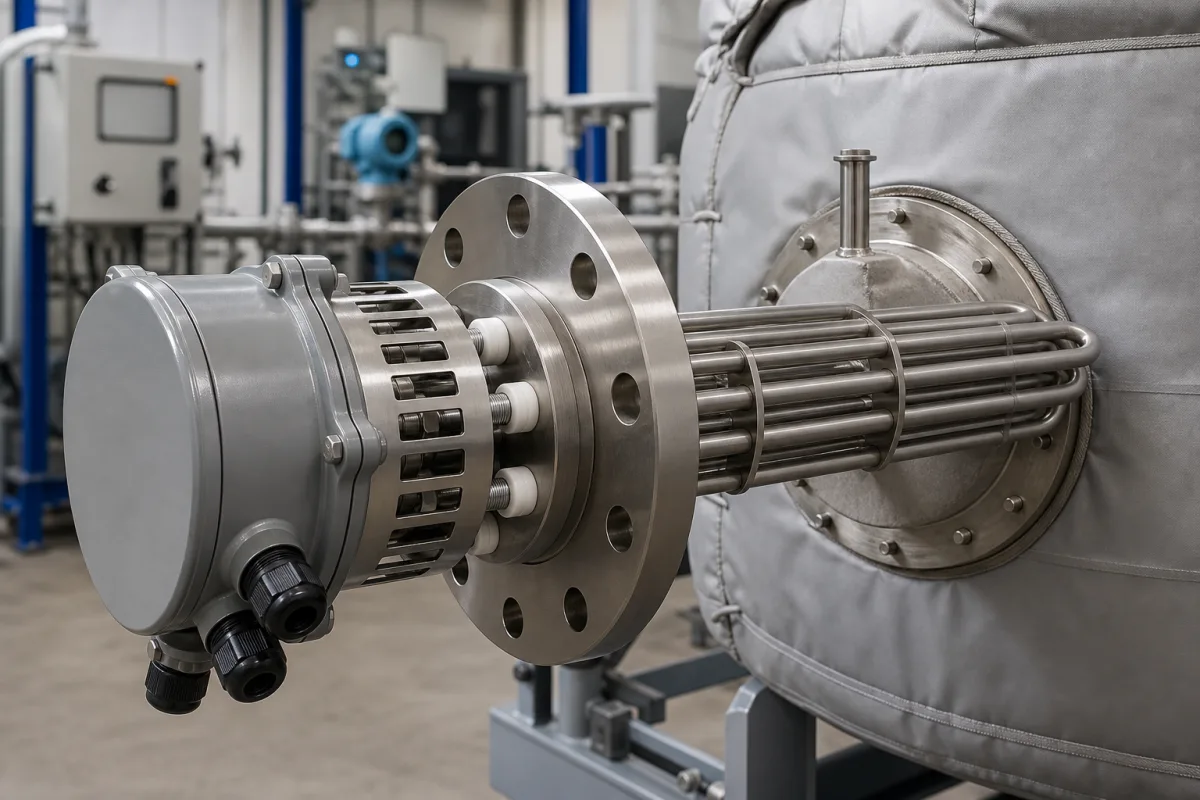
Tubular electric heating elements and the flanged and screw-plug heaters built from them for liquids, air and process equipment · Sheath material and maximum sheath temperature, element diameter, voltage and current limits, sheath and heated length tolerances, terminations and surface finish
A tubular heating element is a resistance wire packed in compacted insulation inside a metal sheath; bent and bundled, it heats water, oils, air and process fluids, alone or as flanged and screw-plug immersion heaters. Its life depends on matching the sheath and its surface load to what is being heated. Ask three things first: what medium the element heats and at what temperature, which sheath material that medium and temperature allow, and what voltage, power, length and termination the equipment needs.
Tubular (sheathed) electric heating elements and immersion heater bundles built from them for liquids, air and process heating. Band heaters (see heater bands), cartridge heaters for moulds (see casting mould temperature control cartridge heater), heating cables (see heating cable) and induction heaters are outside this page.
CNFX editorial research · Sources checked October 12, 2026 · 4 sources
Choose the sheath material for the medium and temperature
Tempco's tubular heater catalogue gives maximum sheath temperatures for its standard sheath materials: Incoloy 840 and Incoloy 800 at 1600 °F (871 °C), 316, 304 and 321 stainless steel at 1200 °F (649 °C), low-carbon steel at 750 °F (399 °C) and copper at 350 °F (177 °C), with Inconel 600 (1800 °F, 982 °C) and Incoloy 825 (1100 °F, 593 °C) for limited diameters. It notes that maximum sheath temperature refers to the sheath material, and that the temperature the heated material can safely take must also be considered. [1]
The catalogue links materials to uses: Incoloy 840 for air heating, Incoloy 800 for air heating and immersion in potable water, 316 stainless where chlorides cause pitting and in deionised water, 304 stainless in food, medical and chemical heating, steel for oils, asphalt, tar, wax, molten salt and heat-transfer media, and copper for clean water. It advises that the supplier of the gas or liquid is the best source for chemical compatibility with the sheath. [1]
Editorial note: sheath temperature in service depends on watt density and on how well the medium carries heat away; ask the supplier for the surface load used in the design and its basis.
OMEGA's tubular heater application guidelines give suggested watt densities by medium: low-viscosity oil heated to 180 °F (82 °C) with a steel sheath at 23 W/in², medium-viscosity oil at 15 W/in² and high-viscosity oil at 6.5 W/in²; water solutions and mildly corrosive solutions to 200 °F (93 °C) with 304 stainless or Incoloy sheaths at 50 W/in²; moving air at 9 ft/s up to 500 °F with Incoloy at 40 W/in², and still air in ovens at 700 °F at 30 W/in². Its range runs from 3 to 53 W/in² for elements of 75–10,000 W up to 172 in long. [3]
The same guide says pressurised liquids should not be heated above the element's maximum sheath temperature minus 100 °F, that the heated section must stay immersed whenever energised, and that watt density should be 20–30% lower in a vacuum because no air carries the heat away. Editorial calculation: 23 W/in² is about 3.6 W/cm² and 50 W/in² about 7.8 W/cm² (÷ 6.45). [3]
Give the supplier the medium heated and its operating temperature, flow or circulation, sheath material, required power and voltage, phase and connection, element diameter, sheath and heated length or vessel geometry, form (straight, bent, flanged bundle, screw plug), mounting, termination type and enclosure, sensor or thermostat needs and approvals.
02
Set voltage and current limits, lengths, terminations and finish
Tempco's electrical limits by element diameter are 250 V and 15 A for 0.260 in (6.6 mm), 480 V and 30 A for 0.315 in (8.0 mm), 600 V and 30 A for 0.375 in (9.5 mm), and 600 V and 40 A for 0.430, 0.475 and 0.625 in (10.9–15.9 mm), with sheath lengths from 11 in (279 mm) to 200 in (5,080 mm) or 255 in (6,477 mm) for the larger diameters. Length tolerances grow with length, for example ±1/8 in sheath and ±1/2 in heated length for 20–50 in elements, with a minimum unheated length of 1-1/4 in at each end. [1]
Standard terminations include a plain pin (pin diameters from 0.091 in for 0.260 in elements to 0.160 in for 0.625 in), a threaded stud with ceramic or mica insulator, a nickel-plated steel lug welded straight or at 90°, and 1/4 in quick-connect terminals. The standard surface is black chrome oxide from annealing before forming; bright annealing in dissociated ammonia gives a clean metallic finish. [2]
Editorial calculation: the 0.375 in element's limits of 600 V and 30 A bound a single element at about 18 kW (600 × 30); actual rating is set by resistance, length and permitted watt density. [1]
03
Check the maker's watt density limit for your heated medium
Watlow's tubular application guide includes a Supplemental Applications Chart that gives, for each heated material, a maximum operating temperature and a maximum watt density and sheath material for its round WATROD and flat FIREBAR elements. For vegetable oil it cites WATROD at 30 W/in² (4.6 W/cm²) or FIREBAR at 40 W/in² (6.2 W/cm²) with a 304 stainless steel sheath. [4]
The guide states performance capabilities of sheath temperatures up to 1800 °F (983 °C), watt densities up to 120 W/in² (18.6 W/cm²) and process assembly ratings up to 1000 psi. When choosing by watt density it asks buyers to consider liquid viscosity at start-up and at process temperature, operating temperature and chemical composition. [4]
Editorial note: for clean water Watlow's chart allows 60 W/in² on WATROD elements, while OMEGA's guideline above gives 50 W/in² for water solutions; makers set different limits, so ask the supplier which limit its design uses. Editorial calculation: static heat transfer oil at 600 °F is listed at 10 W/in² against 15 W/in² when circulating, so the same power needs 1.5 times the heated sheath area in a static bath (15 ÷ 10). [4][3]
Heated material (max. operating temperature)
WATROD element: max. watt density, sheath
FIREBAR element: max. watt density, sheath
Clean water, 212 °F (100 °C)
60 W/in² (9.3 W/cm²), Incoloy
45 W/in² (7 W/cm²), Incoloy 800
Deionised water, 212 °F (100 °C)
60 W/in² (9.3 W/cm²), 316 SS passivated
90 W/in² (14 W/cm²), Incoloy 800
Fuel oil grades 1 and 2, 200 °F (93 °C)
23 W/in² (3.6 W/cm²), steel
30 W/in² (4.6 W/cm²), 304 SS
Fuel oil grade 6 and Bunker C, 160 °F (71 °C)
8 W/in² (1.2 W/cm²), steel
10 W/in² (1.6 W/cm²), 304 SS
Heat transfer oil, static, 600 °F (315 °C)
10 W/in² (1.6 W/cm²), steel
16 W/in² (2.5 W/cm²), 304 SS
Heat transfer oil, circulating, 600 °F (315 °C)
15 W/in² (2.3 W/cm²), steel
20 W/in² (3.1 W/cm²), 304 SS
Molasses, 100 °F (37 °C)
4–5 W/in² (0.6–0.8 W/cm²), 304 SS
5–8 W/in² (0.8–1.2 W/cm²), 304 SS
04
Trace the parts of a tubular heating element
This is a functional reference built from the sources cited; it is not one maker's design.
Fill the specification fields with values for your heater
A heating element specification needs values for your equipment. The table explains each field, gives published values where a reviewed source states them, and says what to obtain from the supplier.
Field
What it means and published values
Ask the supplier for
Sheath material
E.g. Incoloy 800/840, 304/316/321 stainless, steel, copper. [1]
Material for your medium.
Maximum sheath temperature
E.g. 177–982 °C by material; liquids under pressure ≤ sheath max − 100 °F. [1][3]
Value; design surface load.
Watt density
E.g. 6.5–23 W/in² oils; 50 W/in² water solutions; 20–30% lower in vacuum. [3]
The manufacturers below list tubular heating elements on their own websites; each card links to the page reviewed. Confirm ratings, materials and approvals for your order.
Hongtai Heating Elements Factory
Manufacturing site to be confirmed for the order
Lists straight, formed and finned tubular heaters and flanged and screw-plug immersion heaters.
Explore company information and manufacturing capabilities, then discuss the scope of your project with a relevant supplier.
Share this page
Compiled and source-reviewed by the CNFX editorial team.
Published product pages show what a company offers, not tested performance. Confirm the legal seller, factory and scope for your order. How we source and review
· Page last updated 13 October 2026
Buyer questions
Which sheath material should a tubular heater have?
It depends on the medium and temperature: one maker lists Incoloy for air and potable water up to 871 °C, stainless to 649 °C, steel for oils to 399 °C and copper for clean water to 177 °C. [1]
What voltage can a tubular heating element take?
One maker's limits range from 250 V and 15 A for 6.6 mm elements to 600 V and 40 A for 10.9–15.9 mm elements. [1]
What terminations are available on tubular heaters?
Plain pins, threaded studs with ceramic or mica insulators, welded lugs and quick-connect terminals. [2]
What watt density suits oil heating?
OMEGA's tubular heater guidelines suggest 23 W/in² for low-viscosity oil, 15 W/in² for medium and 6.5 W/in² for high-viscosity oil, with steel sheaths. [3]
What watt density can a tubular element run in clean water?
Watlow's tubular application guide lists up to 60 W/in² (9.3 W/cm²) for its WATROD elements with an Incoloy sheath in clean water at 212 °F (100 °C), and 45 W/in² for its flat FIREBAR elements. [4]
Sources and what still needs a direct check
Sources checked 2026-10-12. Tempco's catalogue pages and the OMEGA and Watlow application guides are makers' own documents, cited as examples of the parameters a heating element specification covers, not endorsements.