Editorial Technical Reference

Spindle Housing

This page explains how Spindle Housing is classified within Machinery and Equipment Manufacturing. Technical values and manufacturer relationships are research references; confirm the current specification and supplier evidence for each order.

Technical Definition & Core Assembly

The structural enclosure that houses and supports the spindle assembly in machinery.
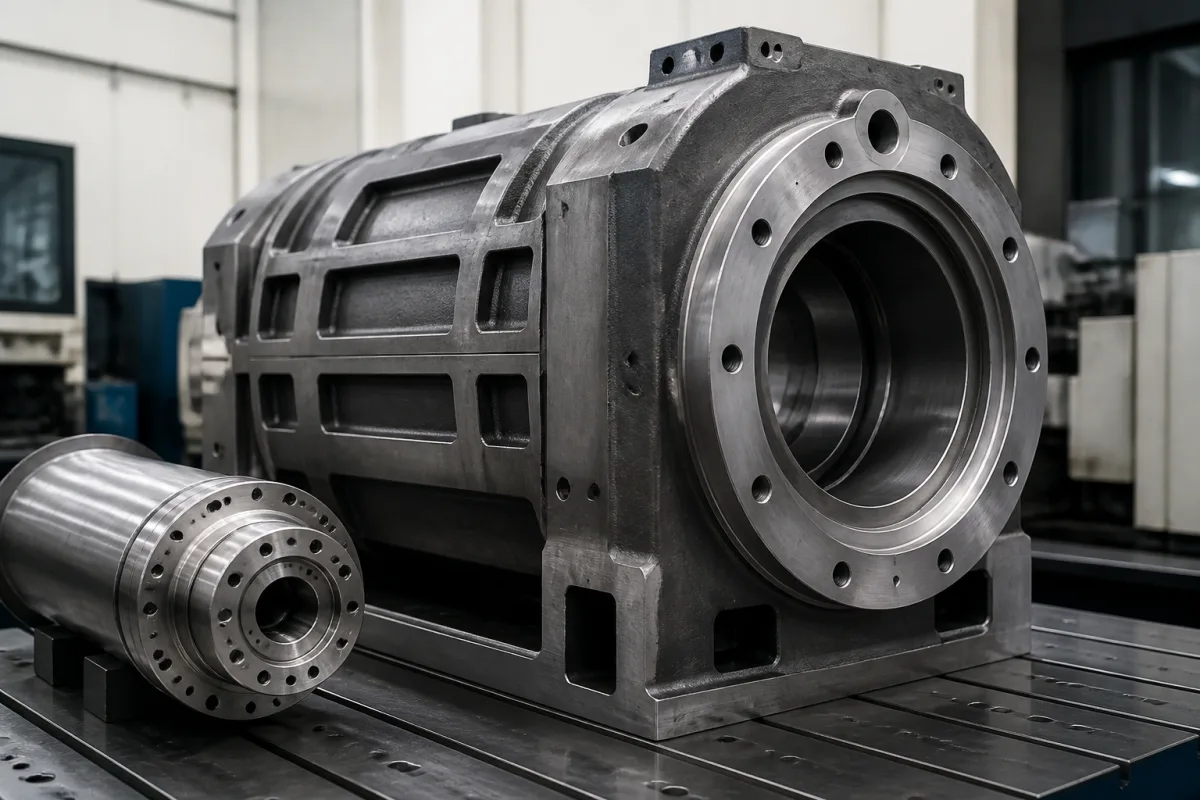
Spindle Housing in a manufacturing environment
Representative product image. Confirm appearance and specifications with the manufacturer.

Product Specifications

Technical details and manufacturing context for Spindle Housing

Definition
A spindle housing is a critical mechanical component that serves as the protective casing and mounting structure for the spindle assembly in various types of machinery. It provides precise alignment, structural rigidity, and environmental protection for the spindle bearings, shaft, and associated components, ensuring stable rotation and accurate positioning during machining or manufacturing operations. The housing is typically manufactured from cast iron, steel, or aluminum alloy, with material selection based on required damping, strength, and weight considerations. Key parameters include spindle bore diameter (50–200 mm), spindle nose type (A2-5 to A2-11 per ISO 702-1), maximum speed (3000–15000 rpm), radial runout (0.005–0.02 mm per ISO 230-1), axial runout (0.005–0.015 mm per ISO 230-1), housing material grade (e.g., HT250 to QT500 per GB/T 9439 and GB/T 1348), operating temperature range (-10 to 60 °C), coolant pressure (1.0–2.5 MPa), weight (80–500 kg), and overall dimensions (400×300×300 to 800×600×600 mm). These values are reference ranges that must be verified for the specific model and application. The housing design must accommodate the machine's envelope, provide adequate coolant flow for chip evacuation, and maintain thermal stability to minimize deflection under load. Proper selection requires evaluating the machining forces, speed requirements, and environmental conditions. Verification of runout and alignment should be performed using ISO 230-1 procedures. Maintenance signals include increased vibration, abnormal noise, or visible wear on mounting surfaces. Failure boundaries are reached when runout exceeds specified limits or when thermal expansion causes loss of precision. Always confirm model-specific values and standards with the legal manufacturer or supplier.
Working Principle
The spindle housing functions by providing a rigid, precisely machined enclosure that maintains the spindle assembly in proper alignment. It absorbs vibrations and forces generated during operation, protects internal components from contaminants, and often includes mounting points for integration into larger machine structures. Proper housing design ensures thermal stability and minimizes deflection under load. The housing's geometry and material properties directly influence the spindle's dynamic behavior, affecting machining accuracy and surface finish. By maintaining the spindle's position and orientation, the housing enables consistent performance across the specified speed and load ranges.
Common Materials
Cast Iron, Steel, Aluminum Alloy
Technical Parameters
ParameterTypical rangeNotes & selection driver
Spindle Bore Diameter50–200 mmDetermines maximum bar stock capacity.
Spindle Nose TypeA2-5–A2-11Must match chuck or tooling interface.ISO 702-1
Maximum Speed3000–15000 rpmHigher speeds require balanced housing and precision bearings.
Radial Runout0.005–0.02 mmCritical for machining accuracy.ISO 230-1
Axial Runout0.005–0.015 mmAffects face machining and thrust load capacity.ISO 230-1
Housing MaterialHT250–QT500Cast iron for damping; ductile iron for strength.GB/T 9439, GB/T 1348
Operating Temperature Range-10–60 °CBeyond this range, thermal expansion affects precision.
Coolant Pressure1.0–2.5 MPaHigher pressure improves chip evacuation but requires sealed housing.
Weight80–500 kgAffects machine dynamics and foundation requirements.
Overall Dimensions (L×W×H)400×300×300–800×600×600 mmMust fit within machine envelope.

Ranges are indicative industry figures for RFQ preparation, not a supplier commitment. Confirm every value and standard with the legal manufacturer before ordering.

Components / BOM
  • Housing Body
    The housing itself: encloses and locates the internal parts and provides the mounting interface.
  • Bearing Seat Part
    Precisely machined surface for spindle bearing installation and alignment
    Material: steel
  • Cooling Jacket
    Channels for coolant circulation to manage thermal expansion
    Material: cast iron or aluminum
  • Sealing Grooves Part
    Recesses for installing seals to prevent lubricant leakage and contamination ingress
    Material: same as housing material

Applied To / Applications

This component is essential for the following industrial systems and equipment:

Industrial Ecosystem & Supply Chain Structure

Complementary Systems
Downstream Applications
Specialized Tooling

Application Fit & Sizing Matrix

Operational Limits
pressure: Atmospheric to 2 bar
other spec: Max spindle speed: 10,000 RPM, Vibration tolerance: <5 µm
temperature: -10°C to +60°C
Media Compatibility
✓ Lubricating oils ✓ Coolant fluids ✓ Clean air environments
Unsuitable: Abrasive slurry or corrosive chemical exposure
Sizing Data Required
  • Spindle shaft diameter (mm)
  • Required housing material (e.g., cast iron, aluminum)
  • Mounting interface dimensions and bolt pattern

Reliability & Engineering Risk Analysis

Failure Mode & Root Cause
Bearing fatigue and seizure
Cause: Inadequate lubrication, contamination ingress, or excessive preload leading to overheating and material degradation
Housing bore wear and geometric distortion
Cause: Thermal cycling, vibration-induced fretting, or improper installation causing loss of dimensional stability and alignment
Maintenance Indicators
  • Abnormal high-frequency vibration or audible grinding/rumbling during operation
  • Visible oil leakage or discoloration around housing seals, indicating seal failure or overheating
Engineering Tips
  • Implement precision alignment during installation and periodic laser alignment checks to minimize eccentric loads on bearings
  • Establish a proactive lubrication regimen with filtered oil and condition monitoring (oil analysis, vibration analysis) to detect early degradation

Indicative industry ranges for design and RFQ preparation. Confirm the exact figures and applicable standard with the manufacturer before specifying.

Compliance & Manufacturing Standards

Applicable Standards
ISO 1940-1:2003 (Balance quality requirements for rotors) ANSI/ASME B5.45-1972 (Spindles and Spindle Noses) DIN 55026:1986 (Spindle noses for machine tools)

Quoted from the published standard.

Manufacturing Precision
  • Bore diameter: H7 tolerance (e.g., +0.025mm / 0mm for 50mm bore)
  • Face runout: 0.01mm TIR (Total Indicator Reading)
Quality Inspection
  • Coordinate Measuring Machine (CMM) dimensional verification
  • Ultrasonic testing for internal casting defects

Manufacturers of Spindle Housing

Manufacturer profiles associated with Spindle Housing.

Sourcing Spindle Housing from China?
Tell us your specification and target quantity — we will match it against manufacturer records and come back with the factories that fit.
Request manufacturers We manufacture this

Manufacturer listings support early research and capability understanding. They are not certification, ranking, or transaction guarantees.

Share this page
Technical documentation
Request current drawings, revision history, and a signed specification sheet.
Manufacturing capability
Verify equipment lists, process limits, capacity, and representative production evidence.
Inspection readiness
Confirm test methods, calibrated equipment, sampling plans, and traceable reports.
Supplier transparency
Check the legal entity, factory address, ownership, certifications, and direct contacts.

CNFX does not score or rank suppliers. Buyers must verify all claims and documents with the legal manufacturer before ordering.

Supply Chain Compatible Machinery & Devices

Automated Powder Coating System

Integrated industrial system for applying dry powder coatings to metal substrates.

Explore Specs →
Centrifugal Pump Impeller

The centrifugal pump impeller is a critical rotating component that converts mechanical energy from the motor into kinetic energy in fluid systems.

Explore Specs →
High-Precision CNC Laser Cutting Machine

Computer-controlled industrial machine using focused laser beams to cut sheet metal with micron-level accuracy.

Explore Specs →
Industrial-Grade Hydraulic Cylinder Piston Rod

This industrial-grade piston rod is a precision-ground cylindrical component designed for use in hydraulic cylinders.

Explore Specs →

Frequently Asked Questions

What materials are commonly used for spindle housings?

Common materials include cast iron, steel, and aluminum alloy. The choice depends on required damping, strength, and weight. For example, cast iron grades like HT250 to QT500 are specified per GB/T 9439 and GB/T 1348.

How do I verify the runout specifications of a spindle housing?

Runout should be measured according to ISO 230-1. Radial runout is typically 0.005–0.02 mm, and axial runout is 0.005–0.015 mm. Use precision dial indicators and follow standard procedures.

What is the significance of the spindle nose type?

The spindle nose type (e.g., A2-5 to A2-11) must match the chuck or tooling interface. It is standardized under ISO 702-1 to ensure compatibility and proper mounting.

What maintenance signals indicate a spindle housing problem?

Increased vibration, abnormal noise, or visible wear on mounting surfaces can indicate issues. Also, if runout exceeds specified limits or thermal expansion affects precision, the housing may need inspection or replacement.

Data Basis

Editorial classification, named public sources where available, and source-reviewed manufacturer records.

Preliminary Technical Classification
This page supports structured research, RFQ preparation, and supplier evaluation. It does not replace buyer-led supplier qualification, standards review, or technical approval.
Buyer enquiry

Request manufacturing insight for Spindle Housing

Ask for use case, specification boundaries, supplier type, and RFQ preparation information for this product.

Where it goes
Straight to the CNFX editorial desk, and to the manufacturer if this product is linked to a claimed profile. Nothing is broadcast to a supplier list.
Your details stay here
We do not sell or rent enquiry data, and we do not add you to a mailing list. Used only to answer this request.
No commission, no middleman
CNFX is a directory. We take no cut of any order and never negotiate on a supplier's behalf.
What we don't claim
A listing is not an endorsement. Qualify every supplier and verify every figure yourself before ordering.

Your business information is used only to process this request.

Thank you! Your message has been sent. We'll respond within 1–3 business days.
Sorry, we couldn't send your message. Please try again, or email us at [email protected].

Need to Manufacture Spindle Housing?

Compare manufacturer profiles with relevant product and process capability.

Previous Product
Spindle Drive
Next Product
Spray Headers
Get QuotesChat