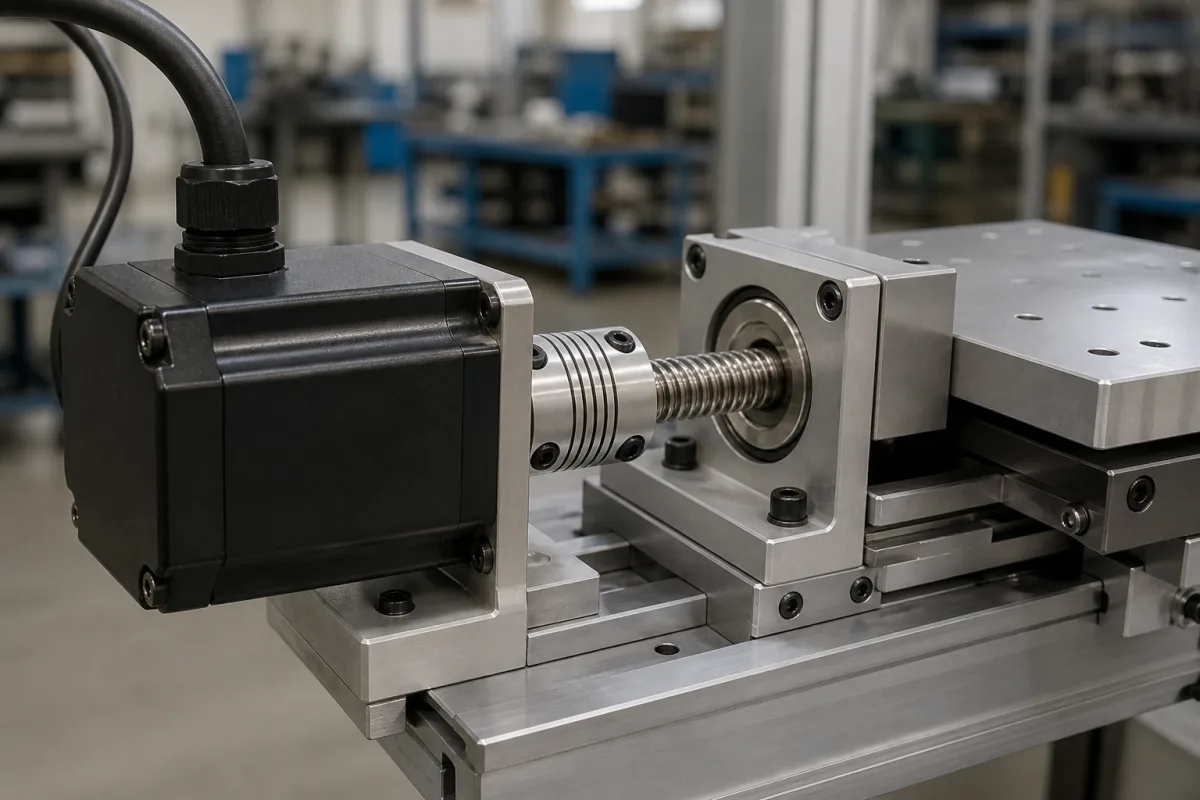
A stepper motor holds position without feedback only while it has torque to spare. Calculate the load and acceleration torque, add a safety factor, and check the operating point against the pullout torque curve at your speed, not the holding torque. Then keep the load inertia and running duty within limits, or choose a geared or closed-loop motor.
Two-phase and five-phase hybrid stepper motors from NEMA 8 to NEMA 34 frames, open-loop and closed-loop, with or without gearboxes. Drive current, microstepping and pulse settings are covered on the stepper motor driver page.
CNFX editorial research · Sources checked October 10, 2026 · 6 sources
Check required torque against the pullout torque curve
Oriental Motor's technical reference sizes a stepper motor by multiplying the sum of load torque and acceleration torque by a safety factor, TM = (TL + Ta) × Sf, and then checking that the operating speed and required torque fall inside the pullout torque curve of the speed–torque chart. It gives a reference safety factor of 2 for stepper motors. [1]
The pullout curve shows how much torque the motor can deliver while running at each pulse speed; it falls as speed rises, so a motor chosen by holding torque alone can stall at speed. Ask for the speed–torque curve measured with the driver and supply voltage you will use.
Oriental Motor also gives reference acceleration and deceleration rates by frame size and step angle, because a large step change in pulse speed with a large inertia can stop the motor from following even when the operating point is inside the curve. [1]
Give the supplier the moving mass, friction, screw or belt data, move distance and time, and the driver you plan to use. Torque curves depend on the driver and voltage.
02
Check inertia ratio and running duty
Oriental Motor explains that large inertia ratios cause overshoot and undershoot on starting and stopping and can make operation impossible. Its reference values for stepper motors are an inertia ratio (load inertia ÷ rotor inertia, divided by the square of gear ratio for geared types) of 5 or less for frames 20 to 35 and 10 or less for frames 42 to 85; above these it recommends a geared type. [1]
Heat is the other limit: Oriental Motor advises an operating duty of 50% or less (running time ÷ running plus stopping time) so the motor stays within its class 130 (B) insulation; above 50%, choose a motor with more torque margin or lower the running current. [1]
Kaifull and Just Motion Control also list closed-loop stepper motors with encoders, which detect lost steps; ask what the closed-loop system does when it detects an error. [2][3]
03
Work out pulses and resolution from step angle
Oriental Motor gives the number of operating pulses as the travel divided by the travel per motor revolution, multiplied by 360° divided by the step angle. [1]
As an editorial calculation example only: a 1.8° motor (200 full steps per revolution) driving a ball screw with a 5 mm lead must receive 100 ÷ 5 × 200 = 4,000 full-step pulses to move 100 mm, so one full step is 0.025 mm. Microstepping in the driver divides each step further, but the motor's own step accuracy and the mechanics still limit positioning.
Suppliers list 1.8° and 0.9° two-phase motors and 0.72° five-phase motors; Kaifull, for example, lists a NEMA 17 five-phase motor with a 0.72° step angle. [2][4]
04
Two-, three- and five-phase hybrids from NEMA 8 to NEMA 34, with geared, closed-loop and IP65 versions
Listed frames run from NEMA 8 (20 mm) in Ctrl-Motor's range to NEMA 34 (86 mm), and some makers add three-phase hybrids to their two-phase ranges. [5][4]
ZGC lists NEMA 23 and NEMA 24 bipolar motors rated IP65; Ctrl-Motor lists frames from NEMA 8 upward and motors for vacuum and extreme temperatures; Henghe lists stepper motors with spur and planetary gearboxes. [4][5][6]
05
Stator and windings, hybrid rotor, shaft, bearings, and optional encoder or gearbox
Materials come from the data sheet of the motor you order; the optional last row includes the geared type Oriental Motor recommends when the inertia ratio is above its reference values. [1]
Part
Role
Fix in the order
Stator and windings
Phases energised in sequence; insulation class limits temperature. [1]
Phases, winding connection, current and insulation class.
Rotor
Hybrid rotor sets step angle and rotor inertia. [1]
Step angle and rotor inertia.
Shaft
Transmits torque to coupling, screw or gearbox.
Shaft diameter, flats or keys, double shaft.
Bearings
Carry shaft loads.
Permissible radial and axial loads.
Encoder or gearbox (optional)
Closed-loop feedback or torque multiplication and lower inertia ratio. [1][2]
Encoder resolution or gear ratio and backlash.
06
Step angle, holding torque, phase current, resistance and inductance, insulation class and frame for a stepper order
Holding torque is listed for completeness: Oriental Motor sizes by the pullout torque curve, so ask for that curve with your driver alongside it. [1]
Field
What it means and published values
Ask the supplier for
Step angle (°)
Sets pulses per revolution: 1.8°, 0.9° or 0.72°. [1][2]
Step angle and step accuracy.
Holding torque (N·m)
Torque at standstill; size by the pullout curve instead. [1]
Holding torque and speed–torque curve with your driver.
Rated current per phase (A)
Set in the driver; lower current reduces heat. [1]
10 companies list this product among what they make. Company figures are quoted from each
company's own website; every card states where the relationship came from.
Changzhou ZGC Mechanical & Electrical Co., Ltd.
Manufacturing site to be confirmed for the order
Lists NEMA 17 to NEMA 34 1.8° bipolar and unipolar stepper motors, including IP65 versions.
Explore company information and manufacturing capabilities, then discuss the scope of your project with a relevant supplier.
Share this page
Compiled and source-reviewed by the CNFX editorial team.
Each manufacturer above links to the page on that company's own website where the product is listed, with the date we checked it. How we source and review
· Page last updated 13 October 2026
Buyer questions
Should I size a stepper motor by holding torque?
No. Oriental Motor sizes by checking speed and required torque, including its reference safety factor of 2, against the pullout torque curve at the operating speed. [1]
What inertia ratio is acceptable for a stepper motor?
Oriental Motor gives reference values of 5 or less for frames 20–35 and 10 or less for frames 42–85, and recommends a geared type above these. [1]
How long can a stepper motor run continuously?
Oriental Motor advises an operating duty of 50% or less; above that, choose more torque margin or reduce running current to protect the insulation. [1]
Sources and what still needs a direct check
Sources checked 2026-10-10. Oriental Motor is a stepper motor manufacturer; its reference values apply to its products and are used here as worked guidance. Supplier pages describe their own offers. NEMA ICS 16 and IEC 60034 were not read for this page.