Industry-Verified Manufacturing Data (2026)

Sterile Product Tank Interface

Based on aggregated insights from multiple verified factory profiles within the CNFX directory, the standard Sterile Product Tank Interface used in the Machinery and Equipment Manufacturing sector typically supports operational capacities ranging from standard industrial configurations to heavy-duty production requirements.

Technical Definition & Core Assembly

A canonical Sterile Product Tank Interface is characterized by the integration of Flange Assembly and Sterile Seal. In industrial production environments, manufacturers listed on CNFX commonly emphasize Stainless Steel 316L construction to support stable, high-cycle operation across diverse manufacturing scenarios.

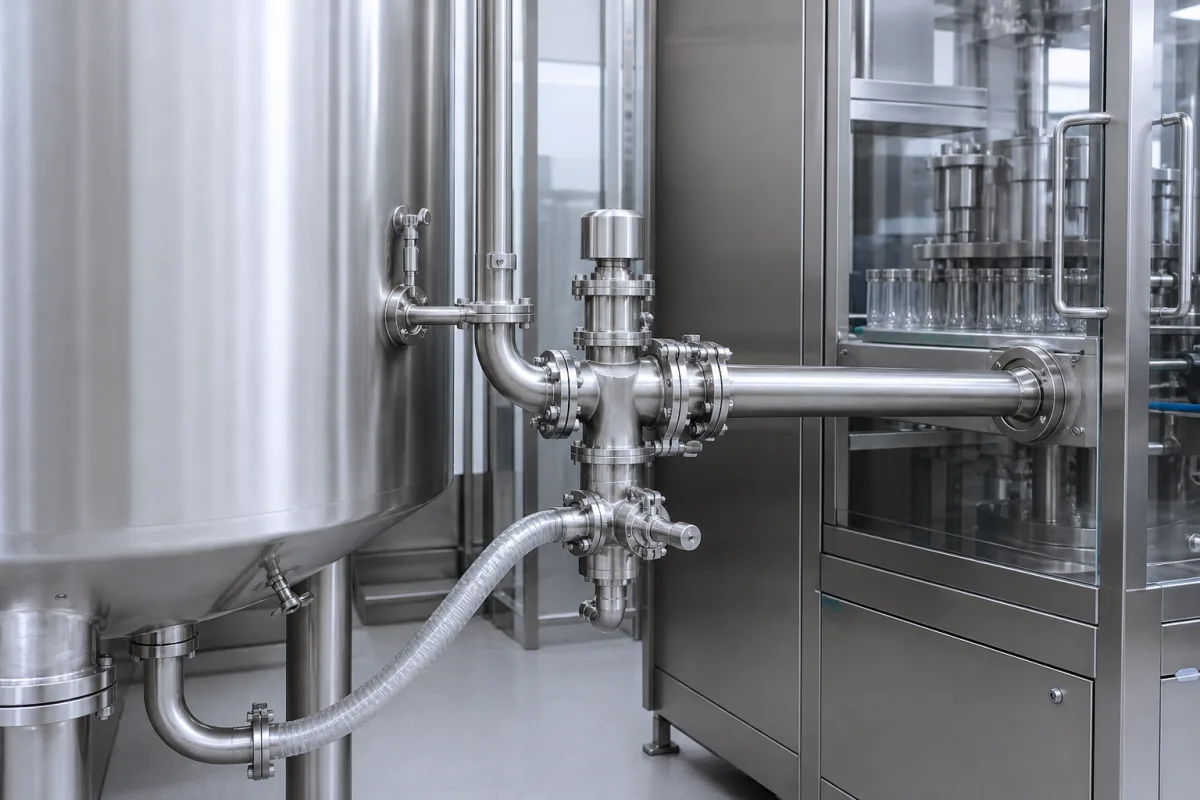
Interface component connecting the sterile product tank to the aseptic filling machine's filling system
Product Specifications

Technical details and manufacturing context for Sterile Product Tank Interface

Definition
A critical interface component in aseptic filling machines that provides the connection point between the sterile product storage tank and the machine's filling system. It ensures sterile transfer of pharmaceutical, biotech, or food products while maintaining aseptic conditions throughout the filling process.
Working Principle
The interface creates a sealed connection between the product tank and filling system, typically using sterile connectors or aseptic transfer systems. It maintains sterility through positive pressure, sterile barriers, or steam-in-place (SIP) connections, preventing contamination during product transfer.
Common Materials
Stainless Steel 316L, Pharmaceutical-grade silicone, PTFE (Polytetrafluoroethylene)
Technical Parameters
  • Connection diameter and flange specifications (mm) Customizable
Components / BOM
  • Flange Assembly
    Provides the mechanical connection between tank and machine
    Material: Stainless Steel 316L
  • Sterile Seal
    Maintains aseptic barrier during connection
    Material: Pharmaceutical-grade silicone
  • Connection Clamp
    Secures the interface connection
    Material: Stainless Steel 316L
  • Steam Port
    Allows for steam sterilization of the interface
    Material: Stainless Steel 316L
Engineering Reasoning
0.5-6.0 bar differential pressure, 1-100°C fluid temperature, 0.1-10.0 m³/h flow rate
Differential pressure exceeding 8.0 bar causes gasket extrusion failure, fluid temperature below -20°C causes PTFE seal embrittlement, flow rate above 15.0 m³/h induces turbulent cavitation at Reynolds number >4000
Design Rationale: Gasket extrusion failure occurs when applied pressure exceeds PTFE yield strength of 23 MPa; thermal stress cracking follows Arrhenius degradation kinetics with activation energy of 80 kJ/mol for EPDM seals; cavitation damage occurs when local pressure drops below fluid vapor pressure of 0.023 bar at 20°C
Risk Mitigation (FMEA)
Trigger Thermal cycling between 2°C CIP solution and 95°C SIP steam causes 0.3 mm differential expansion between 316L stainless steel flange and PTFE gasket
Mode: Gasket compression set exceeding 15% permanent deformation after 500 cycles
Strategy: Install expansion-compensating spiral-wound gasket with Inconel 718 windings and flexible graphite filler
Trigger Electrochemical potential difference of 0.55 V between 316L stainless steel and Hastelloy C-276 creates galvanic corrosion cell in chloride-containing media
Mode: Pitting corrosion at rate of 0.8 mm/year in 1000 ppm chloride solution at pH 6.5
Strategy: Apply cathodic protection using sacrificial zinc anode with -1.05 V potential or install dielectric insulating gasket

Industry Taxonomies & Aliases

Commonly used trade names and technical identifiers for Sterile Product Tank Interface.

Applied To / Applications

This component is essential for the following industrial systems and equipment:

Industrial Ecosystem & Supply Chain DNA

Complementary Systems
Downstream Applications
Specialized Tooling

Application Fit & Sizing Matrix

Operational Limits
pressure: 0 to 3 bar (max operating pressure)
flow rate: Up to 20,000 L/h (dependent on connection size)
temperature: 2°C to 50°C (sterile process range)
slurry concentration: 0-40% solids by weight (viscosity dependent)
Media Compatibility
✓ Purified water/WFI ✓ Protein-based biologics ✓ Vaccine formulations
Unsuitable: Abrasive slurries with >40% solids or corrosive chemical media
Sizing Data Required
  • Required flow rate (L/h)
  • Tank outlet connection size (e.g., 2" Tri-Clamp)
  • Maximum allowable pressure drop across interface

Reliability & Engineering Risk Analysis

Failure Mode & Root Cause
Crevice corrosion
Cause: Stagnant fluid accumulation at gasket interfaces or weld seams, exacerbated by chloride-containing cleaning agents or process fluids in sterile environments, leading to localized pitting and material degradation.
Gasket/seal failure
Cause: Thermal cycling and chemical attack from repeated sterilization cycles (e.g., steam-in-place or chemical sanitization) causing elastomer hardening, compression set, or swelling, compromising sterility integrity.
Maintenance Indicators
  • Visible product residue or moisture accumulation at tank flange interfaces or sensor ports after sterilization cycles
  • Audible hissing or pressure drop alarms during hold periods of sterile operation indicating seal leakage
Engineering Tips
  • Implement routine eddy current testing or ultrasonic thickness mapping at high-stress weld zones and crevice-prone areas to detect early-stage corrosion before breaching sterile barriers
  • Establish a proactive gasket replacement schedule based on sterilization cycle counts rather than visual inspection alone, using material compatibility charts specific to your sterilization media (steam, VHP, etc.)

Compliance & Manufacturing Standards

Reference Standards
ISO 13408-1: Aseptic processing of health care products ANSI/ASME BPE-2019: Bioprocessing Equipment DIN 11864-1: Fittings in hygienic and aseptic areas
Manufacturing Precision
  • Surface Roughness: Ra ≤ 0.8 μm
  • Weld Seam Alignment: ±0.5 mm
Quality Inspection
  • Sterility Assurance Level (SAL) Testing
  • Helium Leak Test at 1×10⁻⁹ mbar·L/s

Factories Producing Sterile Product Tank Interface

Verified manufacturers with capability to produce this product in China

✓ 96% Supplier Capability Match Found

P Project Engineer from Australia Feb 14, 2026
★★★★★
"As a professional in the Machinery and Equipment Manufacturing sector, I confirm this Sterile Product Tank Interface meets all ISO standards."
Technical Specifications Verified
S Sourcing Manager from Singapore Feb 11, 2026
★★★★★
"Standard OEM quality for Machinery and Equipment Manufacturing applications. The Sterile Product Tank Interface arrived with full certification."
Technical Specifications Verified
P Procurement Specialist from Germany Feb 08, 2026
★★★★★
"Great transparency on the Sterile Product Tank Interface components. Essential for our Machinery and Equipment Manufacturing supply chain."
Technical Specifications Verified
Verification Protocol

“Feedback is collected from verified sourcing managers during RFQ (Request for Quote) and factory evaluation processes on CNFX. These reports represent historical performance data and technical audit summaries from our B2B manufacturing network.”

11 sourcing managers are analyzing this specification now. Last inquiry for Sterile Product Tank Interface from Brazil (18m ago).

Supply Chain Compatible Machinery & Devices

Hydraulic Press

Industrial machine using hydraulic pressure to compress, form, or assemble materials

Explore Specs →
Heavy-Duty CNC Plasma Cutting Machine

Industrial machine for precision metal cutting using plasma arc technology

Explore Specs →
Automated Assembly Line System

Integrated production system for sequential component assembly operations

Explore Specs →
Automated Powder Coating System

Integrated industrial system for applying dry powder coatings to metal substrates.

Explore Specs →

Frequently Asked Questions

What materials are used in the sterile product tank interface?

The interface is constructed from Stainless Steel 316L, pharmaceutical-grade silicone, and PTFE (Polytetrafluoroethylene) to ensure sterility, durability, and compliance with pharmaceutical standards.

How does this interface maintain sterility during operation?

It features a sterile seal and steam port for sterilization-in-place (SIP) processes, preventing contamination between the product tank and aseptic filling system.

What components are included in the BOM for this interface?

The bill of materials includes a Connection Clamp, Flange Assembly, Steam Port, and Sterile Seal, all designed for easy integration and maintenance in aseptic filling lines.

Can I contact factories directly on CNFX?

CNFX is an open directory, not a transaction platform. Each factory profile provides direct contact information and production details to help you initiate direct inquiries with Chinese suppliers.

Get Quote for Sterile Product Tank Interface

Request technical pricing, lead times, or customized specifications for Sterile Product Tank Interface directly from verified manufacturing units.

Your business information is encrypted and only shared with verified Sterile Product Tank Interface suppliers.

Thank you! Your message has been sent. We'll respond within 1–3 business days.

Need to Manufacture Sterile Product Tank Interface?

Connect with verified factories specializing in this product category

Add Your Factory Contact Us
Previous Product
Stepper Motor
Next Product
Sterilization Zone