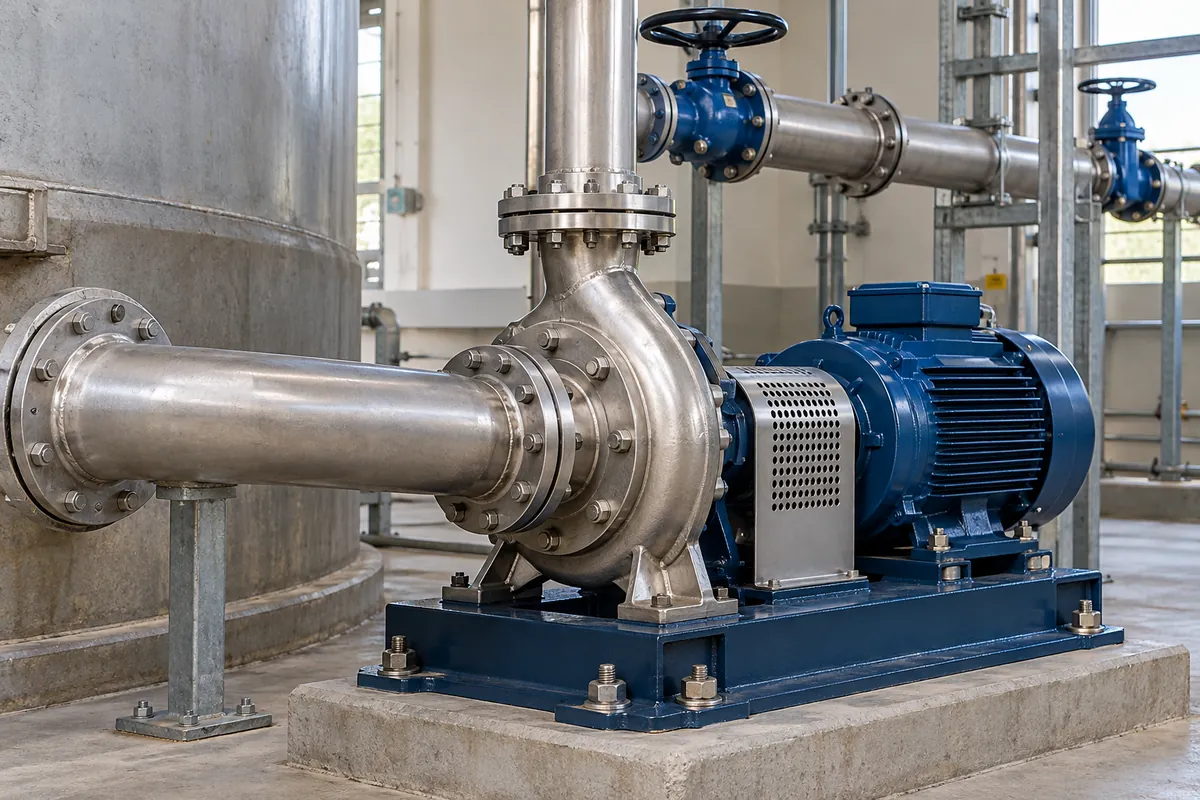
Water supply pump: tank-fed and booster pumps for drinking and service water networks
Water supply pumping · Firm capacity with one pump out, suction from storage, distribution pressure and pressure control
A water supply pump lifts drinking or service water from a storage tank, clearwell or incoming main and pushes it into a distribution network at a pressure the network can use. What sets it apart from a process or circulation pump is the duty around it: the station must still meet peak demand with a pump out of service, must not pull a vacuum on the suction side, and has to hold network pressure inside a band as demand swings.
Centrifugal pumps that supply drinking or service water to a distribution network: end-suction and multistage pumps drawing from ground storage tanks, clearwells or break tanks, in-line and packaged booster sets on the mains, and variable-speed constant-pressure sets with two or more pumps. Industrial pumps across all pumping principles are covered on the Industrial pumps page; cooling-water circulation pumps on the Cooling-water circulation pump page; boiler feed pumps on the Feedwater pump page; ISO 2858 and ASME B73.1 chemical process pumps, polypropylene or PVDF solution pumps and hygienic baseplate pumps on their own pages; general skid-mounted multi-pump packages for process and utility service are covered on the Pumping system (skid-mounted package) page. Fire pumps and borehole or submersible well pumps are outside this page.
CNFX editorial research · Sources checked October 12, 2026 · 4 sources
Firm capacity: peak demand with the largest pump out of service
The Recommended Standards for Water Works (Ten States Standards, 2018) require at least two pumping units in a public water pumping station, sized so that with any pump out of service the remaining pumps still meet the system's maximum pumping demand against the required distribution pressure without dangerous overloading. Booster stations carry the same rule: not less than two pumps, with peak demand met with the largest pump out of service, and each booster station fitted with a flow-rate indicator and totalizer. [1]
Editorial calculation: for a peak demand of 120 m³/h, two pumps of 120 m³/h each give firm capacity with one installed spare, while three pumps of 60 m³/h each also meet peak with one out and leave a smaller pump for night flows. The demand figure is an assumed example. [1]
The U.S. Department of Energy's pumping sourcebook points out that identical pumps in parallel share load evenly, whereas with different sizes the largest pump can dominate and push the others below their minimum flow, so mixed sets need their curves checked against each pump's minimum flow. [2]
Packaged sets follow this pattern. Xiandai lists its constant-pressure water supply sets with 2–6 vertical or horizontal multistage pumps that change both speed and the number of running pumps with demand, stainless steel pumps and main pipes, and liquid temperatures of 0–70 °C. [3] Liancheng's ZWL set combines a converter control cabinet, a flow-stabilising tank, the pump unit, meters and valves, for liquid at 5–70 °C on a 380 V supply. [4]
Give the supplier the average and peak demand, the number of pumps wanted and which ones may be out of service together, standby power, and whether pumps must alternate duty.
02
Suction from ground storage: lift, NPSH margin and the low-pressure cut-off
The Ten States Standards ask that suction lift be avoided where possible and kept within allowable limits, preferably under 15 ft (editorial conversion: about 4.6 m), with priming provided when lift is unavoidable. Booster pumps must not produce negative pressure in their suction lines; those taking suction from storage tanks need adequate net positive suction head, and an automatic shut-off or low-pressure controller must hold at least 20 psi (140 kPa) in the suction line unless the reviewing authority accepts otherwise. Pumps fed from ground storage tanks get automatic shut-offs or low-pressure controllers as the pump maker recommends. [1]
DOE's sourcebook explains that required NPSH (NPSHR, now NPSH3 in Hydraulic Institute terms) is the value at which cavitation cuts pump head by 3%, and cites a design rule of NPSH available at least 25% above NPSHR at every expected flow; oversized pumps running far right of their design point erode that margin. [2] Editorial calculation: a pump with an NPSHR of 4 m at the highest expected flow needs at least 5 m of NPSH available by that rule, worked out at the lowest tank level the controls allow.
Xiandai's constant-pressure sets state a minimum suction pressure of 0.2 kg/cm² (editorial conversion: about 2 m of water head). [3] Liancheng describes its ZWL set as needing no water pool, drawing from the mains through a flow-stabilising tank. [4]
On the suction hardware, the Ten States Standards ask for an isolation valve on each pump's suction and discharge, screened foot valves with a net area of at least 2.5 times the suction pipe area where foot valves are needed, a compound gauge on each suction line, and individual suction lines or manifolds arranged so that each pump sees similar hydraulic conditions. Suction wells need two compartments or another way to take them out of service. [1]
03
Network pressure band: 20 psi minimum, 60–80 psi working, and starts and stops
Distribution systems under the Ten States Standards are designed to keep at least 20 psi (140 kPa) at ground level at all points under all flow conditions, with a normal working pressure of about 60–80 psi (410–550 kPa) and not less than 35 psi (240 kPa) unless approved otherwise. Editorial conversion at 0.703 m of water per psi: 20 psi ≈ 14 m, 35 psi ≈ 25 m and 60–80 psi ≈ 42–56 m of head above ground level at the delivery point. [1]
Pump head must add those pressures to the elevation and friction losses between the pump and the highest or furthest point. Automatic or remote controls need a range between start and cut-off pressure wide enough to prevent excessive cycling; where two or more pumps are installed they must alternate, motors must not be energised during backspin, and surge pressures must not switch pumps on outside the design cycle. Each pump needs a positive-acting check valve between the pump and its discharge shut-off valve and a pressure gauge on its discharge. [1]
Xiandai's sets hold outlet pressure with a pressure sensor feeding the controller and frequency converter, adjusting pump speed to demand. [3] DOE notes that in systems dominated by friction, adjustable-speed drives tend to be the more efficient answer to variable demand, while staging pumps on and off suits systems with high static head. [2]
For drinking water service, the Ten States Standards also require that water seals are not supplied with water of lower sanitary quality than the water pumped, and that lubricants in contact with potable water meet NSF H1, 3H or H3. [1]
State the required pressure at the delivery point, the static height to the highest outlet, the start and stop pressures, and whether the set runs on fixed speed with staging or variable speed.
04
What a water supply pump enquiry needs
Paste it into your enquiry below or into an email to a maker, then replace every bracket.
Water: [drinking or service water; temperature; any solids]
Source: [ground tank, break tank or mains; lowest water level or minimum inlet pressure]
Demand: [average and peak flow; night flow]
Pressure: [required pressure at delivery point; static height; network minimum]
Station: [number of pumps; firm capacity; standby power; alternation]
Control: [fixed speed with staging or variable speed; start/stop pressures]
Materials: [casing, impeller, shaft; drinking-water approvals needed]
Two of the three makers below sell complete multi-pump water supply sets with inverter control; Liancheng also lists sets that boost directly from the mains without a storage pool.
DEFU
Manufacturing site to be confirmed for the order
Lists water supply pumps for HVAC systems, municipal water networks and industrial processing.
Explore company information and manufacturing capabilities, then discuss the scope of your project with a relevant supplier.
Share this page
Compiled and source-reviewed by the CNFX editorial team.
Each manufacturer above links to the page on that company's own website where the product is listed, with the date we checked it. How we source and review
· Page last updated 13 October 2026
Buyer questions
How many pumps does a water supply station need?
The Ten States Standards require at least two, sized so that the remaining pumps meet maximum demand with any one (for booster stations, the largest) out of service. [1]
What suction pressure must a booster pump keep?
At least 20 psi (140 kPa) in the suction line under all operating conditions, enforced by an automatic shut-off or low-pressure controller, unless the reviewing authority accepts otherwise. [1]
How much NPSH margin should be designed in?
DOE's sourcebook cites a design rule of NPSH available at least 25% above NPSHR at all expected flow rates. [2]
What pressure should the network hold?
At least 20 psi at ground level everywhere, with normal working pressure of about 60–80 psi and not below 35 psi unless approved. [1]
Sources and what still needs a direct check
Sources checked 2026-10-12. The Ten States Standards are a model design standard adopted by a group of U.S. states and Ontario for public water systems; local rules may differ. The DOE sourcebook is general pumping guidance. Xiandai and Liancheng figures describe their own sets.