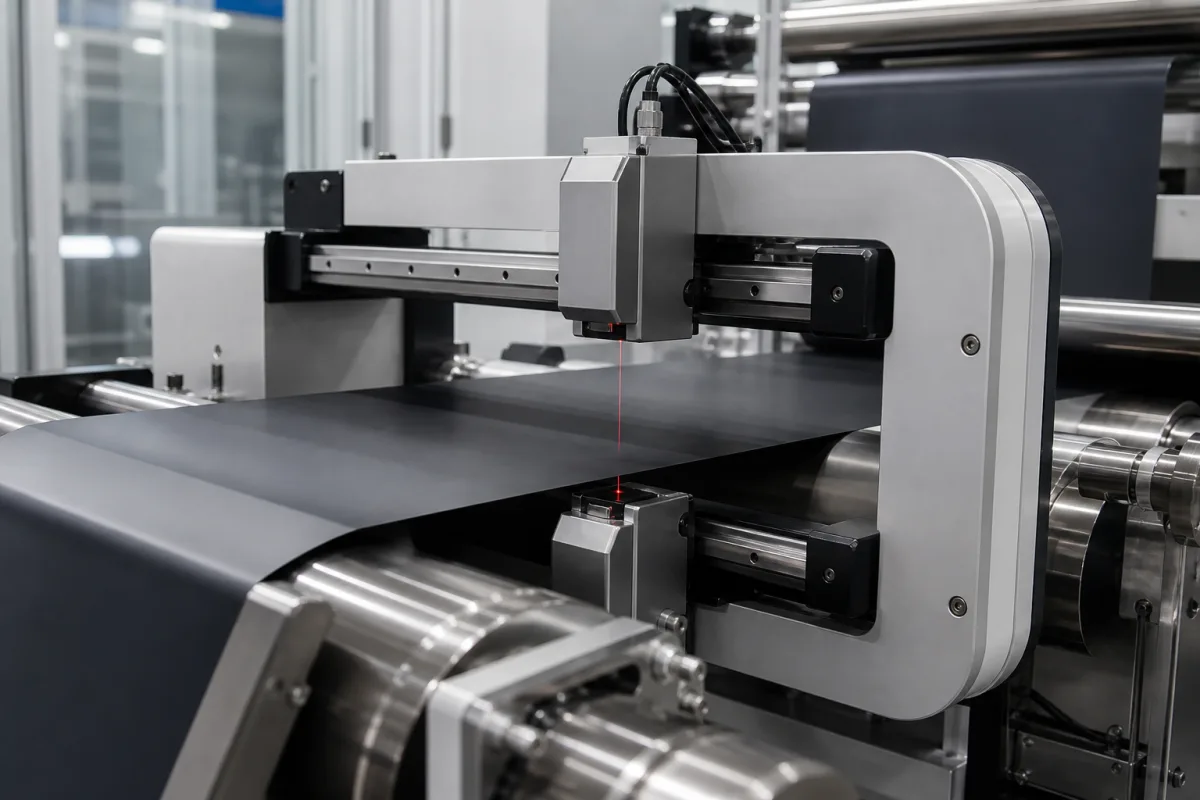
Inline thickness sensors for battery electrode coating and calendering · dual-sided laser and confocal differential measurement, X-ray, beta and infrared gauges, eddy-current/capacitive one-sided sensors, measuring range, accuracy, scan speed, temperature
A thickness measurement sensor checks electrode coating and calendered electrode thickness inline on lithium-ion battery production lines, so coating weight and density stay within limits and every metre is documented. Ask three things first: what must be measured — substrate, coating weight or total thickness after calendering — which decides the sensor principle; the accuracy, range and number of tracks; and the line speed, temperature and space at the measuring point.
Inline thickness and coating sensors for battery electrode production — dual-sided laser triangulation and confocal sensor pairs on C- or O-frames, X-ray, beta and infrared gauges, and one-sided eddy-current/capacitive sensors — with scanning frames and controllers. Offline micrometers, laboratory profilometers, separator production gauges sold alone and complete coating or calendering machines are outside this page except where compared.
CNFX editorial research · Sources checked October 11, 2026 · 4 sources
Choose the measuring principle for what you measure
Thermo Fisher's paper on coating uniformity in battery electrode production advises that X-ray or beta radiation sensors suit the electrode substrates, that coatings and separator films are best measured with infrared, beta or very low-energy X-ray sensors, and that confocal laser sensors are well suited to measuring overall electrode thickness after calendering; sensor resolution and precision must be considered, and synchronised scanners — a substrate-only scanner feeding later ones — can resolve individual layers. [1] Micro-Epsilon, a sensor maker, describes laser sensors used in pairs, two per measuring track, that synchronously measure the distance to the coated film from both sides, with the exact layer thickness calculated from both values and sent to the line control. [2] For one-sided measurement on chrome-plated steel guide rollers, its combiSENSOR KSB6430 combines a capacitive sensor measuring the distance to the coating with an eddy-current sensor measuring the distance to the metal roller, taking the difference as coating thickness. [4]
Editorial calculation: in a two-sided measurement the thickness is the fixed gap between the sensors minus both measured distances; with an assumed 50.000 mm sensor gap and readings of 24.930 mm and 24.920 mm, the electrode is 50.000 − 24.930 − 24.920 = 0.150 mm (150 µm) thick, so any change in the frame gap itself shows up directly as thickness error. [2]
Give the supplier the material (substrate, coated anode or cathode, calendered electrode, separator), measured quantity (thickness, coating weight), thickness range, required accuracy and repeatability, web width and number of tracks, line speed, scanning or fixed points, temperature at the measuring point, space and frame type (C- or O-frame), output to the line control, data logging, radiation-source licensing if X-ray or beta, and quantity.
02
Set range, accuracy, tracks and scan speed
Micro-Epsilon's thicknessCONTROL Quad for coated anode and cathode film uses two measuring frames, each with up to four confocal sensor pairs, measuring up to eight tracks simultaneously in a temperature-compensated design. [3] Its combiSENSOR KSB6430 measures from 5 µm to 3 mm with sub-micrometre accuracy, is described as temperature-stable and insensitive to contamination, and works from −10 to +180 °C. [4] Thermo Fisher notes that scan speed must balance coverage against accuracy: scanning too slowly lets defects pass undetected, while scanning too fast can exceed the sensor's response time and reduce accuracy. [1]
Editorial note: compare suppliers on the same metric — accuracy, repeatability, linearity or resolution — measured on your actual electrode at your line temperature, since the sources quote these figures in different ways.
03
Questions to put to each thickness-gauge supplier
Dacheng Precision, listed below, offers in-line laser gauges; the X-ray, beta and one-sided eddy-current/capacitive options described above come from other makers, so ask which principle each quote is built on.
When requesting quotations, ask each supplier for the measuring principle, uncertainty on your material, track count, scan speed, frame stability, calibration routine and line-control interface.
04
Sensor heads, frame, reference roller and scanner drive
The frame row carries the risk shown in the calculation above: in a two-sided gauge any change in the sensor gap reads directly as thickness error.
What a thickness-gauge quote must state for your electrode line
Resolution, supply voltage, protection class and weight have no published value in the reviewed sources; ask each supplier to state them, and to give accuracy as uncertainty measured on your own electrode.
Explore company information and manufacturing capabilities, then discuss the scope of your project with a relevant supplier.
Share this page
Compiled and source-reviewed by the CNFX editorial team.
Each manufacturer above links to the page on that company's own website where the product is listed, with the date we checked it. How we source and review
· Page last updated 13 October 2026
Buyer questions
Which sensor suits calendered electrode thickness?
Thermo Fisher recommends confocal laser sensors for overall electrode thickness after calendering. [1]
How do dual laser sensors measure thickness?
Two sensors per track measure the distance to the film from each side and the thickness is calculated from both values. [2]
Can coating thickness be measured from one side?
Yes; Micro-Epsilon's KSB6430 combines capacitive and eddy-current sensing against a steel roller, measuring 5 µm to 3 mm. [4]
Sources and what still needs a direct check
Sources checked 2026-10-11. Thermo Fisher and Micro-Epsilon make measuring systems and describe their own approaches.